

Brooklyn Renaissance Plaza is a 32-story hotel-office complex on Jay Street. Opened in 1998, it has a fitness center, an underground garage, and the fourth largest ballroom in the city. Queens-based Muss Development and its partners were given over $50 million in tax exemptions and subsidies from New York City to build the complex. The building sits on city-owned land. City agencies such as the Brooklyn District Attorney’s office occupy nearly half the office tower, and pay Muss over $11.5 million in rent every year.
New Yorkers who clean the high-rent high-rise, however, are struggling. Edith Giron, a single mother with four children, works as a janitor at the building and earns $6.25 an hour with no benefits. Juana Meija, a janitor earning the same wages as Giron, needs to apply for food stamps to feed her family. She’s also had to subsist on what she calls “starvation wages.”
Both Giron and Meija will see a $1 an hour increase in their paycheck this month, thanks to a settlement reached in September by Muss Development and the building’s workers after a bruising four-month strike. Muss has promised them that they will have health benefits for themselves and their families by January, and next April their paychecks will go up to $11.85 an hour.
The strike didn’t just bring well-deserved relief to workers living in poverty. For Service Employees International Union Local 32B-J, it was also a trial run of an increasingly popular union campaign strategy: pressuring companies benefiting from public subsidies to pay their workers a living wage. It didn’t win the strike, but it put the practice on the map in New York. “This is something we are going to use again,” says organizer Bill Meyerson.
The union took its inspiration from the City Charter, which calls for all city contractors to pay a prevailing wage. Why not apply that principle, organizers reasoned, to the increasing numbers of companies and developers reaping city subsidies?
As much as anything, the strategy is a political one, pressuring the city to take action. Guillermo Linares, the City Councilman from Washington Heights whose constituency includes the immigrant workforce that developers like Muss rely on, now has a bill in the works that would assure a living wage and benefits for workers in companies profiting from city subsidies. “One thing we learned [from the Renaissance Plaza strike],” Linares says, “was that when there is a public-private partnership, the rights of workers are very much part of the package.”
_______
Nonunion organizers have taken up the challenge as well. One week before the Renaissance Plaza strike began, on May 9, demonstrators marched outside the Atlantic Center Mall to demand better wages and benefits for workers in all of malls operated by Forest City Ratner, the city’s largest retail developer. Al Sharpton led the chants, but the protest was organized by the Association of Community Organizations for Reform Now–better known as ACORN. The group, organizer Bertha Lewis explains, wants heavily subsidized, “big box” retail developers like Bruce Ratner to make mall tenants agree to pay decent wages and benefits. “If you are feeding at the public trough, then you must at least pay your workers a living wage,” she says.
Ratner’s company, Lewis readily admits, is no worse than any other developer. They all have the same “dead-end, low-wage, non-union, no-benefit jobs,” she says. ACORN singled out Ratner because he’s one of the biggest developers in the city, and because he is currently receiving more than $20 million in city subsidies. ACORN plans to use the issue of public subsidies as a litmus test during next year’s City Council elections, asking candidates to commit to passing a living wage law.
In September, the New York chapter launched a campaign for legislation that would require all employers who get city money, as well as their tenants and contractors, to give their workers benefits and a salary high enough to keep their families above the federal poverty line. It’s one of 75 active living wage campaigns nationwide, according to Jen Kern, who heads ACORN’s living wage effort in Washington. So far, she says, 50 cities, counties and school boards have passed living wage laws.
The threat to revoke public subsidies if fair labor laws are not obeyed has proven effective in other cities. Last year, UNITE used the issue to organize a muffler-making plant in Cleveland. Supertrapp, the company that owned the plant, spent months defying a National Labor Relations Board order to recognize the union. When Cleveland Mayor Michael R. White threatened to take way Supertrapp’s $500,000 tax break if they didn’t cooperate, the company backed down in less than a week.
_______
The battle for living wages in New York City will be more difficult. Mayor Rudolph Giuliani has been an enthusiastic supporter of developers and corporations, offering them tax abatements and other incentives.
For the past year and a half, some 170 employees working in the cafeterias of financial giant Goldman Sachs have been trying unsuccessfully to form a union. They work for a firm called Restaurant Associates, contracted to cater to Goldman Sachs employees in six downtown locations. The workers make $8 to $10 an hour, and none have health benefits.
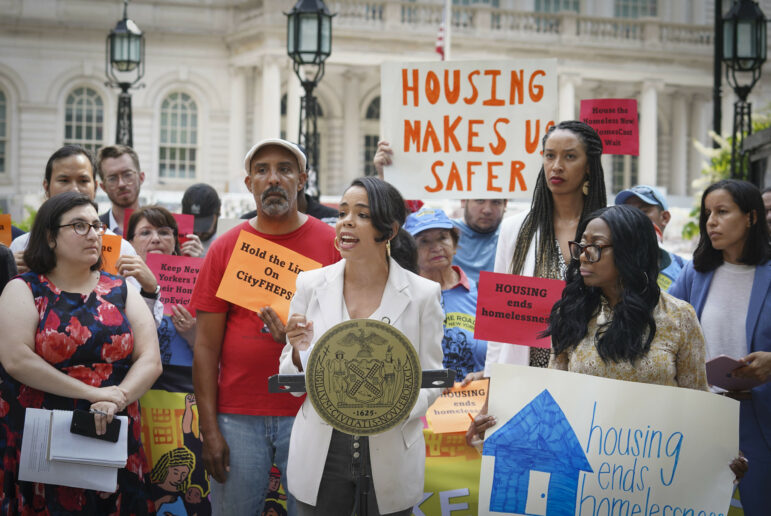
Local 100 of the Hotel Employees and Restaurant Employees union has had no success so far in persuading Goldman Sachs to force Restaurant Associates to improve worker compensation. So Local 100 is working the same game plan 32B-J used, putting the heat on elected officials. Goldman Sachs has received millions of dollars in public subsidies over the years. “Since they receive public subsidies, is there a way to force them to have contractors pay a living wage?” asks Michelle Travis, a research analyst for the local.
New York does have a living wage law, which the City Council passed over the mayor’s veto in 1996, but it ended up covering just 1,400 employees. But this time, organizers say, term limits and changing political winds are in their favor. Rob Hill of the SEIU, who worked with the Renaissance Plaza strikers, has a binder full of angry letters to Muss from more than 25 elected officials, including City Comptroller Alan Hevesi, State Comptroller Carl McCall, Bronx Borough President Fernando Ferrer and Public Advocate Mark Green. Three will be seeking the mayor’s office next year, and one has his eyes on the governor’s mansion.
According to Hill, the legislation has a good chance also because most building owners and contractors already pay decent wages to janitors. It’s in their interest, he observes, to make sure everyone else does too, because it helps employers stay competitive. Several cleaning contractors and developers have written to the City Council’s labor committee in support of legislation favoring a living wage law.
There are, however, pitfalls in this campaign. Real estate companies like Muss might be compelled to bow to the law, but what about companies that can pack up and leave? How about Goldman Sachs, which is currently considering New Jersey’s offer of a $165 million cash incentive to set up operations across the Hudson?