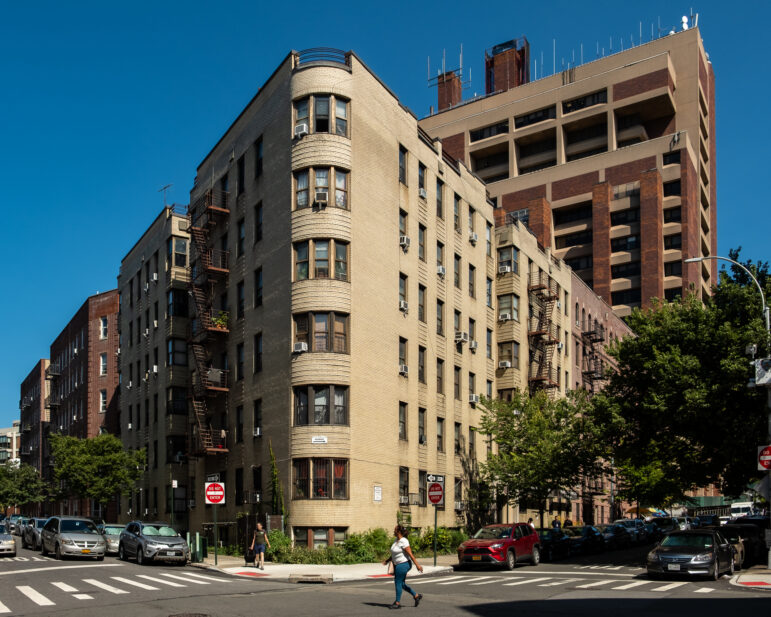


Jose Ricardo Aguaiza has been a leaseholder in a Queens apartment building on 45th Street in Woodside for 14 years. He lives in a one-bedroom now with his wife and their 5-year-old son, and pays $1,018 in rent.
After Manhattan-based Vantage Properties, LLC bought his building in Oct. 2006, the deep-pocketed real estate investment firm sued Aguaiza three times, including twice for not paying rent. He had sent his payment in – he even had proof from the post office – but the company sued him anyway.
“They are looking for opportunities to kick me out of the building. Three times I went to court, but I was right,” said the 45-year-old who works as a doorman, a naturalized citizen originally from Ecuador. He estimated more than half of the building’s residents, many undocumented, have left since the property changed hands. “They are trying to kick out old tenants. An apartment like mine, they rent for $250 more.”
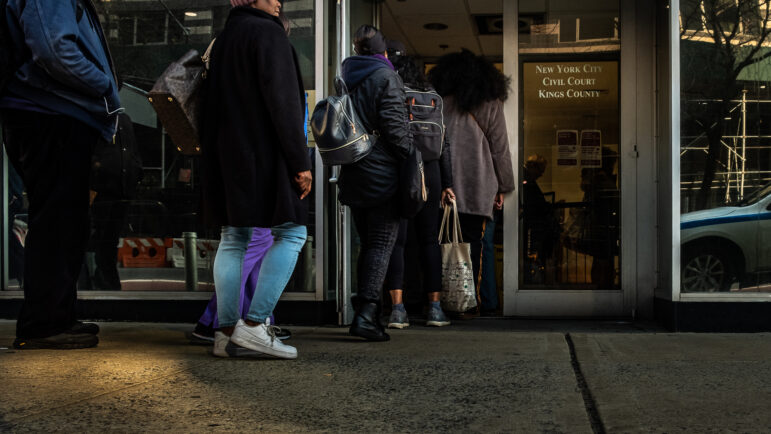
When longterm residents leave and are replaced by those paying more, piece by piece the city’s affordable housing stock diminishes. Driven by tens of millions of dollars in new improvements, which typically lead to higher rents, this loss of stock has caught city and state housing agencies off guard – while lower-income tenants are displaced in droves, housing advocates say. A variety of companies are investing in real estate that formerly held less commercial appeal, bringing new threats to residents – but Vantage tenants, for one, are pushing back. Six tenant-plaintiffs, with the help of the Catholic Migration Office, the Legal Aid Society and Queens Legal Services, filed suit earlier this month against Vantage for engaging in deceptive practices through repeated legal actions against tenants.
Other tenant groups also are making noise to protest real estate investors’ ever-growing holdings in lower-end properties. They say it’s unsustainable for rent-stabilized buildings in Queens, for example, where one-bedrooms average little more than $800 per month, to be renovated and then offered for $1,400 or more.
Housing Here and Now’s lead organizer Chloe Tribich said that is exactly what is happening in Sunnyside, where she led a protest April 17. She said Urban American, a New Jersey-based firm that owns and manages more than 100 buildings, was taking advantage of vacant apartments. “It is very clear that there is a significant difference in the amount of rent between tenants who moved in five or six years ago” and new tenants, she said.
Housing advocates charge that the state Department of Housing and Community Renewal (DHCR) and the city Department of Housing Preservation and Development (HPD) are fighting last century’s enemy – the urban slumlord – and are not yet tuned in to the latest assault on low-income renters: massive private-equity investment that has snowballed over the past five years to control nearly 10 percent of the more than 1 million rent-regulated apartments in the city.
Since 2003 there have been marquee purchases – such as Tishman Speyer buying largely rent-stabilized Stuyvesant Town in Manhattan for $5.4 billion – but less attention has been paid to the purchase of outer-borough apartments with rents ranging between $700 and $1,000. The number of such units has been shrinking dramatically, according to the 2005 Housing and Vacancy Survey. The Survey found that from 2002 to 2005 the supply of apartments renting between $500 and $800 fell by 90,000 units. Those renting from $800 to $1,000 declined by 28,000 units. But apartments renting for $1,000 to $1,500 increased by 80,000.
Wall Street-backed firms have bought about 90,000 units of rent-regulated apartments, advocates say, and are plowing millions into rehabilitation, then recouping that investment in higher rents. (See City Limits Weekly #604, Sept. 10, 2007, When Wall St. Comes To 139th St., Tenants Worry.)
“I think HPD is… not particularly tuned in to this problem. They view slumlords as the problem. They are not keyed in to these developers,” said Benjamin Dulchin, deputy director of the advocacy group Association for Neighborhood and Housing Development.
“High rent vacancy decontrol needs to be repealed so there is less incentive to harass-out tenants paying a moderate rent, and the DHCR must be more proactive in informing tenants so there is less fraudulent abuse” of state housing rules, Dulchin said.
Patterns of potential abuse?
Vantage Properties, a real estate investment and management company that has joined with Wall Street investors to buy about 9,500 units of housing in Queens and upper Manhattan since early 2006, is one example of the new crop of landlords. Critics say they are using aggressive tactics such as frivolous legal actions and not cashing rent checks to push out longtime tenants. The company denies any accusation of unwarranted litigation, and maintains its right to use the courts to remove tenants living illegally in their buildings.
A spectrum of companies is aggressively raising rents, though some treat tenants better than others, advocates say. Tishman Speyer, SG2 Properties, Urban American, Pinnacle Group and Dawnay, Day are operating in the same market, and attracting scrutiny from advocates and elected officials.
The city has several programs aimed at financially helping landlords repair aging buildings and preserve affordable rental housing. A 2007 city Independent Budget Office study, however, projected that only about 20,000 units of housing will be preserved as affordable to lower-income renters (defined as a single person making $39,700 or a family of four taking home $56,700).
In an effort to build more housing, Mayor Bloomberg pledged to create or preserve 165,000 units of housing by 2013 with an investment of $7.5 billion. According to HPD spokesman Neill Coleman, that should offset any loss of affordable housing. And investment in apartments is generally a positive force for renters, Coleman said. “If a building owner is making necessary repairs to a building, that is good for the tenants. If the owner is improperly charging for improvements, then rent-stabilized tenants can assert their rights through DHCR,” he wrote in an e-mail.
On the state level, at DHCR, officials are keeping an eye on the trend, said spokesman Dan Irizzary. “We are definitely aware of what is going on in the market,” Irizzary said. “If we see a pattern of abuse or potential abuse, we are monitoring those situations closely.”
DHCR has beefed up inspectors, he said, but charges of aggressive landlords had to be handled on a case-by-case basis. As an example he noted that media reports in 2007 about alleged tenant harassment by Pinnacle led the department to track the company “with a fine-toothed comb.”
“Where there were irregularities we addressed them,” he said.
New math in a new era
The new threat to lower-rent housing comes not from abandonment, but from significant investment, which is undertaken to make the buildings attractive to moderate-income buyers.
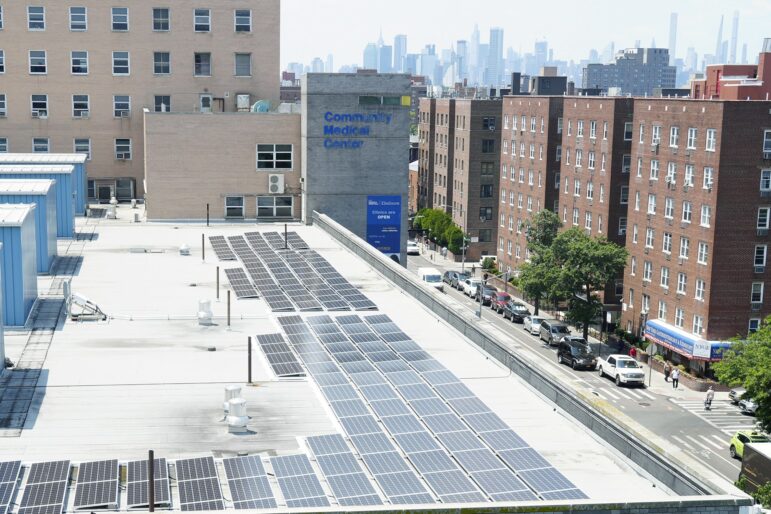
Vantage Properties’ Queens Portfolio I, bought in Oct. 2006, and Queens Portfolio II, purchased in January, provide examples of the complex forces in play in the housing market. Tenants, owners and advocates all agree that many of the approximately 4,000 apartments the company owns in the borough need repairs. What advocates question is under what circumstances the apartments are vacated, because it is the vacated apartments that are rehabilitated and returned to the market at a far higher price.
According to a financial prospectus from its 1,948-unit Queens Portfolio II, Vantage anticipated that one-fifth of the units would be vacated in the first two years because of ineligible tenancies. That’s in addition to an expected 10 percent annual turnover rate. Combined, that would be a rate three times what the Rent Guidelines Board says is the natural 5.6 percent turnover rate for rent-stabilized buildings under $800.
Once vacant, the units will be rehabilitated with about $24,000 in upgrades including kitchen appliances, electrical upgrades, hardwood floors and bathrooms. DHCR permits a landlord to increase the monthly rent of an apartment by 1/40 of the total cost of an upgrade, called an individual apartment improvement. That will allow the company to add $600 per month in rent, plus additional charges from major capital improvements and other adjustments. The company also plans to rehabilitate common areas, landscaping, plumbing and boilers, as well, with a total investment of $53 million for the 47 buildings in the portfolio. The business plan estimates that the net operating income will soar from $12.4 million in the first year to $20.9 million in the third year, and increase less dramatically in later years.
Vantage president and CEO Neil Rubler said his company wants to improve the neglected buildings and provide working-class housing. But he was not trying to provide housing for low-income New Yorkers.
“When an apartment vacates, the incoming resident is 100 percent of the time middle-income — teachers, students, city employees — but may not be low-income, as we don’t receive any subsidies to support low-income housing,” Rubler said.
At Urban American, chief operating officer Douglas F. Eisenberg struck a similar note. “We buy significantly run down buildings and improve them, upgrading public areas, security, elevators and the overall infrastructure. Only when apartments become free do we upgrade the apartment and then increase the rent based on applicable guidelines,” Eisenberg wrote in an e-mail statement. “By doing this we can provide better housing to the residents who are there and improved units for working families who are still able to rent the apartments and pay 30 percent or less of their income for housing. We believe this model allows us to serve those with the greatest needs along with other working people who would otherwise be priced out of the city.”
Also, he said, “only a very small percentage of the apartments we have renovated in Queens have rents at or above $1,600 per month.”
Rubler added that a rent of $700, which would bring in $8,400 per year, barely covers the average annual maintenance cost of $7,500 per unit. His figures were supported by a Rent Guidelines Board 2004 survey of unit operating costs that at the time were $611 per month for large apartment buildings in Queens.
Rent checks and balances
Rubler said his company has never harassed any tenants. “We need to defend our rights when a tenant seeks to defraud us by illegally subletting their apartment for their personal gain…Under the law, we can only accept a rent check from the tenant of record… In some cases, to do so would endow the third party with tenancy rights,” he said. “Any suggestions that we have harassed any tenant are completely baseless, and entirely unsupported by the facts.”
But Rob McCreanor, staff attorney for the Catholic Migration Office, alleges Vantage has been overly aggressive by rejecting rent checks, then claiming non-payment – or claiming that tenants did not actually live in their apartments, but somewhere else.
The suit claims Vantage brought 965 lawsuits against tenants in the 2,124-unit portfolio, Queens Portfolio I, in the 16 months since it bought it in Oct. 2006. He said the previous owner, Nathan Katz Realty, sued his tenants only about 50 times in 2005, and no more than 300 times per year in the mid-1990s.
“I believe the six plaintiffs are representative of a much larger group of people. But what is most frightening is we don’t know the number of people who have packed up and left, who were intimidated because of their immigration status or for another reason were vulnerable,” McCreanor said.
When asked about the 965 lawsuits, Rubler could not confirm the numbers, but said most were for tenants who did not pay their rent. “In Queens, for example, we are owed millions of dollars in unpaid rent. Bringing such cases generally costs us more in legal fees than we can collect,” he said.
Harold Shultz, former special counsel at HPD, and now a senior fellow at the Citizens Housing and Planning Council, a nonpartisan advocacy group, said the loss of lower-end affordable housing should not be blamed on the big equity firms. Smaller landlords are engaging in the same practice, which is based on the increased value of their properties as demand for housing continues to rise.
“I would say a lot of these buildings need investment. While HPD programs have a role, HPD can’t fund all the investment that is needed in New York City,” said Shultz – though the loss of the lower-cost housing needed to be addressed. “There may be other strategies the city can use to address this strata. There may be special targeted tax breaks to keep them affordable,” he said.
Dulchin of ANHD said the financing of the Queens Portfolios was risky, citing a Securities and Exchange Commission filing for a Vantage portfolio in Washington Heights that anticipated 20 to 30 percent of the units would be vacated in the first year. Not only would that kind of turnover point to poor treatment of residents, but, Dulchin said, if that target could not be reached, he predicted the building would fall into disrepair as owners sought to save money.
Rubler said the financing of the company’s portfolios was solid. “All our partners are very, very well capitalized, and are all long-term investors, so we feel under absolutely no pressure to do anything but provide excellent service.”
A few streets away from Jose Ricardo Aguaiza in Woodside, Lucia Gabiria, 63, has lived in what’s now a Vantage building for 24 years. Gabiria is worried about her own future because Vantage has returned three of her checks since taking over in February. That never happened with the previous landlord. “They have to send a new lease. We don’t have anywhere to go,” she said.
Attorney McCreanor said the city and state should take notice of the widespread loss of affordable housing, irrespective of whether tenants are being removed without cause. “Even if Vantage or others are doing everything by the book, the people in the housing are the very people who need the housing, and to let them be displaced does not make any sense,” he said.