

For years, tenants in neighborhoods around New York coped with landlords who tried to squeeze money out of aging buildings by delaying repairs and denying services. Now they face a new type of owner, armed with money from private investors, and ready to purchase properties at heretofore unheard-of prices. To the buyers, these purchases reflect robust confidence in the value of real estate in the five boroughs. To tenants, eye-popping purchase prices constitute “predatory equity”—which seems designed to drive the value of buildings beyond what the rents will support, clouding the future of these affordable units.
That’s the fear facing tenants in some of the 52 Harlem buildings owned by a private investment group called Tahl-Propp Equities. Tahl-Propp—named after managing partners Joseph A. Tahl and Rodney Propp—has shelled out more than $150 million over the past decade to take control of 3,000 apartments in East and West Harlem. Seventy-five percent of the units they now own are federally subsidized. Most of the remaining 25 percent are rent-regulated by the city and state. No matter what kind of program the units are in, advocates say, the prices Tahl-Propp paid puts tenants at risk.
For instance, Tahl-Propp acknowledges paying $8 million (although city land records indicate the higher price of $9.3 million) for 1900 Lexington Avenue, a 19-story, full-block building at East 118th Street. This bland and decaying 33-year-old tower, known as UPACA 7 (the acronym comes from the name of its original sponsor, the Upper Park Avenue Community Association) hardly seems like a cash cow. It’s highly subsidized housing for low-income people, and has received tens of millions of dollars in state and federal subsidies over the past three decades to keep it afloat.
“No,” Tahl declared decisively when asked if the $230 per room per month (or $1.8 million a year) he collects in subsidized rents can cover the debt and maintenance costs on UPACA 7. He says the building defaulted in the mid-1990s, before he owned it, and was only salvaged because the government added new subsidies. “One reason it failed then is because the rents were too low,” he said. “And they’re still too low now.”
UPACA 7 was built and maintained through a mixture of government programs—including a tax abatement and low-interest mortgage under the state Mitchell-Lama program, an additional annual subsidy of almost $350,000 a year through the federal Department of Housing and Urban Development, and financing through the federal low income housing tax credit program. These programs guarantee that the apartments will remain affordable to low-income people until 2027.
Still, Tahl has a plan to make a profit. He has told the state that he intends to pay off the subsidized mortgage on the property, ending the low interest loan and tax abatement. Ordinarily, this would mean greater expenses for the owner – except that the move would also allow the tenants to apply for what are called enhanced Section 8 vouchers. Under the Section 8 program, tenants pay one-third of their income toward rent and the government pays the rest. With enhanced vouchers, the government promises to pay an unspecified but potentially higher market-rate rent to the landlord. According to Tahl, enhanced vouchers could double his income – raising average rents from $1,200 a month to $2,400 – without increasing costs to the tenants. “Every one of our deals has to work without burdening the tenants with a rent increase,” he says.
Harlem tenants uniting
Nonsense, says Alvin Johnson, who has lived in UPACA 7 since the year after it opened and is currently president of the tenants’ association. To Johnson, Tahl’s plan will put all 134 units at risk. Johnson notes that, if the building leaves the Mitchell-Lama program, it will lose its low-interest financing and favorable property tax deal but will still remain bound to the rules governing federal tax credits. As people move out (and on average five tenants move every year), they will take their enhanced vouchers with them, and the rents in the apartments they vacate will revert to extremely low tax credit levels—perhaps as little as $400 a month, down from approximately $1,200 now, making it incredibly difficult for Tahl-Propp to meet its debt payments.
Already, Johnson says, conditions are deteriorating and Tahl-Propp has been pleading poverty about making repairs. “There’s no way the numbers add up,” he adds. “He overpaid, based on the current rents. We think he’s going to [financially] crash the building.”
Tahl responds that he understands the risks and will have to cut back on expenses to make his profit. “I know that when someone leaves I have to factor it in with how I operate the building.”
To Johnson, who has already lived through one financial crash at UPACA 7, that’s a blueprint for continuing decay. He suggests that Tahl-Propp should sell UPACA 7 to a local nonprofit that has the commitment and expertise with government programs to continue to run it as a low-income Mitchell Lama rental.
~
A few avenues away in West Harlem, another group of Tahl-Propp tenants face a different threat but make a similar argument. They say Tahl-Propp overpaid for their building, so much so that the buyer now must convert it to luxury condos to make a profit.
The past landlord (Central Park North, LLC, run by Yusuf and David Bildirici – who tenants say made almost no repairs), bought the twin buildings at 1845 and 1851 Adam Clayton Powell Boulevard in 2000 for $2.6 million. Just four years later, Tahl bought them out for more than three times as much: $8.1 million. According to Tahl’s own financial figures, at that price he’d be lucky to eke out a meager profit of $20,000 a year. And given that he has installed a new heating system and a new roof (though tenants complain the new baseboard heating system is unfinished, inadequate and has caused leaks) and is holding several apartments vacant, it’s clear that the buildings are losing money.
For years, the tenants queried Tahl about his plans, and he told them one thing was sure: he did not intend to convert the buildings into a condominium. Then, in late 2006, he told the tenants that he was going to sell the apartments as condos. The plan to create what Tahl-Propp is calling “Central Park Plaza Condominiums” has not yet been approved by the state Attorney General.
Tahl insists that he was honest with the tenants. In an e-mail to City Limits, he wrote, “Although I may have told them [the tenants] at various times over the past 5 or 6 years that we had no present plans to do so, I believe these statements were correct when I made them.” In other words, he meant it when he said it, but later changed his mind. Still, the condominium filing that Tahl-Propp submitted to the AG’s office, called a Red Herring, contains documents showing that Tahl had been contemplating converting the building months before he let tenants know he was in fact seeking this change in status.
There was, however, one thing Tahl was indisputably straightforward about. When he informed the tenants of his condo plan, they asked whether they would have the opportunity to purchase their homes. His response, according to tenant leaders: “There’s no way you can afford this.” And it was true: the average cost of each apartment in his condo plan is more than $1.2 million.
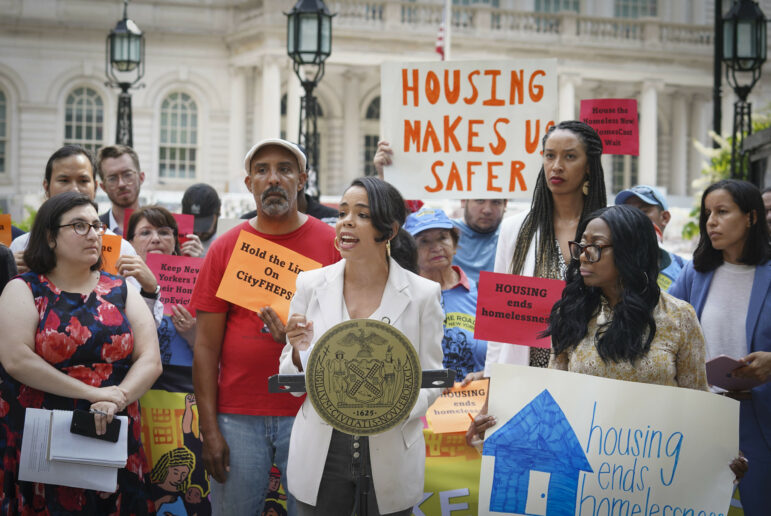
This is the kind of thing that has led to the creation of Harlem Tenants Against Tahl-Propp, a group of residents from many of Tahl-Propp’s buildings. “There’s a pattern here,” says Alvin Johnson, who has helped coordinate these meetings. Still, he concedes, it’s hard to come up with solutions. The usual response from elected officials, he notes with a sigh, is to essentially say: “If these guys want to pay too much for their buildings, that’s their right. Who are we to stop them?”
And among the housing regulatory bodies – whether HUD at the federal level, the Division of Housing and Community Renewal (DHCR) at the state level, or the city’s Department of Housing Preservation and Development – authority over these buildings’ situation is shared, but also incomplete. Regarding Johnson’s building, for instance, DHCR says its hands are tied. “Owners of Mitchell-Lama buildings have a statutory right to buyout of the Mitchell-Lama program after 20 years without the consent of the Commissioner,” spokeswoman Nancy Peters said in a written statement. “We have no authority to block a buyout.” The agency, she added, “is currently completing its review of UPACA Site 7 and owners are awaiting notification from DHCR to proceed to public meetings.”
One thing that bothers many Tahl-Propp tenants contacted by City Limits is the ominous precedent of 305 W. 150th Street, where tenants were forced out due to demolition work Tahl-Propp was doing in the building. Almost one year on, the tenants are still not back home, and they will likely not be able to go back for another 18 months to two years.
Tahl says the situation developed because of a foul-up between the Buildings Department, which approved the work, and the Fire Department, which ordered tenants to vacate the building. He says his firm is paying the tenants’ rents in their relocation housing and that they will be able to move back in at their original rents once his renovation is complete.
“We regret that fiasco,” he says. “It was a horrible time period and we felt awful. But I’m buying a building that hasn’t been kept up properly for 50 years. I’m clear that we’re responsible. It’s not always easy to make up for 50 years of deferred maintenance.”
~
Buildings with a history
Long-time residents of 1845 and 1851 Adam Clayton Powell Boulevard have a galling story to tell about the buildings. Back in the mid-1980s, both 1845 and 1851 were temporarily taken by the city for unpaid taxes. The tenants, working with a city-appointed administrator, took over the management, pooling the rent money to make repairs and putting in sweat equity to cut costs.
Rashidah Abu Bakr, a poet and retired teacher, recalls how tenants made repairs and volunteered their labor to help reduce costs. Abu Bakr herself helped fix the roof, make repairs, clean the hallways, and tend the outside plantings.
But just before the city was set to vest the property, another company paid the back tax bill and the city returned it to its owners. The tenants fought the case in court, arguing that this precedent of allowing third parties to pay off the tax debt would enable developers who were interested in picking up foreclosed buildings on the cheap to swoop in and take control of foreclosed buildings for the cost of the back taxes. They lost their case, and lost control of the building.
Despite that debacle, Abu Bakr continued her work in the garden, saving the trees and planting hundreds of bulbs, flowers and shrubs. She ticks off the species she cultivated over two decades: “Lilac, cherry and mulberry trees, a 25-year growth of lilies of the valley, crocuses, daffodils, and roses.” This year, Tahl ripped out all her plantings, claiming that they had to be removed to make repairs on the façade. “He not only chopped everything down, he bulldozed the roots.”
Tahl points out that he has spent a tremendous amount of money installing a new heating system and ripping off many layers of tar paper to put down a new roof. What’s more, he says, in all of his buildings, he has never applied for a rent increase due to his capital improvements, even though he is legally entitled to do so. He says he will put in new landscaping when the work is complete.
In addition, he says, he is converting the building as a non-eviction plan, meaning that the tenants will remain in the building and will retain their rent regulation. Also, Tahl asserts that he doesn’t expect the rent-regulated apartments in the buildings to attract any buyers, because the rents will not cover the mortgage and maintenance expenses. “We are only expecting to sell the 13 or 14 apartments that are vacant or are already at market rents,” he says. Taking in $14 million will allow him to pay off his mortgage, cover his capital improvement costs, and emerge with $2 million or so. “I’m out with a small profit,” he says, adding that more money will pour in as tenants move out and he sells the units they vacate.
Harold Shultz, a senior fellow at the Citizens Housing and Planning Council and former special counsel at HPD, has been following “predatory equity” deals around the city. According to a 2002 report by his organization, if Tahl-Propp’s purchases in Harlem can be considered “gentrification,” that actually correlates with stability for lower-income tenants, who like to hang on to their apartments in improving neighborhoods when possible.
As for buyers overpaying in general, Shultz wonders if the constriction of credit wrought by the subprime mortgage crisis will start cutting off the lending relied upon by Tahl-Propp and others. There are signs that the landmark Stuyvesant Town purchase, for example, isn’t yielding what the buyers predicted. “If Stuy Town turns out not to be able to return that value, that would probably make a lot of banks think twice about lending in such situations,” he said.
There goes the neighborhood
Many residents remain suspicious of Tahl-Propp’s agenda. “He doesn’t want me here,” says Abu Bakr. “He doesn’t want me here because my presence is an obstacle. He’s about to sell our apartments from under our feet.”
Residents report that most of the market-rate tenants Tahl-Propp has moved into its buildings are white, while most of the longer-term tenants are black—and this has created some hard feelings.
“They’ve not rented to a black or working-class person,” says Fatima Faloye, who has lived in 1845 Adam Clayton Powell Blvd. since she was a teenager. “The new tenants are 99 percent white. This is a perpetuation of the historic alienation of black people in Harlem.”
Eric Alugas, who lives in the neighboring building at 1851, sees Tahl-Propp as part of a wave of predatory equity that will destroy the traditional culture of one of New York’s most famous neighborhoods. “There are very few black people who can afford this,” he says. “My daughter won’t know the Harlem I know.”
Tahl, who lives with his wife and three children in two apartments that he combined on the top floor of 1851 Adam Clayton Powell Boulevard, doesn’t see it that way. “I like the idea of people of different backgrounds living in the same building,” he says. “I think that’s a more worthwhile way of providing affordable housing.”
He thinks the “good old days” are more myth than reality. “A lot of these buildings were absolutely horrible. Harlem was begging for private investment – going back to the 50s. I happen to think that Harlem is a healthier community than it has been. One reason for that is the amount of investment.”
Still, tenants and their advocates distrust Tahl-Propp’s professed commitment to the health of the neighborhood and the buildings. “Surely they’re not in the business of maintaining affordable housing permanently,” says Andrew Lehrer, supervising attorney of the Legal Aid Society’s Housing Development Unit, who represents the UPACA 7 tenants and has had meetings with other Tahl-Propp tenants. “They’re more interested in the money.”
That’s a constant in real estate, of course – but it remains to be seen whether this new breed of buyers will make as much money, in the end, as they hoped.