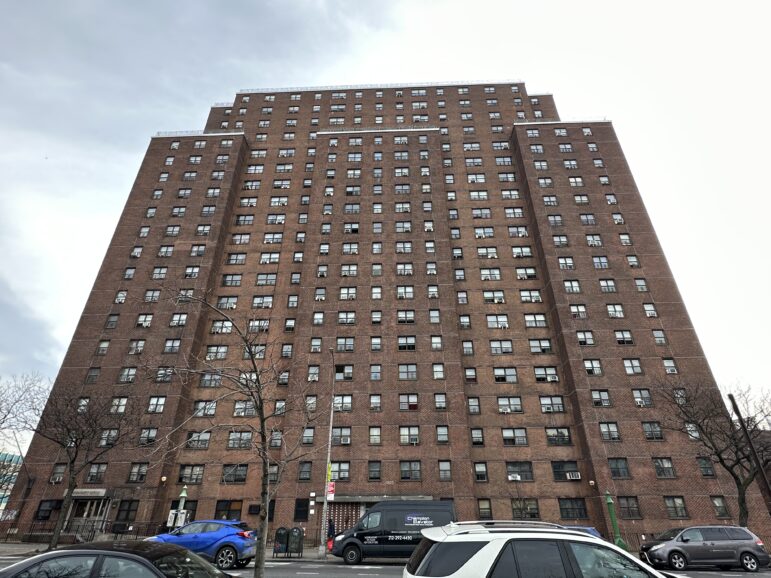


Renita Williams has struggled to survive in her own home since she moved in a decade ago. In a rainstorm, water cascades through the roof of her fifth-floor apartment at 2268 Washington Avenue in the north Bronx. She covers the holes in the ceilings above her children’s beds with plastic tarps, but has lost three televisions and a computer to rain damage. The moisture has led to fungus growing, which has caused asthma among her family. In the morning, when she wakes up in a room of crumbling walls and heads into a kitchen with leaking pipes, she seeks solace in a cup of joe. But, she said, “You can’t set your coffee down, because roaches are in your coffee.”
Williams is one of many tenants around the city who endure foul living conditions in exchange for cheaper rent. But a legal decision stemming from her neighborhood indicates change may come. Bronx Supreme Court Justice Sallie Manzanet-Daniels last month ruled for the Northwest Bronx Community and Clergy Coalition in a decision the group sees as a clear defense of the right to speak out against negligent landlords.
When the NWBCCC began to work on tenants’ behalf in Williams’ neighborhood in 2003, the titular landlord then-responsible for five buildings, Steve Tobia, filed suit against housing organizers. When they picketed and posted flyers on the properties, he claimed the activists were trespassing and committing libel and wrongful interference with the landlord’s bank, Washington Mutual. “The actions of these activists groups scared off WaMu,” said attorney Lawrence Gottlieb, who represented the landowners, then seeking refinancing. “We in essence had to go to other banks.”
But the NWBCCC filed a counter-suit, alleging the landlords’ action was a “Strategic Lawsuit Against Public Participation,” or SLAPP, under a state statute created in 1992 to protect speech rights. SLAPP suits are filed in response to citizen organizing and communication with an influential party to quell public activism. It took a few years, but in July Justice Manzanet-Daniels dismissed all of the landlords’ claims. Because this is the first case in which an anti-SLAPP suit was used in tenant-landlord relations – it’s more often used in the context of land development disputes – the NWBCCC team is claiming that a precedent has been set for tenant organizing and free expression.
The decision “says loud and clear to landlords, ‘You cannot sue community-based organizations'” for exercising their First Amendment rights, said Albany Law School assistant professor Ray Brescia, who served as lead attorney in the case in collaboration with the Urban Justice Center. Harvey Epstein, executive director at the Center, said the message to landlords is: “If you do this, you are going to get SLAPP’d.”
The five properties Tobia was responsible for, which included two apartments on Washington Avenue, two on Walton Avenue, and one at 1055 Grand Concourse, were among about 100 buildings – including Renita Williams’ – that were part of the New Line Realty group. This collection of Bronx real estate corporations is thought to be ultimately controlled by Westchester businessman Frank Palazzolo.
~
When the court battle began, Chloe Tribich was the NWBCCC’s lead organizer in the neighborhood. She described the Palazzolo apartments as “easily the most dilapidated, poorly cared-for buildings in the Bronx.” She met with tenants to discuss a slew of grievances that included vermin infestation, falling ceilings, and faulty locks on their doors. Tribich, who is currently a lead housing organizer for advocacy group Housing Here & Now, helped communicate these complaints to Tobia’s mortgage lender, Washington Mutual Bank, in the hope that WaMu would enforce its “good repair clause” on the buildings.
Tobia argued in court that their conference with his mortgage lender put him at economic disadvantage, but NWBCCC lawyer Wendy Stryker asserted that the NWBCCC’s tactic is not uncommon. According to Stryker, an attorney with the firm Frankfurt Kurnit Klein & Selz, some banks even hire officers specifically to investigate tenant complaints in order to ensure responsible mortgage-lending practices. “This particular landlord group didn’t understand it,” she said.
But as the legal maneuverings continued, tenants suffered from ongoing negligence. A SLAPP suit can create a “chilling effect” on public participation even if a judge ultimately dismisses its claims.
“I did caution my staff to throw down what we were doing in about 50 apartment buildings,” said Mary Dailey, who was NWBCCC executive director through the spring of 2005. “We put a lot of our advocacy on hold.” After organizing efforts slowed during the first six months of the lawsuit, relationships with tenants began to grow stale, and the NWBCCC began to lose touch with the neighborhood.
“Even though they only maybe listed five buildings in the lawsuit, we basically stopped working in most of the buildings we were involved in because we were afraid they would be added on,” said Orlando Torres, the NWBCCC organizer recently assigned to renew the area’s advocacy efforts.
Meanwhile, tenant desperation continued to build. Since the lawsuit began, the five buildings involved and many of the surrounding Palazzolo properties have changed hands – some multiple times. According to NWBCCC records, the apartments are currently owned by real estate firm Seventh Avenue Management. But, said Torres, any one of these properties “could have been sold, or it could have been moved to another management company owned by the same person.” That happens all the time, deceiving tenants, he said. His “gut feeling” is that Palazzolo still controls the buildings. Even Danillo Fernandez, the superintendent of both 2268 Washington Avenue, which is not included in the lawsuit, and 2334, which is, isn’t sure whom he’s working for.
Many tenants feel they are being pushed out. Williams understands the logic; with a monthly rent of $933, there’s little financial gain to be made from investing in her apartment. She and others think the landlord is waiting them out, so that once conditions get too awful to live in, the landlord can spiff up the apartment and rent it to a higher-paying customer.
~
“This building is a piece of crap,” said fellow resident Cynthia Suarez. When she calls for the building’s maintenance workers to repair bursting pipes or nails protruding from the floorboards that cut into her daughter’s feet, she is told “Mañana, after mañana, after mañana.” Even though she doesn’t speak Spanish, she has learned that “tomorrow” will never come. Organizer Torres urged Suarez not to give up, and invited her to a tenant-rights informational meeting earlier this month at Our Savior Church across the street. She and her neighbors were eager to attend.
This was the first time Torres stepped inside 2268, where he explained the July court decision to tenants – most of whom weren’t familiar with the lawsuit. Tribich remarked that when Tobia filed the SLAPP case, “It became clear how deeply the landlords were threatened by tenant organizing … it was almost inspiring, because it suggested that people can get together and fight for repairs.”
People can “engage in social justice action without fear of litigation,” said Epstein, from Urban Justice. “This is a really important precedent.”
Gottlieb, representing New Line Realty, disagrees. Justice Manzanet-Daniels granted NWBCCC’s request for summary judgment only because he wasn’t able to present strong enough evidence – because the passage of time meant losing track of potential witnesses who could have signed sworn affidavits. It wasn’t a trial situation where people’s presence can be compelled. “I don’t see any precedential value,” he said.
As to the condition of the apartment buildings, Gottlieb said, “I just don’t think that was relevant” – but if it was, he claimed a “vast majority of tenants” had signed petitions saying they had a good working relationship with the landlord.
Still, it’s not over. Attorney Stryker said she will be back before the judge next month to argue that New Line Realty group pay the NWBCCC’s legal and compensatory fees, of at least $1 million, plus $10 million in punitive damages. “Now we turn around, and we’re on the offensive,” she said.
The message is still filtering through to residents. “Now, is this going to give me a problem with my landlord?” said 2268 resident Carmen Ortiz when organizer Torres asked about the conditions in her apartment. No, he explained, it legally cannot.