

Cost overruns and management lapses plague a $780 million plan that outsourced the administration of much of the New York City Housing Authority’s construction program, according to internal memos obtained by City Limits.
The problems have contributed to a drastic scaling-back of the work that NYCHA will complete under a crucial initiative to rebuild its aging housing stock. The number of construction projects NYCHA can afford could shrink by as much as 75 percent – leaving thousands of public housing residents in need of new roofs, better kitchens, improved wiring and more.
The memos, penned this autumn by inspector general Robert McSweeney, who is charged with NYCHA oversight by the city Department of Investigation, and former NYCHA chairman Tino Hernandez, indicate that NYCHA management was alerted to the problems years ago but has moved slowly to take corrective action.
NYCHA said Tuesday it is working to correct the problems.
In 2003 NYCHA launched a program called “CM/Build” that hired outside construction management firms to oversee half of NYCHA’s capital program—replacing the authority’s in-house construction management team that normally oversees jobs. NYCHA was attempting to improve a capital program that rarely completed work on schedule. Under CM/Build, the authority would pay construction management firms to oversee and subcontract all the work on particular projects. For example, the firm Hill International contracted to receive $6 million in fees for overseeing $44 million in capital work.
NYCHA said in its 2006 annual report that the goal of CM/Build “is to improve the quality of construction work, and ensure that capital projects are completed on time and within budget.” The approach was modeled after similar programs at the Port Authority and the city’s Department of Design and Construction, according to NYCHA.
In an October interview with City Limits, NYCHA general manager Doug Apple said of the CM/Build program: “We think we’re actually squeezing efficiency out of our capital program. We’re getting quality work. We actually think we’re achieving all of that.”
But the memos indicate otherwise.
On Sept. 17, inspector general Robert McSweeney sent a memo to the NYCHA board. It reported that “in many instances, there have been multimillion-dollar differences” between NYCHA’s cost estimates and what projects administered by outside construction managers actually cost, with few documented attempts to reconcile the differences.
The construction management firms also approved a number of sole-bid contracts—with no competition—”five of them totaling over $55 million,” the memo said. Change orders, in which a contractor asks for an increase in payment because of changes in a job’s scope, received only a “cursory review” and had little documentation.
The current phase of NYCHA’s capital plan, paid for by a $300 million bond sale, was supposed to complete at least 100 projects. But because of cost increases and inaccurate estimates, the inspector general reported: “Rather than fund 154 planned projects, or the guaranteed minimum of 100, the bond process will finance only 39 projects.”
The Capital Projects Division’s oversight “has been inadequate over the past four years,” the report concluded, with employees reporting that they had been told to take a “hands-off” approach to supervising the outside firms. That lack of supervision, the employees testified, “resulted in [construction management] firms using inexperienced staff to supervise subcontractors and poor construction quality on many contracts.”
The report indicates that concerns about CM/Build are not new: As early as 2005, NYCHA’s own audit committee “identified a number of internal control weaknesses,” like a lack of competitive bids, outdated internal estimates, and lack of documentation for payments to the construction managers and wide cost disparities. Chairman Hernandez called for a “corrective action plan” in Feb. 2006, and a plan was drafted that, among other things, called for preparation of a new manual for running the CM/Build program. New safeguards were also put in place for reconciling disparate cost estimates.
But the inspector general says NYCHA applied those safeguards to few of the 39 projects funded so far, including those bid out in 2008. In Jan. 2008, a new unit was put in charge of overseeing change orders and cost estimates. But the inspector general’s report said that “over six months have passed without the effective implementation of many of the planned internal controls and supervisory procedures.” What’s more, the report noted, “Over two and a half years [after it was ordered in Feb. 2006], the draft procedures manual still has not been finalized.” A plan to hire more staff to oversee contracting by Jan. 2009 “has met with unanticipated delays,” the inspector general added.
Reacting to the inspector general’s memo, then-Chairman Hernandez sent a memo to Apple on Oct. 9, 2008. It said that internal audits and the inspector general’s memo “have all identified serious and recurring deficiencies in the management” of the CM/Build program “in terms of both financial accountability and regulatory compliance.” Hernandez continued: “These findings of significant deficiencies have a direct and adverse impact on NYCHA’s financial statements and on its current and future ability to preserve its physical infrastructure.”
In his memo, Hernandez pointed to recent—but at best modest—improvements in performance: that 12 of 13 CM/Build projects bid in 2007 and 2008 were within 20 percent of cost estimates. But the steps taken to date, he wrote, “have yet to adequately address all of the significant deficiencies” identified by the inspector general.
Hernandez directed Apple to finalize the long-overdue procedures for the program and “provide the board with an assessment of the costs which should be recouped from Construction Managers and/or subcontractors,” suggesting that NYCHA will seek to recover money that it has overpaid. It is unclear if Apple has finalized the procedures by now.
Hernandez’ official last day at NYCHA was Friday, Dec. 12. He has been replaced by NYCHA general counsel Ricardo Elias Morales while a national search is conducted for a permanent replacement.
Morales issued this statement today: “NYCHA is aware of the inspector general and Audit Committee recommendations concerning the Capital Program. As the new Chairman I have issued pro-active directions to address those pre-existing issues identified in the report and ensure their implementation to correct them in a timely manner. Once these issues are addressed NYCHA can focus on strengthening existing programs and introducing new programs that will allow us to continue with our preservation of public housing.”
According to the inspector general’s memo, the NYCHA official who supervised the program, former Deputy General Manager Joseph Farro, who had left NYCHA by mid-2006, refused to cooperate with the inspector general’s inquiry on advice of counsel. Attempts to reach Farro on Tuesday were unsuccessful.
Firms that participated in the construction management program contacted by City Limits were also unwilling to say much. One who did comment, project manager Russ Imbrenda of Hudson Meridian construction – a major New York City contractor – said only, “They’re a good client. I’m not aware of any cost overruns.”
Others, however, believe the problems exposed by the memos demand attention.
“It appears that there needs to be a closer look at CM/Build and the capital projects department so that we can avoid there being another fiscal catastrophe in NYCHA,” says Reginald H. Bowman, chairman of the Citywide Council of Presidents of NYCHA residents’ associations. “We’re talking about audit committee findings that there were deficiencies in 2005. That’s three years ago. This hasn’t been fixed yet and millions of dollars have been spent and things haven’t been fixed. There needs to be a serious intervention.”
John Graham, the city’s Deputy Comptroller for Audits, Contracts and Accountancy, told City Limits that, “CM/Build contracts should only be used in rare instances with appropriate oversight because they remove the basic safeguards found in owner-managed, competitively bid contracts.”
In a statement, DC 37 Executive Director Lillian Roberts, whose union represents NYCHA’s in-house construction managers, said that audit “proves once again that contracting out backfires creating cost overruns, insurmountable delays and a host of other problems caused by few if any checks and balances and little or no oversight.” She added: “With hundreds of DC 37 members facing the threat of layoffs, the findings of this audit lead us to believe that NYCHA should take a closer look at its finances, internal controls and supervisory procedures to see how New Yorkers would be better off if NYCHA maintained its services.“
The CM/Build program was only one of a batch of reforms that NYCHA introduced in recent years. NYCHA also agreed in 2003 to work with the city’s trade unions to contract more work with union firms in exchange for unions accepting more NYCHA residents into its ranks. According to officials in the trade unions, the agreement has placed the promised 300 residents in unionized construction jobs. They hail it as a success.
For the past several years, NYCHA has struggled to cope with mounting deficits caused by underfunding from the Bush administration and decisions by the city and state to stop subsidizing the 21,000 public housing units that they built. Nine-digit deficits have led to layoffs, service reductions, the sale of land and a landmark decision this year to use Section 8 vouchers to subsidize public housing. Massive future deficits loom as the cost of employee benefits soars. NYCHA must fund its deficits by spending down its cash reserves—a practice that could soon put the agency in violation of federal regulations.
Preserving its physical stock is a key part of NYCHA’s plan for survival. Eighty-one of NYCHA’s developments are more than 50 years old. In 2005, the authority announced a $2.7 billion capital improvement plan. NYCHA recently began advocating in public for a new federal economic stimulus package to include capital money for public housing.
The 75 percent reduction of capital projects that the authority can afford, from 154 down to 39, is a serious blow to a cash-strapped authority with a $6 billion backlog of capital needs. It’s unclear what projects will be downsized or cancelled. NYCHA’s 2008 capital plan includes myriad projects at many of the authority’s properties—from electrical upgrades at the Adams Houses in the Bronx to new kitchens at the Van Dyke projects in Brooklyn, to roofwork, brickwork and improvements on the grounds of other developments. Some of those projects might not be overseen by the CM/Build program but by NYCHA’s in-house staff. From fiscal 2007 to 2008, the percentage of NYCHA’s active capital projects that were on schedule dropped from 39 percent to 22 percent.
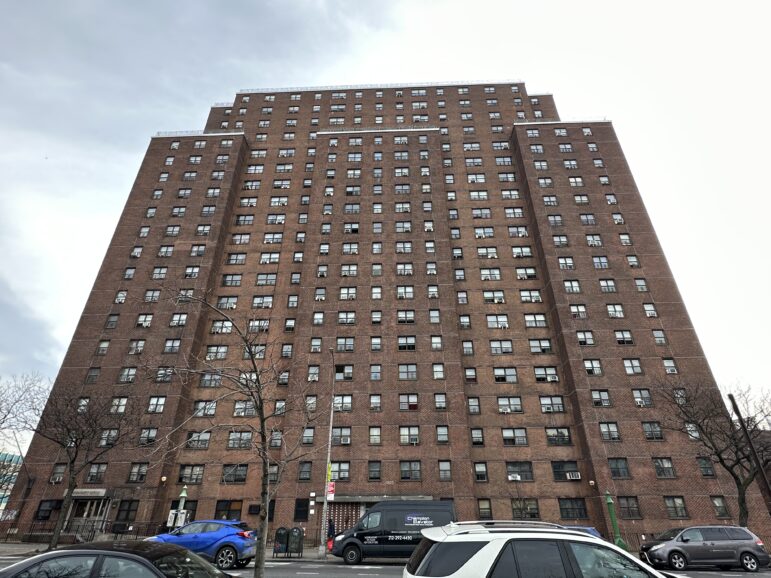
NYCHA is the nation’s largest and oldest public housing authority, overseeing 179,000 apartments in 2,700 buildings among 343 developments around the city, and housing at least 400,000 residents—or about as many people as live in Miami. It is regarded as the best-managed authority in the country; while projects in other cities succumbed to crime and vandalism, NYCHA’s developments have remained viable.
However, the authority’s capital program has occasionally shown weaknesses in the past. In the 1980s, two NYCHA contracting officials were jailed for demanding kickbacks from contractors, and organized crime figures were linked to the authority’s window contracting operation.
This year, the authority has come under fire for the condition of its elevators after five-year-old Jacob Neuman fell to his death while trying to escape a stalled elevator at the Taylor-Wythe houses in August. The head of elevator repairs recently left the authority. NYCHA vowed to spend more on fixing its elevators, but said doing do would require shifting money from other parts of the capital budget—a budget already strained by the problems with the CM/Build program.
City Limits Investigates will publish a major report on NYCHA in late January.