

When Hope Sloan’s building on Clay Avenue in the Crotona section of the Bronx went into foreclosure last year, conditions that were already bad spiraled out of control, she says. The landlord and management company didn’t answer phone calls or letters. The supers were fired. Residents started buying cleaning supplies for building maintenance themselves and took up a collection to pay a new super.
The building where Sloan, 40, an unemployed administrative assistant, lives was owned until recently by the private equity-backed Ocelot Capital Group. When these Ocelot properties entered foreclosure last year, government-sponsored financial giant Fannie Mae was left holding the bag on a $29 million mortgage package it underwrote for Deutsche Bank. Now 300 families live without effective management in buildings suffering from thousands of serious housing code violations, including collapsed ceilings and faulty electrical wiring. With Fannie Mae preparing to auction the debt it holds on the 19 buildings – in effect selling them – the city’s Department of Housing Preservation and Development says the sale’s design could become a template for how the city handles the disposition of other financially troubled buildings.
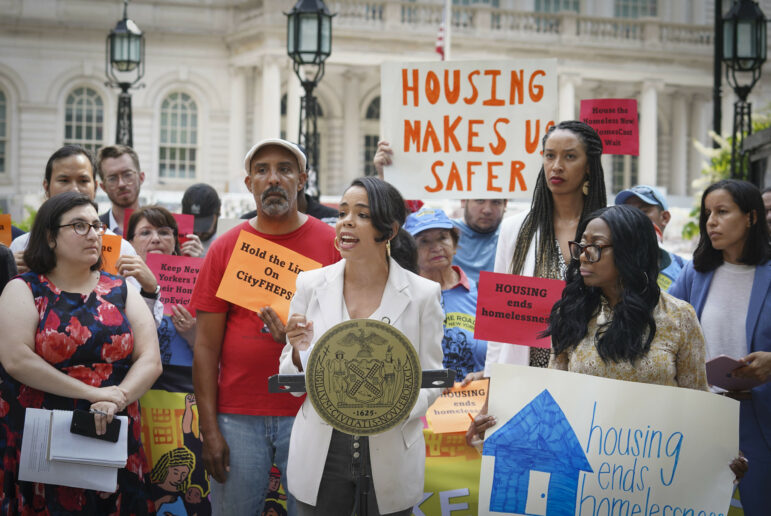
“We’re seeing it as a test case,” said RuthAnne Visnauskas, HPD’s assistant commissioner for new construction finance. Tens of thousands of apartments around the city presently rest on shaky financial footing and could end up in foreclosure like the Ocelot properties if owners stop making debt payments. In cases where mortgages stand to be transferred again, those involved all say it’s crucial not to sell to yet another unreliable owner. Sloan joined with other residents and activists in a rally on July 20 to tell Fannie Mae that a nonprofit buyer is the better choice.
But Fannie Mae maintains that an open auction is the best way to find a responsible owner and begin the process of repairing the buildings. “Fannie Mae is committed to selling its Ocelot notes to a responsible buyer who will address safety and affordability issues at the property and deal fairly and appropriately with tenants,” said Jon Searles, Fannie Mae’s director of communications. Fannie is working with HPD to establish criteria for selecting the winning bidder. “The criteria will include demonstrated financial strength and a strong track record in managing and maintaining large affordable rental properties in a responsible manner,” said Searles, who noted that the company is less interested in recovering its debt than in selling to a landlord who will take care of the buildings.
Ben Dulchin, executive director of the Association of Neighborhood Housing Developers (ANHD), which represents 97 nonprofit housing organizations citywide, is cautiously optimistic that the right sale could rescue the buildings and preserve affordability. Some ANHD members have expressed interest in the buildings, despite the mountain of repairs they need.
“This is potentially a really good outcome to a terrible situation. It is hopeful that Fannie Mae is seeing that they have an obligation to make this story come out right,” said Dulchin. If the sale price were low enough, ANHD members or other developers committed to managing quality affordable housing could buy, repair and maintain the buildings. “As long as Fannie Mae says it goes to a responsible owner, that is a good thing. Hopefully that’s what they are committing to,” he said.
Do the right thing
That’s an open question. Housing advocates who have been sounding the alarm for years on the danger posed to tenants by over-leveraged buildings are skeptical. They fear the sale planned for August 12 (when sealed bids will be accepted for one, some or all the buildings) may simply transfer the apartments to yet another owner who is unwilling or unable to maintain them as decent homes for low-income New Yorkers. Nonprofit community development organizations can’t compete with deep-pocketed private investors, and shouldn’t have to, said Dulchin.
The problem, says Dina Levy, director of organizing for the Urban Homesteading Assistance Board – which coordinated last week’s rally, along with the Bronx group Casa – is that the buildings are overpriced. Rents in the neighborhood, where the median household income is just $20,000, could never support a mortgage of $29 million. That’s why Hope Sloan, her neighbors and advocates demonstrated on the front steps of one of the Ocelot properties on 175th Street, holding signs reading “Write down the loans, save our homes,” and calling on Fannie Mae to call off the planned auction and instead sell – at a far lower price – to a developer with experience in low-income housing and a track record in the Bronx.
Levy argues that an auction, by its very nature, is the wrong remedy. “It’s just not viable for what we all want to achieve. What we want to achieve is a preservation outcome where nobody pays a dime more than these buildings are worth. And the debt auction mandates that somebody does that,” she said. “The truth of it is these buildings have very little value because they are so horribly distressed.”
She values HPD’s efforts so far – but would like to see the agency employ, in this case, the property transfer approach that’s proven itself in existing HPD programs such as third-party transfer.
~
At the rally, tenant Cesar Guzman put it this way: “Fannie Mae, you shelled out $29 million on this and on our end we didn’t see nothing but pain.” Guzman described falling ceilings, broken windows and weeks without heat and hot water. “It’s very simple. We pay rent to live in a home. All I want is somewhere I can feel safe. That’s not too much to ask,” he said to cheers from his beleaguered neighbors. (Click here to see a slideshow of conditions at Guzman’s building.)
U.S. Rep. Jose Serrano, who represents the area and attended the rally with U.S. Sen. Charles Schumer and Bronx Borough President Ruben Diaz, called on Fannie Mae to abandon its plans to sell the buildings on the open market. “Our role is to make sure that Fannie Mae doesn’t make the same mistake again,” Serrano said. “Never again will we let this happen. We are not Wall Street. You don’t come here and make money off our backs.”
Schumer said Fannie Mae’s role as a secondary buyer of mortgages was part of the problem that allowed private equity real estate deals to threaten affordable housing. “Fannie Mae, you helped put these innocent tenants in this mess. You have a responsibility to help get them out of this mess,” he said. “We will stay on Fannie Mae like peanut butter on jelly until they sell these buildings to someone who will fix them and take care of them.”
HPD assistant commissioner Visnauskas says that holding an auction and obtaining a responsible new owner are not incompatible. With the right criteria for the auction, the sale can create a blueprint for possible future sales of affordable apartments citywide whose owners are in untenable mortgages.
“[Fannie Mae] said they would work with us once they got the bids to find a responsible owner with a record of managing multi-family rentals who is committed to preserving affordability,” Visnauskas said. “We want to make sure this wasn’t a highest bidder auction. We don’t want to start this process over again.” She said HPD would help community housing developers put together financing for a bid on the Ocelot properties using the NYC Acquisition Fund, a pool established by the city and private funders.
Repair costs will be substantial, both HPD and Fannie Mae acknowledge. The housing agency lists 8,000 code violations on the 19 Ocelot buildings, 2,000 of them deeply serious C violations that require immediate intervention. The buildings are also part of HPD’s alternative enforcement program, which gives the agency great latitude to intervene and repair damage without cooperation of the landlord, said Visnauskas, who has been consulting with Fannie Mae over the buildings’ fate.
‘A critical moment’
Dulchin and others in nonprofit development said it was unclear precisely how bids would be evaluated and how much weight would be given to would-be buyers with experience in affordable housing. Levy of UHAB and tenant organizers said the buildings need to be sold for far less than the $29 million. A high price would only continue the speculative investment strategy that landed the buildings in such dismal shape, she said.
Fannie Mae spokesman Searles says developers and housing advocates should rest assured that the seller shares their values. “Clearly there is a great deal of work to be done on these properties and that will affect the sale price,” he said. “Investors are not our primary focus here. It really is all about transferring to a responsible owner. It’s possible we will have to take a loss.”
Searles also defended Fannie Mae’s decision to dispose of the loans through the company Debt Exchange, an online marketplace for buying and selling loans. “The reason we are pursuing the auction is it’s the most transparent method and a way to reach the highest number of responsible buyers,” he said.
Debt Exchange or DebtX is a private company that facilitates sales on the secondary debt market, meaning it provides a forum for large financial institutions and institutional investors to trade debt investments. Fannie Mae isn’t the first government entity to rely on its services. The Federal Deposit Insurance Corporation maintains a contract with the firm; in January the U.S. Department of Housing and Urban Development contracted with DebtX and another firm to sell $144 million worth of loans. Potential buyers have to be vetted and approved to bid on a loan they want to buy, according to information on the company’s website.
~
While the fate of the Ocelot properties has garnered considerable attention, they are just one glaring instance of private equity investment run amok. Ocelot Capital Group, a company whose majority investor is Eldan Tech, a publicly traded real estate investment fund based in Israel, bought the Bronx buildings in 2007. Last summer Eldan Tech told Ocelot is would stop putting money toward the buildings’ upkeep. Last fall Ocelot prepared to sell the portfolio to Vintage LLC, another real estate investment firm, according to court records. Before the sale was finalized, but after Vintage LLC assumed responsibility for the mortgages and upkeep, the buildings went into default. The new company failed to make mortgage payments and Fannie Mae began foreclosure proceedings March 2. The buildings are now the responsibility of a series of court-appointed receivers. Communicating via e-mail, Rachel Arfa, president of Ocelot Capital Group, said she was traveling outside the U.S. and would answers questions only after the Fannie Mae sale was complete.
Absentee owners who treat properties as investments rather than homes are characteristic of private equity deals, Levy says. And despite the apparent lessons of the ongoing economic crisis spurred by the housing collapse, “people are still overpaying for real estate in New York and for bad debt in New York,” she said – with the recent purchase of six other Ocelot buildings – 220 units with 3,000 outstanding code violations – recently being sold on the private market for more than $14 million.
ANHD estimates as many as 70,000 units of affordable housing in the five boroughs may be dangerously overleveraged, with owners unable to maintain both debt payments and living conditions. ANHD arrived at the 70,000 unit figure by looking at the default watch lists maintained by loan servicers, according to Dulchin.
If those owners default and mortgage holders look to sell the debt, they need to be ready to accept substantial losses, he states. “For there to be a real preservation strategy the banks need to realize they need to really step up and bring the buildings down to their real value. It will probably cost them more, but it will undo a lot of the damage they have done to our neighborhoods,” Dulchin said. “They have an obligation to stabilize themselves in a way that is useful to the community as a whole. These are financial institutions that have been the beneficiaries of tremendous government largesse. This is really a critical moment.”
Depending on the outcome of the Ocelot sale, Dulchin said, the city and advocates could put pressure on other mortgage holding banks to write down the value of troubled properties.
For its part, HPD is trying to stay ahead of the problem of over-leveraged buildings, Visnauskas said. It doesn’t want another Ocelot and it doesn’t want to return to the days of the 1980s, when the agency held a huge roster of tax-delinquent and abandoned properties.
“We are trying to continually assess the magnitude of the problem,” Visnauskas said. “HPD is developing a watch list to serve as an early warning system, to be more proactive in stepping in when buildings start to be distressed.”
“We definitely believe the other shoe will drop, but we want to have a system in place to address it. In contrast to the housing crisis of the 1970s, we have so many strong, capable nonprofit and committed for-profit developers that really have a track record with managing rental housing.”