

Photo by: By Alice Proujansky
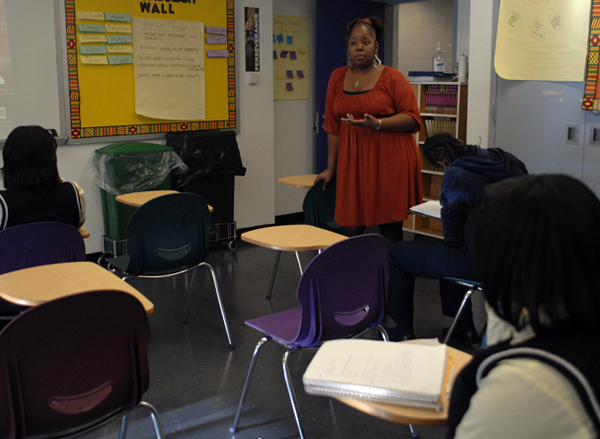
Patrice Ward teaches English and film to ninth-graders in the Harlem Children’s Zone.
This article is part of our special reporting on the Harlem Children’s Zone, the antipoverty initiative examined in depth in the current issue of City Limits magazine, Hope or Hype in Harlem?
Patrice Ward teaches ninth-grade English language arts, African-American film, and college prep in HCZ’s Promise Academy I High School. This is her second year with the school; in 2008-09, she taught eighth-grade English and moved up to high school along with her students. Ward is 32 years old and graduated from Hillcrest High School in Queens and City College, where she began as a pre-med student, then became an English major.
After graduation, Ward worked for the Albert Ellis Institute as an office manager and newsletter editor. She also worked for three years with Kaplan, Inc., preparing students for the SAT, PSAT and specialized high-school admissions test. She says that once she realized, “I’m pretty good at this teaching thing,” she became a New York City Teaching Fellow, part of the Department of Education’s alternative teacher-certification program for college graduates. Before coming to the Promise Academy, Ward taught for five years in a middle school in Queens. She spoke with City Limits about what life is really like inside one of the country’s most famous schools. Here are highlights from that interview.
How did you come to teach at the Harlem Children’s Zone?
I was interested in trying a different avenue of teaching. I had some administrative issues in my previous building where I just felt like I needed to try a different avenue. They hired a lot of administrators through programs, people who haven’t actually taught, or who haven’t taught in years, or people who come in with this corporate head-hunter mentality. It was itching me the wrong way. So I thought, let me try something a little different. I came in, I interviewed, and that’s how I got here.
This building offers you a lot of support. If you’re having a problem, there’s another colleague that wants to help, there’s an administrator that will offer their assistance, there’s something going on. I got way more [professional development] here in the last year that I’ve been here than I got in the five years in a DOE school.
What’s the mix of new and experienced teachers at the Promise Academy?
There are a lot of teachers here, where this is their only teaching experience. At least 50 percent of the staff fall into that realm, where this may have been their first job. The school is now building. Last year, there was only the ninth grade. (During this school year, the high school comprises grades 9 and 10; it will grow one grade per year as students age up.) They basically had to hire a set of staff to be with [the new grade], so we have maybe six-plus people, teachers and teachers assistants, that weren’t here last year, although they may not be new to teaching.
How is the curriculum developed at the Promise Academy high school?
It’s a little bit of everything. That’s the blessing of a charter school. I can take DOE curriculum, a developer can come in, I can bring my own ideas … It’s a blend, a flux.
Here, we’re focused on finding out what kind of skills the students have and don’t have. We do a lot of grammar; that is enforced into our curriculum now. In charter schools, we can do what we want. In the DOE schools, grammar’s been pulled out of the building. Right now, I’m working on subject-verb agreement, how to write coherent, complex sentences.
How big a role does test preparation play in curriculum and daily instruction?
I think there’s a way to do it. In our building, I think, it’s all about the teacher and the dynamics. In my [former school], it was all about the testing. New York City is just a testing city. Numbers are everything.
Here, I think it’s so integrated that the students don’t see it as a burden. The way our schedules are broken up in the week, Monday is for genre and reading comprehension, for them to expose themselves to the kind of textual material they might actually get on the state test. Tuesday is actually a test prep day. We do Regents or SAT prep with them on Tuesdays. Then, on Wednesday, Thursday, and Fridays, it’s built into every day. (There is also Regents-exam preparation on Saturdays.) …They become comfortable. It’s just something that they’re used to doing, that’s just blended in.
But there’s often a difference between what students ‘should’ produce and what they actually do.
I think they’re doing very well. … These are not the typical Harlem Children’s Zone children, in the Zone since K. These 9th and 10th graders now just came in, in the 6th grade. Whatever educational difficulties they may have, they brought with them here. As somebody who rotated from [grade] 8 to [grade] 9, I can see the growth.
I remember my first day at work, asking for essays and having children give me blank faces, and only being able to produce paragraphs—or if more than one paragraph, it may have been three sentences, two sentences, very simple sentences, completely with no understanding of how to take a topic, flip it into their own words, deliver a thesis statement—where now, they can articulate that their essays have to start with a thesis statement. I can give them a topic like McDonald’s and Burger King and say, make me a thesis statement about fast food … You should be able to take ‘Lysol’ and give me a thesis statement. They’re at that point now. It may not easy to pull out, but their writing has gotten much, much better.
You wouldn’t know it, but there is a great African population in this building, where most of their parents don’t understand English, and they’re first generation in the city and their first language was whatever language they speak. But they came here [officially listed] as English speakers. It affects their grammar and their spelling and you can see it– they might not be on the record as [English Language Learner] students, but you can see it.
Will your ninth-graders go on to college?
Yes, because they can verbalize that they want to go. Right now, they don’t see the full connection of how school, English, passion and effort directly correlates itself to ‘I want to go to college.’ Much like a video game, they just want to get to the end of it.
It’s an age of immediate gratification—and English is a tedious subject, because many of them don’t have families that make them read at home. They don’t sit still for 30 minutes and read something. Then when you ask them to do that here, because you’re trying to prepare them for an English Regent that’s going to be 6 hours long, they don’t understand it.
The Harlem Children’s Zone’s approach includes character development. How are expectations communicated—both to the students and the teaching staff? Does the direction come from the principal or from the HCZ leadership?
Yes, there is character development here. In the Harlem Children’s Zone, we’re just in an atmosphere of character. …It’s not something anyone has to say. You just know that the Harlem Children’s Zone expects excellence from you as an employee, and they expect for you to exude that excellence at all times and impress it upon anyone you touch—another employee, a student, or whatever. Even in just the dress [code]—no male in this building is ever walking around without a shirt and tie on.
It’s definitely coming from the top. In terms of hierarchy, it’s definitely coming from the corporate level, because we’re not separated. [Floors] 6 and 5 are corporate, 4, 3, and 2 are the school. So Geoff Canada walks into this building, children, executives or not, he wants to see everyone in this building looking like they work for the Harlem Children’s Zone. Definitely, that corporate feel is in the building; you’re a school, but you need to run it in an orderly fashion. It needs to be upstanding.
Do kids ever push back against the expectations on their behavior?
Sure, they’re kids. But some of the kids also know that … you’re just being diligent. It can’t feel like a punishment. It’s an expectation: That you believe in them, and that’s why you want it from them. You think a lawyer comes in with no belt on and his shirt untucked and his sneakers on with his suit? No. So dress the part right now. Come in every day like you mean it. It doesn’t have to wait, because if it’s not in proper practice, you won’t be able to do it later. The same way all your teachers are here looking professional, we want the same from you. Whatever it is, get comfortable wearing it.
How would you describe the strength of the school?
Staff cohesiveness. Everyone is here for the same greater purpose. Everyone exudes it and will support you in it. So the students, from every person they encounter, are going to get the same message: That they can succeed, that they can go to college, and here’s what you need to do. No, you’re not going to fall apart—no, we’re not going to let you have a bad day—we want you to succeed, we’re going to push you in that direction. We’re here; you’re going to see our faces, we’re not going anywhere. We’re the same people on Monday that we are on Friday, the same at 9 a.m. and 3 p.m. It works for me the same way.
How engaged are parents in their children’s education?
I tell my students all the time, a lot of your education is all your own choices. I had a single mom that had to work two full-time jobs; she left the house at 7 in the morning and didn’t come back until 1 in the morning. My mom stopped going to parent-teacher conferences when I was in the third grade. But I knew I had to do what I had to do. No teacher had to call my house. I knew what I was supposed to be doing.
Here, it all depends upon the child. Obviously, every child is different, every circumstance is different. …Some of the parents are adamantly involved. And others, different circumstances—not that a parent doesn’t care, but being a single parent, trying to do everything that they have to do, obviously, every circumstance is just different. It wanes. I don’t think the resources are the problem. If I could get my parents to be more involved, that would make a lot of a difference.
How many parents attended parent teacher conferences this fall?
About 40 percent, 40 to 50 percent.
You work a very long day and a long school year. Do you think about getting burned out?
It’s funny. I think this building is unlike a regular DOE school, where school is just school. This building is not the same. There’s so many little quirky ‘family’ aspects to the building.
We had a very difficult day on Tuesday, to say the least, with some of our students. It was complicated—a bad student day, it just happened. Just a bad student day. The kids were not being functional, they were not doing things you want them to do. You had some clash with one student. It was tumultuous, on top of it and on top of it. It just kept rolling. By the end of the day, I just wanted to leave.
They were having an [afterschool] art class next door. It’s just a little nugget of happiness in the middle of your day. It’s about five of our same students, not some other kids, they gave us all little piggy banks and they gave us all paint, and we all sat and painted together. And laughed—hard.
You know they’re going to fight you in class. No one wants to be in class. And when you have a complicated living arrangement and a complicated living environment, it becomes hard. You may get some pushback But when they get to see that you’re not just Ms. Ward, guardian of ELA, enforcer of all that is right and good in subject-verb agreement—but actually a person that will help me figure out how much garlic to put in my pasta and help me mix my watercolor paints and tell me that red and white makes pink, my favorite color to paint my pig, you get a whole different dynamic. It just makes it completely different. The building is human. There’s no robots happening here; these kids know you’re real people. You have human emotions.
Some say charter school teachers should be part of the teachers’ union. You’ve worked in a union school and here, at the Promise Academy. Do you miss the union’s resources?
I’m not the kind of person who needs them. You do your job. You just do your job. The union is for those little in-between, crux moments, ‘I have an issue, it didn’t play out like I thought it would.’ Those issues still come up; you have to be your own advocate. You just have to be someone who knows your worth and who can speak up for yourself.
I think it’s an interesting dynamic of this building: There is no union, and you could just lose your job. Things happen; it happens. …It is a corporate environment, and people who work here can’t forget that. If you do something your boss finds inappropriate in a corporate environment, you’ll get fired. But if you’re doing your job and you have all this support, you come in every day, you don’t have to feel that fear. And I don’t. I’m not concerned about losing my job.
Is your boss the principal or Geoff Canada?
My boss is everybody. Everybody has the right to have a say-so in what I’m doing, and if I’m doing it well or not.