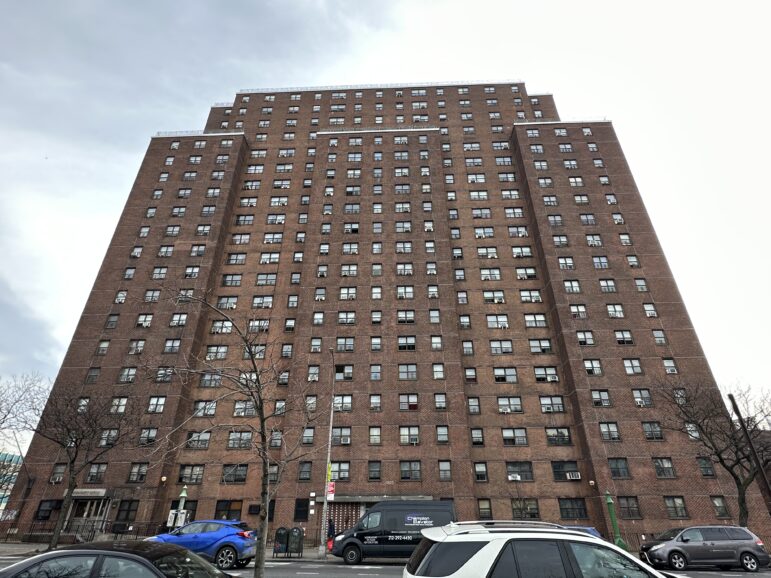


There’s an invisible wall around much of the public housing in New York. To approach one of the larger public housing projects is to confront a different world. Suddenly the city’s trademark lively street scene vanishes, replaced by a forest of boxy red brick high rises.
Public housing’s isolation from the economic and community life around it can contribute to problems ranging from crime to long-term unemployment, according to stacks of reports from think tanks and housing advocates. Even the secretary of the federal Department of Housing and Urban Development, Shaun Donovan, says projects create “whole neighborhoods of concentrated poverty and segregation.”
Local housing experts are beginning to use the same language. While HUD’s Donovan – the former NYC housing chief – speaks of “building a geography of opportunity,” a recent report from the Pratt Center for Community Development is titled “Public Housing in New York City: Building Communities of Opportunity.”
The report calls for stronger job training programs, links to mass transit, and new building on under-utilized land under the control of the New York City Housing Authority (NYCHA). “This will start chipping away at public housing’s isolation,” says Alyssa Katz, the report’s editor (and a former editor of City Limits). “There is a whole lot more that the Bloomberg Administration can do.”
The recommendations in “Communities of Opportunity” can probably be achieved without the controversy and expense caused by public housing demolition and redevelopments in other cities, but it’s unclear whether the recommended expansions of existing programs will be enough to break the isolation of our public housing.
Warehousing the poor
Many experts now claim that housing too many needy families too close together without enough services creates islands of deprivation — what Brookings Institute researcher Bruce Katz has called “warehouses for the very poor.”
This critique is a reversal of what was once a conscious policy choice. Advocates once pressed the government to use public housing to help the people who needed it most, and public housing is still the “housing of last resort” for many families, according to Katz.
In New York City, public housing tends to be located in the poorest neighborhoods, and almost half of NYCHA residents are living in poverty, earning less than $22,050 a year for a family of four. The report points out the irony that: “A disproportionate number of the New Yorkers who could benefit most from aid in securing such supports as job training, employment, and reliable public transportation live in complexes that are isolated from those opportunities.”
To bring residents earning a wider mix of incomes into its public housing, the housing authority has created a “working families” preference. Today, NYCHA provides apartments to new tenants making up to 80 percent of area median income (for a family of four, that’s an income of $61,450 a year). Once tenants are in place, they can make more than that.
But this raises other concerns. “My sense is that the study is informed, like many others today, by a wish to eliminate remaining pockets of poverty in New York so that we will live in a ‘perfect’ city,” says Nicholas Dagen Bloom, author of Public Housing That Worked. “NYCHA projects are one of the few elements in the city that keep Manhattan and Brooklyn diverse, interesting places,” says Bloom, “as well as providing a source of workers in the service industry.”
New jobs, more transit
The Pratt report recommends breaking up concentrations of poverty in public housing largely by focusing on improving the fortunes of the people already living there, first by strengthening job training programs and links to mass transit.
Far-flung public housing projects should be connected to job opportunities with new bus rapid transit service, for example.
Pratt’s report also critiques the isolation of the housing authority itself, which makes it less effective in providing job training to residents. “NYCHA largely operates separately from the city agencies that could make a positive difference—such as the Department of Small Business Services, which administers job training programs,” says the report.
For example, the city’s recent construction boom has failed to provide much in the way of jobs to public housing residents. Despite a federal mandate called Section 3, few public housing residents have been hired or trained for construction and maintenance jobs. Large contractors working for the authority are supposed to spend 15 percent of their labor costs on employing local public housing residents. Audits by the city comptroller of 52 recent projects found none that met the spending requirement. Only 10 public housing residents had been hired.
Change has already begun for the housing authority. City Hall has directed NYCHA to work more closely with agencies including the Department of Youth and Community Development and the Department for the Aging. Also, due to budget cuts, NYCHA’s in-house workforce development program is due to be transferred to the Human Resources Administration, which administers welfare-to-work programs.
NYCHA officials have struggled to break the isolation of their agency — with mixed results. It’s had punishing budgets to work with: From 2001 to 2008, the federal government gave housing authorities many hundreds of millions of dollars less than they needed to operate — paying an average of 80 cents per dollar of operating expenses, according to HUD’s own funding criteria. The state government also cut off funding for 12,000 public housing apartments built by the state decades before and managed by NYCHA.
The agency’s crippling budget deficit should be alleviated by renewed support from Washington, including a projected $423 million in stimulus funds. The stimulus money will be dedicated to much-needed capital projects and building maintenance.
While the Pratt report has not evidently made a huge impact in NYCHA offices, Heidi Morales in the communications department said it “includes interesting proposals that NYCHA will continue to review and consider in an effort to develop strategies that would best serve our residents.”
The authority already is “committed to enhancing economic prospects for residents by fostering employment opportunities through public/private partnerships, supporting targeted training efforts in growth industries, and developing financial literacy and asset building initiatives,” according to a statement. “NYCHA’s Office of Resident Economic Empowerment and Sustainability has been working closely with other city agencies, building on existing partnerships and expertise, to explore ways to systematically expand opportunities for NYCHA residents.”
Losing the lead?
NYCHA has held a reputation as one of the best-managed housing authorities in the country, but it may be falling behind as other public housing authorities transform themselves.
In recent decades, New York’s public housing remained “viable,” in the words of the Pratt report, while other cities were plagued with notorious projects like Orchard Park in Boston, which was so decayed and crime-ridden that by the 1990s hundreds of its apartments stood empty because potential residents refused to move in, even after waiting for years on Boston’s public housing waiting list.
The 774 public housing apartments at Orchard Park have now been torn down and rebuilt under the federal HOPE VI program. The new project has fewer units — just 446 public housing apartments mixed in with 45 for-sale homes spread over a larger site. But a decade later, they remain fully occupied and crime is low: In 2008 the public housing property received a national MetLife Foundation Community-Police Partnership Award.
Although that story has been repeated across the country in practically every major U.S. city and the HOPE VI program has handed out more the $6 billion in grants to more than 600 projects, New York’s housing authority has started only three HOPE VI developments. That’s because advocates and city officials are unwilling to support any policy that cuts the number of public housing apartments.
“No one is talking about reducing the number of units,” says Katz, from Pratt.
However, many housing authorities have redeveloped public housing into mixed income housing and still replaced all the original public housing apartments, usually by expanding the development site into nearby blocks — an expensive proposition in much of New York.
In 2005, the city announced plans to build 6,000 new units of housing on vacant or under-utilized housing authority land, building around existing public housing, and the Pratt report includes several recommendations to improve and codify the process of redevelopment, in particular to make sure that the needs of local residents around these redevelopments are respected.