

Photo by: Richard Caplan
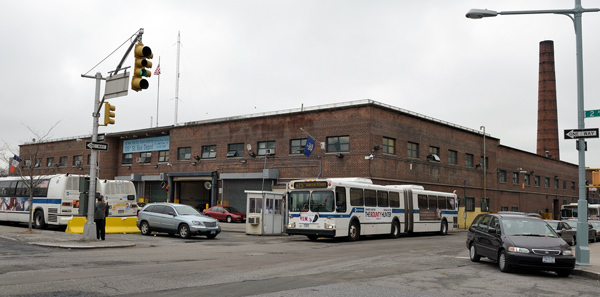
This bus depot, which is set for expansion, sits atop an old burial ground.
Efforts to preserve a pre-colonial burial site on 126th Street near the East River bears some resemblance to the fight that forced a construction shut-down at the African Burial Ground downtown in 1993.
Unlike the African Burial Ground in Lower Manhattan, however – now a national monument – the African burial ground in Harlem contains no shiny plaques or national park rangers in uniform. At the Harlem site, there’s nothing to acknowledge it as the final resting place of slave and free African families buried there when Dutch settlers farmed upper Manhattan.
The only stone slab at the site is the concrete floor of the Metropolitan Transit Authority bus garage sitting on top of tons of fill mingled with human remains. The Harlem African Burial Ground Task Force – composed of church leaders, activists, historians and elected officials – seeks preservation and official recognition of the colonial-era cemetery.
Church records show that free and enslaved Africans from all over Manhattan buried their dead in the cemetery of the Reformed Low Dutch Church, now Elmendorf Reformed Church, on First Avenue between 126th and 127th Streets. Researchers agree that beginning in the 17th century and ending in 1856, Africans buried their dead in what is now called East Harlem back when Harlem was farmland.
While the exact number buried there is not known, the task force is combing through relevant church records to piece together details about the site. In records already uncovered, several names have been found: Henry Blake, an unnamed child of the last name Blake, Israel Williams and Mary Elizabeth Ferguson.
But most had forgotten the burial ground, apart from Elmendorf Church archivists, until 2008 when it was brought back into public discourse as the Department of Transportation began work on the Willis Avenue Bridge just east of where historical maps suggest the burial ground is located. In 2015, the MTA also plans to expand the bus depot that now sits on top of the burial ground. Task force members say that the agencies have not been in communication with them about the plans.
Eric Tait, Jr., vice president of the Harlem Preservation Foundation and a member of the Harlem African Burial Ground Task Force, feels a bit of uncomfortable déjà vu. Tait is the creator of a documentary, “Then I’ll be Free to Travel Home,” about activists’ ultimately successful efforts to have memorials created for the African Burial Ground in Lower Manhattan.
Now, Tait fears those lessons are not being applied uptown. “Unfortunately the MTA and DOT seem determined not to learn from the 13-year battle our community fought in lower Manhattan beginning in 1991. That long, bitter struggle was a direct result of the General Services Administration’s federal bureaucracy and not having any persons of color or any concerned GSA person who would take seriously the cultural and historical significance of that African burial ground,” he said.
At a public hearing at the Elmendorf Reformed Church on March 19 – hosted by State Senators Bill Perkins and Jose Serrano, whose districts both include East Harlem – that’s not how transportation officials described their work.
DOT Manhattan Borough Commissioner Margaret Forgione testified at the hearing and brought along an engineer and an archaeologist. “The department takes the presence of any historical or cultural resource in or near the bridge work very seriously,” said Forgione. “We’ve been working with an archaeological firm for the past 10 years to help us understand the African burial site and to monitor excavation. Because the area where the bridge work is being done was under water when the cemetery was in operation and because it was excavated many times since, we believe it is highly unlikely that there are human remains or cultural artifacts in the area of our construction zone,” said Forgione, who noted that no human remains have been found by DOT workers.
Representatives from Historical Perspectives, the archaeology firm hired by DOT, presented a timeline, background information and several historical maps that indicate the location of the cemetery is outside of the boundaries of construction work under way for the Willis Avenue Bridge. When asked by Senator Perkins how far away the construction zone is from the accepted eastern boundary of the burial ground, Forgione said she would have to get back to him with an exact measurement.
MTA government affairs director Hilary Ring reminded hearing attendees that the burial ground was originally paved over, not by the MTA, but by the Third Avenue Railway in 1947 to house trolley cars. “Construction of the new 126th Street depot is currently planned between 2015 and 2019. Our preparatory work will include archaeological studies and the design of the new structure,” said Ring, who outlined the acronym-laced environmental assessment process associated with depot construction.
Rev. Patricia A. Singletary, Elmendorf’s pastor and a leader within the Harlem African Burial Ground Task Force, would like to see the burial ground undisturbed and a cultural center on or near the site created.
“We recognize that both the Department of Transportation and the Metropolitan Transportation (MTA) are attempting to meet complicated transportation needs of the city. However, we are certain that both agencies can meet these needs without violating this sacred site or ignoring the community’s significant place in American history,” Singletary said.
The New York State Historic Preservation Office recently recommended that the 350-year-old Elmendorf Church (now located on 121st Street) be placed on the state and national registers of historic places. The burial ground was not included in the recommendation.
Task force members ultimately plan to seek historic designation for the burial ground as well as the construction of a museum or cultural center exhibiting documents and artifacts from Harlem’s colonial days.
“This burial ground is significant on many different levels,” Sen. Serrano said at the start of the hearing. “If we have a proper commemoration, it will serve as an inspiration for the local residents and as an educational landmark for our youth in this community.”