

Photo by: Eileen Markey
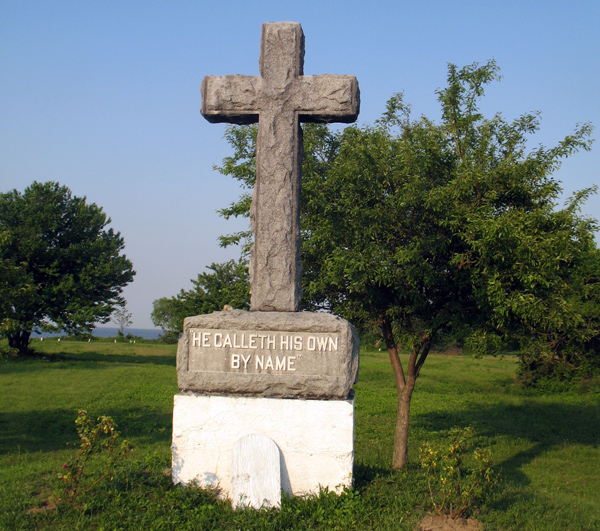
Photographed a few years ago, this monument on Hart Island memorializes its indigent dead.
The spring sun shines on the glassy surface of Long Island Sound as a handful of people make their way from City Island in the Bronx to Hart Island. Their mission is to honor those whose final resting place is on this one-mile stretch of land. This is where the city’s unclaimed dead are buried.
Each year close to 1,400 people are laid to rest on this quiet, wind-swept island. They are the city’s homeless, indigent and unknown. If families cannot afford to bury a loved one, the city inters that person on Hart Island. Or if a body can’t be identified, and the person’s identity can’t be determined by fingerprint records, the deceased find their final repose on the island among the seagulls and geese, beside the crumbling ruins of a 19th century hospital.
For the past three years, members and supporters of Picture the Homeless, a homeless rights organization, have been ferried out to the island every two months to hold memorial services for those buried here. They come in recognition of the human dignity of men, women, and children whom others may see as simply paupers or unfortunate souls united communally in death and misery.
“This is about the spiritual care of homeless people,” said Owen Rogers, a member of the group. “These are people who in life were disrespected, abused, pushed aside. We’re pushing for them to be cared for, respected, in death.”
So on the third Thursday of every other month, Rogers rises early and makes his way to the Bronx, riding the Number 6 train to Pelham Parkway, then boarding a bus to City Island. A brief walk later he is on a ferry dock controlled by the City of New York Department of Correction (DOC), facing an open expanse of water and the final resting place of the city’s poorest. “These are my people. That’s what I think when I am on the island. I am surrounded by people I know but don’t know their names. They are part of my community,” Rogers said.
Hart Island has been a potter’s field since 1869. The correction department says 750,000 people are buried there.
Riker’s Island inmates are transported there several days a week to dig graves and perform burials. Because the island is under DOC control, with security concerns paramount, the burial site is closed to the public. But Picture the Homeless launched a successful campaign for regular access to the island in 2006, and now members visit along with clergy from the Interfaith Assembly on Homelessness and Housing.
Once on the dock the visiting group is met by a DOC public liaison, who rides the ferry with them to Hart Island. On the other side they are met by DOC Capt. Martin Thompson, who maintains the island and burial ground. Small stone statues of angels line the walkway from the ferry dock. For Kym McNair, an associate minister at Antioch Baptist Church in Bedford Hills, N.Y., and a fellow at Poverty Initiative, a program at Union Theological Seminary, visiting Hart Island is an important ministry.
“We can’t forget people, especially people who were forgotten in life,” she said, reminding the group that burying the dead and remembering them is one of the earliest marks of civilization.
The graceful arch of the Throgs Neck bridge and the silvery skyline of Manhattan loom in silence across the water. The only sounds are the crunch of gravel underfoot and the cry of birds nesting in the tall grasses.
“This isn’t a bad place,” Thompson said. “We take this work very seriously. It’s solemn. We’re putting people to their final rest.”
The group – McNair, Rogers, a seminary student and this observer – gathers at a wooden gazebo beside a monument commemorating the dead and Rogers speaks. “We are always looking for a goodbye. We recognize that in God’s name these are our brothers and sisters. That’s what calls us to be here,” he said. “There is an uneasy peace to this place. It’s not an easy life or an easy death that brought them here.”
After a few moments of silent reflection the group returns to the ferry dock. They haven’t walked among the rows of marble posts marking the communal burial plots that occupy the center third of the island. On this day, Thompson said, there is too much debris from a recent storm to venture through the fields. Still, they pay their respects to some of the city’s most marginalized citizens.
Once back on City Island the group talks about future goals. “I’d like corrections to start allowing church groups to come and mourn and grieve,” said Rogers.
He would like to see chaplains or other clergy present when people are buried. A DOC spokesman said the department tries to work with family members who want to visit loved ones and religious or other groups who want to honor those who rest in the island’s uneasy peace.
“The ideal would be to see the island become less of a prison for the dead,” Rogers said.