


Photo by: Alice Proujansky
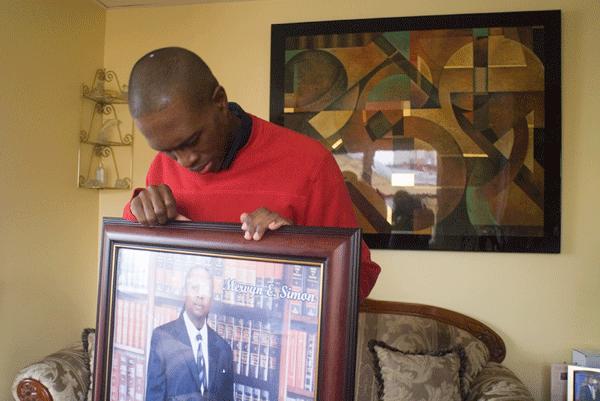
Simon stood for a Mother’s Day photo shoot at Kings Plaza Mall in Brooklyn a few years ago, when he was about 45. Here Curtis Stephen admires the photo. “He loved his dreadlocks,” Stephen said.
For the island of Jamaica, the year 1976 marked one of the darkest chapters in history. With politically-fueled violence, high inflation and record unemployment, Jamaica appeared on the brink of unending social anarchy.
No one was immune from the chaos. Days before headlining a unity-themed concert dubbed “Smile Jamaica,” reggae legend Bob Marley was shot and wounded inside his home by unknown gunmen. Soon after the incident, Marley granted a television interview where he appeared—as he so often was—in a philosophical state of mind. “My life is no important to me,” he said dismissively. “I think life [is] important. My life is only important if [I] can help plenty people … My life is the people.”
I was reminded of those spirited sentiments in early December as I presided over the memorial service held in Brooklyn for my brother, Mervyn E. Simon, after he died unexpectedly at the age of 49. As the eldest of my mother’s seven sons, Mervyn naturally fussed over us all. In my own life, he was a constant, steady and influential presence. But as I observed the hundreds of mourners who assembled to pay respects to my brother, I took solace in the most poignant lesson from his life. He was not a politician, nor was he ever an officially recognized activist, but he showed that one person truly can make a difference in the lives of others while also impacting a community-at-large.
My brother’s sense of public service was fostered at an early age. Born to Margaret Stephen and Christopher Simon, Mervyn had a humble upbringing in Trinidad during the 1960s and early ’70s. In the northeastern town of Manzanilla, he was raised in a tight-knit community where people looked out for one another. But those were also fast-changing times. Set against the backdrop of the American civil rights movement—and the subsequent Black Power era—it was also a period steeped in revolutionary fervor, as Trinidad, along with scores of other Caribbean islands, basked in the glow of independence.
Mervyn soaked in as much of the era as he could through adolescent eyes. Years later, he spoke often and passionately about how the heady period shaped his identity and reinforced his sense of confidence when he emigrated to the United States with our mother in the mid-1970s. They were part of an historic wave of new arrivals who benefited from landmark federal legislation enacted a decade earlier. The Immigration and Nationality Act of 1965 eliminated the national quota system and sparked a dramatic rise in the number of immigrants from non-European countries.
Mom and Mervyn’s first destination was Silver Spring, Maryland, where she labored long and hard as a domestic worker. But after visiting friends of the family in New York, Mervyn instantly fell in love with the pulse of Brooklyn and—after much pleading—convinced our mother to move. But the city they found in the late 1970s was caught in the throes of a debilitating financial crisis. Still, like generations of immigrants before them, Mervyn and our mother charged ahead.
As a teenager adjusting to his newly adopted home, Mervyn learned a valuable lesson—namely, how to navigate multiple worlds while staying true to himself. Despite the broadening appeal of Caribbean musicians like Marley and the legendary calypsonian, The Mighty Sparrow, being a West Indian teenager in ’70s-era New York brought its share of alienation and stigmatization. But Mervyn used his sharp wit, keen observational skills and an insatiable curiosity to make lifelong friends, defuse tensions, and forge connections with people from all walks of life. He saw diversity as a path to personal and spiritual development, excitedly quoting whatever new foreign phrase that he picked up along the way.
While attending George W. Wingate High School, Mervyn contributed to the household by working at a public library in Crown Heights. In his spare-time—when he wasn’t playing soccer—he took the initiative to use the library’s resources to study New York’s history, politics and institutions. Mervyn eventually made history of his own in 1985 as the first person in our family to graduate from college, earning a bachelor’s degree at New York Institute of Technology.
As the first-born, Mervyn regularly pitched in by watching over his younger siblings. For me and my brother Michael, having him as our guardian while growing up in the 1980s was quite an experience. Unlike an overprotective drill sergeant and more like an advice-dispensing mentor, Mervyn sought to instill discipline as he carefully weighed our endless pleas for sugary breakfast cereals, Nintendo video game playing-time and “hang-out” sessions on the streets of East Flatbush. Often, he would balance those executive decisions by helping us reason through the consequences of our choices.
In short, he challenged us. That’s because he knew precisely what was happening outside our two-bedroom apartment in those days. It was the height of the crack epidemic. Between the late 1980s and early ’90s, there were some 2,000 murders annually in New York City. As I walked to my junior high school at the time, it was impossible to cast my eyes away from the many crack vials that littered the sidewalks. Fortunately for me, Mervyn’s guiding influence and colorful stories about lessons learned on those same streets helped to steer me away from drugs and gangs.
Similarly, Mervyn provided further direction after I announced plans to pursue journalism at the age of 12. Without any real knowledge about what the profession entailed, I quickly gained a lot of insight thanks to my brother, who firmly believed that learning should transcend an seven-hour school day. As a result, my classwork was supplemented with lessons from what can best be described as the Mervyn E. Simon School of Social Justice.
We took field trips to the once-venerable Liberation Bookstore in Harlem as well as the Slave Theater in Bedford-Stuyvesant, which regularly hosted guest-speakers from independent media outlets. Fostering a love for books, Mervyn gave me his copy of The Autobiography of Malcolm X along with other works by historians like J.A. Rogers and John Henrik Clarke. The book collection—which we later expanded to include titles on everything from the Great Depression and the Vietnam War to Watergate—brought perspective, while perfectly complementing my high school studies. We also regularly watched TV news broadcasts along with socially-themed episodes of “Donahue,” and listened to talk shows on the radio station, WLIB (1190 AM).
But just as Mervyn was opening my eyes to the world around me, I was gaining a stronger appreciation of what he meant to countless others beyond my family. For more than 20 years, he worked as an engineer for the city’s Department of Environmental Protection (DEP). It was a job that he thoroughly enjoyed, allowing him to travel across the five boroughs to inspect the boilers of public, commercial and residential buildings to ensure compliance with city regulations. Mervyn always had a sense of adventure about the job and made the most of it with enthusiasm and a high degree of professional integrity.
Inside the city’s West Indian community, collective enterprise is deeply valued. It’s an ideology that manifests itself, for example, with “susu,” the African-derived microfinance system in which participants pool their money and distribute it among themselves. Yet Mervyn had an entirely different role as a local ambassador, of sorts. He sympathized deeply with the city’s immigrant experience because he knew it firsthand. In fact, he often sang to himself the refrain from Sting’s hit ’80s song “Englishman In New York” (“Be yourself, no matter what they say.”).
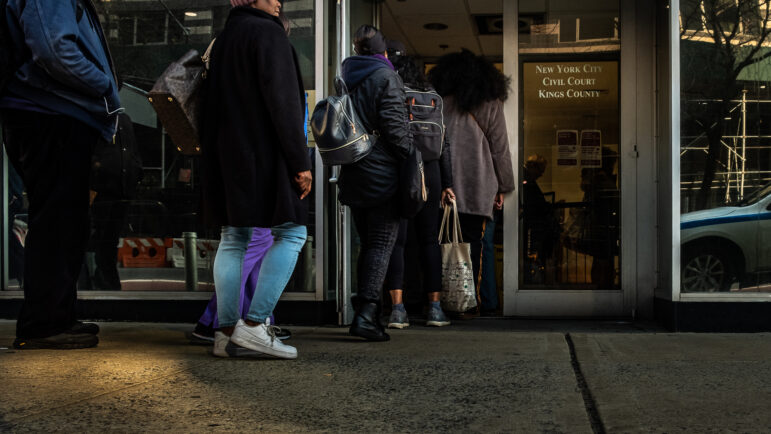
Despite his personal success, Mervyn never forgot his humble roots. And so, if you needed a job, he’d bend as many ears as possible until you landed one. If you were hungry, he bought food from the many bakeries and restaurants along Nostrand Avenue. If you were behind on the rent, he’d provide what he described as “pocket change.” And he’d also attend housing court to offer additional support. If your apartment lacked heat, he made the calls. If you were confused while navigating through the complex immigration process, Mervyn provided aid and counsel. And if you needed legal assistance or a letter for the parole board, he was similarly ready to help in some way.
Watching Mervyn perform this work was awe-inspiring. Not once did he ask for anything in return. On the streets of East Flatbush, Mervyn commanded respect and was often greeted like a rock star. This was quite apparent a couple years ago when a prominent elected official, who shall remain nameless, made a public appearance in the neighborhood. Mervyn and I watched how the politician, who despite his best efforts to be noticed, walked into a local discount store virtually unrecognized by residents despite his many years in office. Out of curiosity, Mervyn and I decided to follow him. Once inside, Mervyn was approached by so many patrons that it appeared as though he—and not the man who stood about ten feet away—was the veteran officeholder.
Mervyn was equally revered in Trinidad and visited his homeland annually. With similar passion, he celebrated New York’s West Indian experience. In doing so, he encouraged both newly arrived immigrants and longtime residents alike to recognize their role as a vital part of the city’s fabric. Anything less, he passionately argued, would result in them only being relevant during the annual Labor Day Parade.
By 2001, Mervyn’s strong community-based links and my budding journalism career would intersect. That year, he and one of his best friends, Owen Rezende, met with me to discuss Colin Warner—a Trinidadian immigrant who was wrongfully incarcerated for more than two decades in New York for a murder he didn’t commit. Owen, who knew Colin, showed me several letters written from prison. He also described the circumstances of the alarming case, which had just begun to receive news coverage. As the three of us met on the eve of Colin’s release, Mervyn suggested that I report on the case, placing greater emphasis on some of the pitfalls within New York’s criminal justice system..
Initially, I wondered if I was up to the task. I had only written my first story for City Limits—about a bookstore—months earlier. And I was a fairly recent graduate of Long Island University. But Alyssa Katz, then-editor of City Limits, took a leap of faith on me and the story. Over the course of eight months, I reported on Colin’s case—culminating in the investigative piece that we produced. After that, Mervyn served as a valued adviser for every single article I wrote.
Mervyn’s sudden passing has left an enormous void in our family. He leaves behind a wife, one son, a granddaughter, many nieces and nephews, and legions of loyal friends. In life he took his many responsibilities seriously, but never himself. He always maintained a healthy perspective about life and death—telling me often over the years, much to my consternation given his youth and vigor, that I would someday recite the eulogy at his funeral. For many years inside his apartment, he had a prominently displayed sign marked: “Put Aside Your Pride, Set Down Your Arrogance, and Remember Your Grave.” Ultimately, Mervyn believed that our lives should be defined by our deeds.
It was virtually impossible to ever find my brother worrying about himself. But one afternoon about a year ago, he briefly engaged in a rare bit of fretting. As we discussed life after DEP, he wondered about his next move. “I guess I can finally get that law school degree,” he said. We then joked about the name of his future firm (“Rasta Man Associates”). But he didn’t need the degree. After all, he was perfectly suited for the job he always had in East Flatbush—working class hero.





2 thoughts on “Homage For A Working Class Hero”
Well written my family. An Mervyn will say hold it down..
Nice article! Thank you for sharing