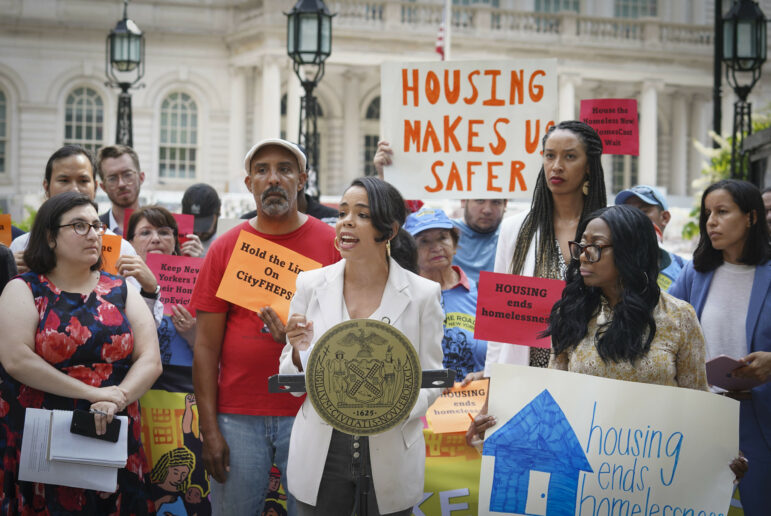


During a meeting of the New York City Central Labor Council late last year, union leader Barbara Bowen congratulated a coalition of service-industry unions and community groups for pushing the City Council to defeat the Bloomberg administration’s redevelopment plan for the Kingsbridge Armory.
Bowen’s congratulatory words were met with derision from representatives of the building trades unions, whose members would have found work on the large-scale development project.
While the project would have eventually created retail jobs in the proposed mall, the developer, The Related Companies, refused to promise that the workers would make more than $10 per hour—the wage guarantee that neighborhood groups and their allies in organized labor demanded for upwards of 1,000 workers who would eventually be employed at the new mall. The Council voted the proposal down in December and a week later overrode a veto of that decision by Mayor Bloomberg.
Bowen, president of the Professional Staff Congress, which is the union for faculty members at City University of New York, interpreted Kingsbridge as a decisive win. But not everyone in labor saw it that way.
The opposing views illustrate a breakdown of traditional union solidarity: Two factions of organized labor — both claiming to be looking out for the best interests of working people — ended up butting heads over job-producing development projects in the city. The result is a portrait of one set of workers — mainly white, male and middle class — pitted against another set that is largely working poor women of color.
Now the unions are waiting to see whether the next development project opens the rift further. Much could depend on the economy: The lack of work during the recession (construction employment in the five boroughs in January was 16 percent lower than two years earlier) exacerbated tensions between unions.
Kate Bronfenbrenner, a professor at the School for Industrial and Labor Relations at Cornell University, says this rift in labor is an old one.
One problem in bridging the gap, Bronfenbrenner noted, is that building trades unions are more fragmented than they used to be. Most, like the Ironworkers, are in the AFL-CIO. But the Laborers and Teamsters are in the five-member Charge To Win coalition, which also consists of two unions that are known for pushing prevailing wage laws—the SEIU and the United Food and Commercial Workers. The Carpenters are an independent union.
“It’s hard to get them pressured as a group, which makes it harder to get that kind of solidarity,” Bronfenbrenner says.
Bloomberg’s mayoralty has seen a hardening of some of the divisions. Many private-sector unions supported his candidacy for a third term based on his record of promoting development, while public sector unions lined up behind his opponent William Thompson, figuring that he would be a better mayor to collectively bargain with.
In the battle over Kingsbridge, the mayor said the city was in no position to impose wage burdens on businesses. City Hall claimed concern about setting a precedent that would discourage developers’ investments.
Bill Hohlfeld, an official at Local 46 of the Ironworkers, says that the building trades unions are misunderstood and unfairly maligned on this issue. He notes that those unions did push for a living-wage provision on the Kingsbridge project, but adds that the leadership is ultimately accountable to its membership, meaning that unions wouldn’t turn down jobs, with or without the wage provision.
“We’re not going to refuse to build it,” he says. “The building trades gave a tremendous amount of support for [the living-wage mandate] for a very long time.”
And Stuart Appelbaum, president of the Retail, Wholesale and Department Store Union (RWDSU)—which fought for higher wages at Kingsbridge— says he understood the building trades’ point of view.
“There were a number building trades who were supportive of [the living wage] publically and privately but I also understand how bad it is in lots of sections of the economy,” he says. “Unemployment there is outrageous. People want jobs. People are worried.”
Indeed, during Council hearings on the Kingsbridge plan, building trade union leaders lamented the divisions over the plan and the lack of a citywide wage standard for developments built with public subsidies, as some cities—including Los Angeles—have.
Joshua Freeman, a professor of history at the City University of New York Graduate Center and labor expert, says that the two sides didn’t necessarily have irreconcilable differences. In the case of Kingsbridge, he noted, unions like the RWDSU were in favor of the project as long as there was a living-wage mandate.
“I think it’s not impossible that there might be the best of all worlds,” Freeman said. “If the Mayor had gone along with a living wage and other stipulations both sectors of the labor movement would have been happy.”
Some new development sites have union consensus; the service unions and the Central Labor Council heralded the Willet’s Point plan as a good-jobs project.
The City Council is considering a bill that would require wages comparable to those paid to union members for non-union building service workers at developments built with city funds. In response, the Bloomberg administration is commissioning a study of the impact of living wage rules.
With economic recovery only starting to take hold, job creation for both construction workers and retail workers may depend on new development, and both Hohlfeld and Appelbaum believe that unions could overcome the schism, although there is not talk of a more robust living-wage campaign in the city.
For Hohlfeld, that will mean the rest of the labor movement realizing how important it is for his sector that developments be built union. “We need to foster some mutual respect,” he says.
“At the end of the day there is a hell of lot more that unites us than divides us,” Appelbaum says.