

Photo by: Spencer T. Tucker, courtesy of City Hall
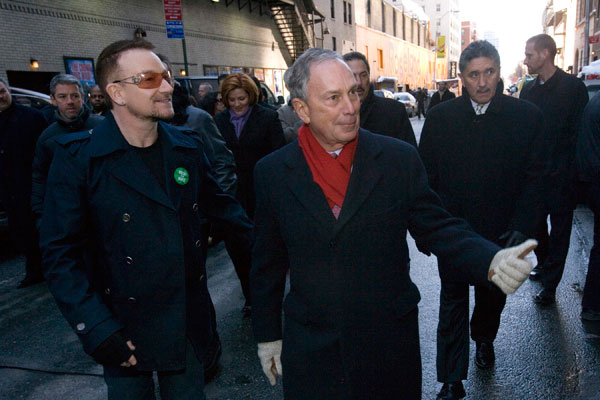
U2’s Bono has called Mayor Bloomberg “a fellow combatant in the fight against extreme poverty and disease.” The centerpiece of the mayor’s poverty program achieved mixed results.
When Mayor Bloomberg announced in 2007 that he was launching a pilot program to give cash incentives to poor New Yorkers for changing their behavior—including bonuses for such activities as attending parent-teacher conferences and holding down a job—the hope was to come up with a novel approach to ending poverty.
“Even though it turns my stomach to pay a mother $10 to see a doctor,” Chinese-American Planning Council executive director David Chen, a member of Bloomberg’s poverty commission, told City Limits at the time, “in a practical sense it works.”
Or maybe not. MDRC, the research group hired by the city to evaluate Opportunity NYC (funded, like the rest of the project, with private donations), issued its preliminary report on March 30, two-and-a-half years into the experimental “conditional cash transfer” program. And while Bloomberg chose to highlight the program’s successes—a mayoral press release bragged that the program “has reduced poverty by 11 percentage points, and improved a number of health and education outcomes”—MDRC’s conclusions were less rose-colored.
Though the results show that the “concept is feasible to implement and can make a difference in the lives of poor families,” the researchers wrote, “the effects that have been observed so far are generally not large, and, so far, the program has not improved educational outcomes for elementary and middle school children.”
When city officials followed up by saying that they do not plan to continue the program once it expires after this year, headlines rang out across the country declaring the experiment a failure.
So what went wrong? From one perspective, nothing. Mayoral spokesperson Jessica Scaperotti notes that Opportunity NYC was always intended to be a pilot program that would end after three years. “We learned some things work, and we learned some things didn’t,” she says. “And that’s exactly what we set out to do.”
The goal of pilot programs, though, is to find promising strategies that can be expanded into new permanent policies. And on that score, Opportunity NYC’s results have to be considered disappointingly inconclusive.
The model for New York’s conditional cash transfer program was Oportunidades, Mexico’s large-scale cash assistance program that drew international attention for offering welfare payments with strings attached: Cash was handed out to poor families for specific behaviors deemed worthwhile, like having regular medical checkups and keeping their kids in school. The results were dramatic—poverty fell, and overall health improved. But because Mexico had no widespread welfare system in place beforehand, it was hard to say whether this was because of the incentives, or merely because the government had started giving poor Mexicans money.
In New York City, that wouldn’t be a problem. In addition, to help further refine the results, Opportunity NYC program was designed with a control group. The 4,800 families applying for the program were randomly assigned to one group or the other, and only half received incentive payments. Both were then tracked to see how their relative outcomes differed.
The most striking positive effect was in families’ financial well-being. Of the families receiving cash rewards, after one year 58.9 percent reported having income below the federal poverty line, and 16.7 percent below half the poverty line (so-called “deep” poverty); the corresponding numbers for the control group were 70.0 percent and 30 percent. However, most of this was because of the payments themselves: Of the average income gain of $338 per month, $258 came straight from cash rewards for meeting program goals. (Among the rewards offered: $200 for a doctor’s visit, $25 for a parent-teacher conference, and $150 for holding down a full-time job for a month.)
Meanwhile, unemployment insurance records for Opportunity NYC participants who received cash rewards actually showed less official wage income. Self-reporting, however, showed wage income remaining steady. MDRC lead researcher Jim Riccio speculates that people may have done more self-employed or off-the-books work (he mentions home hair-braiding as an example), though “we tried very hard not to pay the bonus if you couldn’t produce evidence that you were working in a tax-covered job.”
As for encouraging good behaviors, the results were scattered. After a year of participating in the program, more families who received cash rewards had bank accounts (73.3 percent to 51.8 percent), and fewer had gone a year without seeing a dentist (14.0 percent to 17.0 percent) or used hospital emergency rooms for routine care (from 5.3 percent to 3.3 percent). Other measures, like having health insurance and getting a health checkup, showed no statistically significant changes.
Schoolchildren’s grades and attendance, meanwhile, were largely unchanged—though more kids did get library cards, something that earned a $50 reward. More couples were married than in the control group, but more also were divorced; MDRC speculated that “one possibility is that the increased financial stability that some parents experienced made them feel better positioned to change their marital status.”
Opportunity NYC was one of the centerpieces of Bloomberg’s anti-poverty efforts, announced with much fanfare back in 2006. Most of the reported results so far have been of the “too soon to tell” variety; The most recent available Census statistics show that the city poverty rate fell slightly in 2008, from 18.5 percent to 18.2 percent, though it’s impossible to say how much of that can be attributed to Bloomberg’s policies and how much to the tail end of the pre-recession economy.
The “spotty and sporadic” results of Opportunity NYC should have come as no surprise, says Drum Major Institute executive director Mark Winston Griffith, who’s been openly critical of the program from its inception: “Whether you’re rich, middle class, poor—if any of us is told that we get more money by doing something, I think that everyone would probably respond on some level.” While Griffith lauds Bloomberg for at least putting poverty on his mayoral agenda, he’s not sorry to see the cash transfer program bite the dust: “To me, it’s just another twist on the idea that poor people just need a kick in the pants. These are folks who are struggling anyway. To dangle a carrot in front of them, instead of investing in them, is a little twisted.”
Though Opportunity NYC ends in September, the data gathering will continue: Last month’s MDRC report didn’t even have full data for the second year, and tracking will continue for two years after families have left the program. (MDRC doesn’t plan to release its next comprehensive report for “a couple of years,” says Riccio, though there may be interim memos in the meantime.)
“I think that as families learn more about the offer, and about what they might be able to do to earn the rewards, and make adaptations in their lives to take advantage of them, you might see a bigger response,” Riccio says. “I mean, that’s a hypothesis—we have no idea.”
If so, there’s a chance that conditional cash transfers could be revived: Scaperotti says that the mayor’s Center on Economic Opportunities, “in partnership with MDRC and several other cities, is considering a second-generation pilot program, which would be informed by lessons learned to date.” However, she adds, any such effort would focus on whether such a program could “succeed in other locations”—meaning that if Bloomberg’s grand experiment is to continue, it will likely be on some other city’s watch.