

Photo by: Lizzie Ford-Madrid
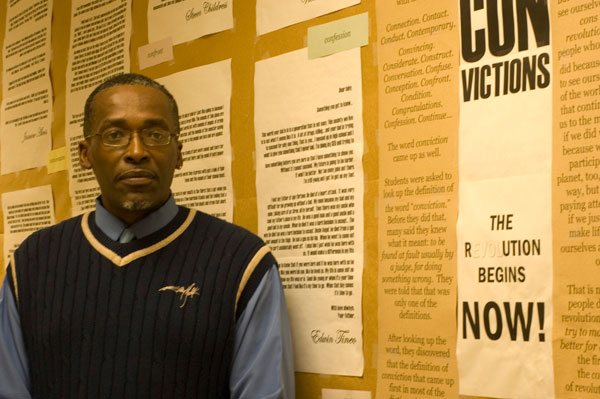
George Jones survived unemployment with help from family and—only very recently—food stamps. “I don’t know how I did it,” he says.
In March, as the national unemployment rate remained at 9.7 percent for the third straight month, the rate for black men rose to 20.2 This month’s edition of City Limits magazine presents a comprehensive investigation of the causes, consequences and political controversy of black make joblessness. In this web extra, we look at how black men and families are surviving the economic crisis.
Leaning up against the outside of a deli on Convent Avenue near 127th Street in Harlem in January, Carl Allen says, “A lot of people I know, they lost jobs.” And to make ends meet, he says, “A lot of people I know, they doing the wrong thing.”
The dramatic increase in black unemployment, especially among men, during the recession—and the longer-term problem of persistent black joblessness, involving people who have fallen out of the labor force altogether—raises the question: How are black families surviving?
Some are probably doing, as Allen calls it, “the wrong thing,” meaning they have turned to crime. The economic downturn, which obviously affects more than the black community, may have triggered a recent spike in offenses: Several categories of major felony crime (murder, rape, felony assault and burglary) are up so far this year, although the big property crimes (robbery, grand larceny and auto theft) are down slightly. Drug arrests were up a modest 3 percent in 2009 over 2008. It’s unknown, of course, how many of the perpetrators are unemployed black men. Maria Ortiz, director of training at the East Harlem employment agency STRIVE, says her young, mostly men-of-color clientele survive life without jobs through some combination of “jail, shelter, shuttling between relatives, selling drugs.”
The social safety net helps many—but not as many as one might think. Only about two-thirds of unemployed New Yorkers receive unemployment insurance benefits. The city’s unemployed population increased by 86 percent from December 2006 to December 2010, but its welfare caseload decreased by about 6 percent over the same period, so cash assistance can hardly be keeping up with need.
Food stamp usage, however, is up 50 percent over the same period. Nine of ten food pantries in the city reported an increase in first-time clients in 2009. The federal stimulus bill included hundreds of billions of dollars in funding for extended unemployment benefits and other safety net measures.
For many black men, families are often the safety net. Andrew Salmond, a college graduate, had a successful contracting business, but when customers stopped paying him it collapsed. He moved his wife and children in with relatives in Brooklyn. “It’s temporary—six months max,” he says. George Jones, a trained cook whose own catering business suffered in the recession and who’s had a hard time getting hired elsewhere because of a prison record, says he only recently applied for food stamps, having previously relied on an extensive support network. “I don’t know how I did it,” he says.
The support network is different for everyone. “Family can be a downfall for someone of my caliber,” says Edward Bennett, an ex-offender. “Siblings, they’re used to knowing that you’re the bad guy.” He recently stopped sleeping on a relative’s couch because she was pressing him for money. His support, instead, has come from two female friends.
For black families, however, providing that support has costs. Economist Darrick Hamilton of The Milano School has estimated that up to 27 percent of the difference between black and white poverty is explained by black people having other poor people in their family; in other words, black families bear the additional burden of helping kin who are out of work.
Some unemployed people of color actually work—but their jobs are in the shadow economy. They do handiwork, cut hair in the kitchen or run an informal childcare in the living room—as well as work in traditional businesses, but for untraditional wages.
“Part of it is people opening their own business, doing child care, and I think part of it is people working off the books,” says Annette Bernhardt, policy co-director of the National Employment Law Project. It’s not a new phenomenon: Even during the recent boom, many New Yorkers, she says, “had to supplement their wages with off-the-books work” to pay the rent.
Black men who work as security guards, in car washes, doing building maintenance in non-union buildings uptown, parking cars or carrying messages often work invisibly, as far as unemployment statistics, labor laws and taxes are concerned. According to the Fiscal Policy Institute, a third of New York City’s residential construction workers are underground.
Low wages might be better than nothing. But Bernhardt points out that underground jobs have the potential to drag whole neighborhoods down. “It creates an economy of demand on its own,” she says, because people earning below the minimum wage eventually are able only to support neighborhood businesses that, to keep their products cheap, must pay their workers off the books as well. It’s a vicious cycle.
Steven Pitts—a labor economist at the University of California, Berkeley—says one way for government to respond to the twin crises of high black joblessness and low black wages is to find a way to bring people from the shadow economy into the light of formal employment. “How do you [create a] legal form of informal work?” is the key question, Pitts says. “How do you find other ways to organize [informal work] so it’s better for the workers themselves?” Perhaps it means gathering child-care providers into co-ops that can share space and advertising costs. Maybe it entails giving underground mechanics and handymen space to work.
For the government, at least, the incentives are already there. The IRS estimates that the federal government loses $195 billion in tax revenue each year because of unreported income, some of it in the form of underground wages.
The presence of men of color in the informal economy suggests that a willingness to work is not the problem these men face. Edwin Rodriguez, an ex-offender raising a two-year-old with his wife, collects scrap metal and does odd jobs to pay the bills. He eats some meals at soup kitchens. “I won’t bring my family to a shelter,” he says. When City Limits met him in March at the Center for Employment Opportunities in Manhattan, rent on his family’s small room was due—a bill for $600.
Says Rodriguez: “That’s a lot of scrap metal.”