


Photo by: Colin Lenton
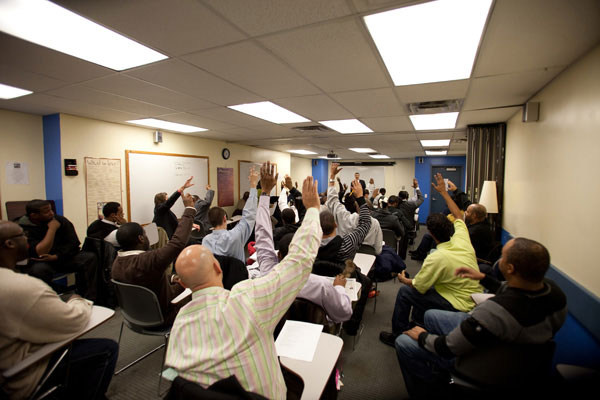
Students at STRIVE in East Harlem, one of several organizations around the city working to place jobless men in work or training.
In March, as the national unemployment rate remained at 9.7 percent for the third straight month, the rate for black men rose to 20.2 The May edition of City Limits magazine presents a comprehensive investigation of the causes, consequences and political controversy of black make joblessness. In this web extra, we look at how some organizations in New York are attacking the problem one client at a time.
Amid alarm over high black male unemployment in New York City and elsewhere, it’s easy to forget that most black men are in the labor force and have jobs, that most have never been to prison, have graduated high school and are not poor. It’s not that most black men are disconnected from the workforce—just that too many are.
Nor is black joblessness being ignored by social service providers. While policymakers and politicians debate how to respond to the national phenomenon, several nonprofit agencies on the ground in New York City are assisting individual black men—and other men of color—in their struggle to find work.
In East Harlem, STRIVE is teaching civics and “soft skills” to out-of-work people, mostly young men of color, many of whom were previously in prison or on welfare. In the shadow of the Queensborough Bridge, The Fortune Society pairs formerly incarcerated men with career development coaches to help them navigate the difficult path from prison to employment. And the Center for Employment Opportunities (CEO), in Lower Manhattan, places ex-offenders in transitional jobs, while they search for private sector employment.
Each organization comes to the problem with a different history and approach.
CEO was launched by its current executive director, Mindy Tarlow, as a subsidiary of the Vera Institute of Justice in 1994. Its philosophy is that intervening immediately after someone is released from incarceration is crucial; getting them into a program and a job quickly is key to preventing their return to jail or prison.
CEO brings ex-offenders in for pre-employment training (tips on workplace demeanor and interviewing), puts them in transitional jobs doing maintenance and repair work, sends them on interviews for private sector work and then offers guidance and incentives—like movie tickets and bonuses—as clients move through their first months in the workforce. In fiscal year 2008, CEO had a budget of $14.1 million and placed 1,223 people in jobs.
Rob Carmona founded STRIVE 25 years ago in the basement of a housing project. Now based on 123rd Street, the program serves a wider clientele than CEO or Fortune, which focus solely on ex-offenders. With a 2008 budget of $3.9 million, STRIVE accepted 1,300 students in 2009 for its month-long “core” class, which teaches workplace conduct and interviewing skills, but also mixes in civics lessons about civil rights figures like Emmett Till and Malcolm X. The point, says chief operating officer Angelo Rivera, is to give some historical context to the situation young black men and other clients find themselves in, so they say to themselves, “Now I know why I’m so pissed off!”
Some graduates of STRIVE move from the core program to a green construction training program.
The Fortune Society traces its origin to a play about prison life that a Broadway press agent, David Rothenberg, used his life savings to produce in 1966. The show touched off spontaneous audience debates about prison life, and in order to support a longer-lasting conversation—and develop programs to help former inmates—Rothenberg founded the Fortune Society. It’s location at Queens Plaza is no accident; there, the bus from Rikers Island lets out several batches of released prisoners every day. The guys come off the bus telling each other to “stay strong.” But that’s tough to do.
With a budget of $15.3 million in 2008, the Fortune Society offers ex-inmates help in areas like housing, health, and education. Its career development program starts with a two-week job readiness course consisting of mock job interviews, followed by job placement assistance and sessions with a career counselor. Placing clients has grown harder in the past year, as the recession has rippled through New York’s economy, says career development manager Gyasi Headen. But it’s not impossible. “Our view,” Headen says, “is that everyone is employable if they knock on enough doors.” Keeping a job depends on knowing how one is to act in the workplace. For example, he says, “If it’s 4:59 and the boss asks you to stay, can you make that phone call: ‘Baby, I can’t tonight.’?”
The clients of all three organizations come from a variety of backgrounds.
There’s Edward Bennett, a 47-year-old who was due to graduate high school early but quit to help his drug-addicted mother and then developed a drug problem of his own that landed him in prison several times. He’s a client at CEO, along with Marvin Lassiter, who did a long stint in prison in his thirties for selling drugs, stayed out for seven years, then went away again because he allegedly stole Medicaid benefits. John Whitfield, who never touched drugs, was also at CEO; he was a cook, who served eight years after assaulting someone and then another year for a parole violation.
One February day at STRIVE, Andrew Salmond, a 31-year-old whose once-successful contracting business got torpedoed by the recession, came in to sign up for help. Also there was a young black women who was studying to be a fashion designer when a violent confrontation with her father forced her to leave home, a security guard who’d been laid off, a sometime drug dealer, a guy in his early 20s who’d been working since he was 14 but recently found himself unemployed and a licensed plumber with two decades experience who says she’d stopped getting hired.
Meanwhile, the Fortune Society helps guys like George Jones, a 47-year-old ex-Marine and trained cook (his specialty, raspberry-glazed duck) whose drug problem sent him behind bars more than once, and Jeffrey Harris, a 41-year-old who dropped out of high school to work to support his mother, started selling drugs and was repeatedly incarcerated.
The men don’t make excuses for themselves, and their hopes are as basic as they get. Harris pines for a building maintenance job: “I love doing manual labor. I love seeing the results of my work.” Lassiter, with five kids, isn’t picky. “Whatever job they give me,” he said. “I just want something to pay the bills, to be a people person, a team player.”
They all are running into trouble finding work—more trouble than they had after earlier stints in prison. When Lassiter was released in 1999, amid the economic boom of the ’90s, he could balk at $9 an hour and his employer would raise the wage. “Now, ” Lassiter said, mimicking a potential employer, “‘If you won’t do it, John will do it down the block.'”
Whitfield was also striking out when interviewed in early March. “They sent me out on four interviews. The first said sales are down 20 percent. They said they’d get back to me. That was in January. The second said they’d call me for a second interview. I have yet to hear from them,” he said. “The others said, ‘We’ve got to finish the interviews. You’re resume looks good. Hopefully, you’ll hear from us.’ I want to follow up but I don’t want to seem like I’m pestering.”
At least some of them draw on a reservoir of confidence. “I’m marketable. I’m able to communicate. I’ve a sound mind,” Bennett, who has three children in their 20s and 30s, says. As proof, he offered his past as a drug dealer . “I’m a sales rep by trade.” CEO has made him hopeful, he adds. “They give you the opportunity to feel like the man you can become.”
Others rely on insights they have obtained the hard way. Jones has lied about his criminal history on work applications, but had no luck anyway. “I always wore a suit and tie. That might not have been appropriate. People thought I was coming for their jobs,” he says. “I don’t try to come across as intimidating. I can’t help it that I’m 6’3″. But perception is everything.”
The lack of luck has forced Jones to rethink his plans. He recently realized that being a cook might not be what he’s meant to be. So he took a job with the Society. “Maybe this will be the start of my success story,” Jones says. “At 47, I’m finally starting my life.”
Private agencies are not alone in trying to help the jobless. New York’s 10 city-run Workforce1 centers aim to connect unemployed people with training and serve as a clearing house for private sector job openings. In 2008 and 2009, more than 215,000 people sought help at the centers and some 37,000 were placed in jobs, most of them full-time positions. Nearly half the people who sought help, and half of those placed, were black.
Each borough has at least one Workforce1 center. Three centers specialize in placing workers in specific industries: healthcare in Long Island City; manufacturing in Downtown Brooklyn; and transportation in Jamaica.