


Photo by: Colin Lenton
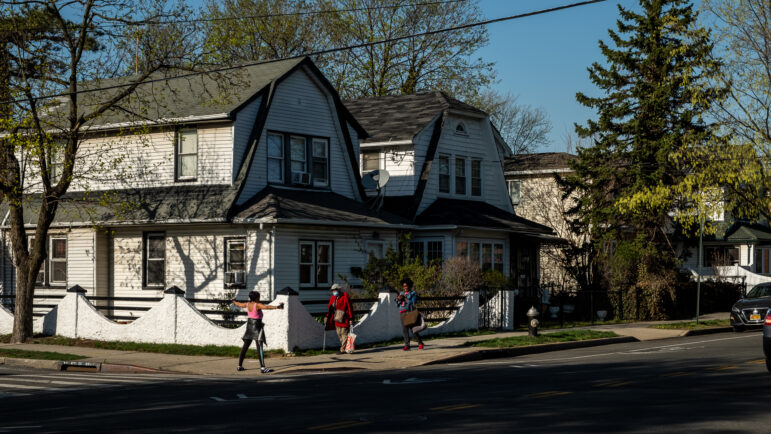
A house in southeast Queens, an area hard-hit by the foreclosure crisis.
Redlining is making a comeback.
That’s the warning issued in a new report that analyzed lending patterns before and after the subprime mortgage collapse. Although communities of color were flooded with often unaffordable, high interest mortgages and home equity loans in the first half of the decade, after 2007, lending in those communities fell off sharply.
“The financial crisis has led to significantly reduced access to mortgage credit for all borrowers and communities. In communities of color, however, where the foreclosure crisis has taken an especially severe toll, access to prime, conventional mortgage loans has declined precipitously,” the
report states.
Conducted by the Neighborhood Economic Development Advocacy Project and six partner organizations across the country, the study examined Home Mortgage Disclosure Act data in seven cities, including New York. For the five boroughs, it found that between 2006 and 2008 quality mortgage lending dropped 40 percent in communities where 80 percent or more of the residents were people of color. In neighborhoods where at least 90 percent of the residents were white, lending dropped too, but only 23 percent.
The discrepancy between which neighborhoods were able to refinance loans was even steeper: Refinance loans – the kinds homeowners might use to get out of an unaffordable mortgage – dropped by 68 percent in communities of color, compared to 39 percent in predominantly white communities.
That’s having a direct effect in neighborhoods like Bedford Stuyvesant and Jamaica that were hard hit by the wave of foreclosures that followed subprime lending. “The impact is that people right now who are really struggling with loans that were predatory are being denied the credit they need to make their homes affordable,” said Alexis Iwanisziw, program associate at NEDAP and one of the report’s authors. “We’ve seen a lot of people who could have sought a good, high quality refinance loan who are unable to qualify for them.”
The pattern was even starker among the nation’s four biggest bank holding companies, the ones that took massive bailouts from the federal government. Bank of America, Citigroup, JPMorgan Chase and Wells Fargo averaged a 32 percent increase in refinance lending in white communities in the seven cities from 2006 to 2008 and a 33 percent decrease in the same lending in communities of color, according to the report.In New York, refinance lending dropped for everyone, but the decrease was greater in communities of color: 61 percent compared to 52 percent.
For Iwanisziw, those dramatic discrepancies are worrying, because they seem to signal a return to the bad old days when neighborhoods of color were systematically denied credit. “It certainly appears to be the case that redlining is reemerging,” she said. “It’s a little hard to say because of credit scores and all the predatory lending happening before that destroyed people’s credit. Is it that banks are retrenching and returning to their original lending patterns that were based on redlining?”
Preliminary data on lending practices in 2009 suggests the same pattern of loans for white neighbors, but not for communities with larger percentages of black, Latino and Asian residents, Iwanisziw said.
A spokesperson for the American Banker’s Association said the association would need to read and analyze the report before it could comment.
The study’s major limitation is that it did not know the credit worthiness of people denied mortgages or refinance loans. It is possible that prime, conventional mortgages dropped so precipitously in communities of color because applicants had low credit scores and did not qualify for conventional mortgages. The study relies exclusively on data the federal government collects from all banks. That data does not include information on credit worthiness, said Iwanisziw.
During the run-up to the subprime meltdown, however, even African-American borrowers with excellent credit, who qualified for prime, conventional loans, were twice as likely as whites to end up in subprime or adjustable rate mortgages they couldn’t afford.
The report, called Paying More for the American Dream IV, recommends a variety of government actions, from the establishment of an independent consumer financial protection agency to an expansion of the Community Reinvestment Act to consider the race and ethnicity of borrowers and neighborhoods, not just income, when determining whether banks are in compliance with CRA lending rules.
The study also urges increased fair lending law enforcement at the U.S. Department of Justice and requiring banks to help restore the neighborhoods they destroyed with predatory mortgage products.
The Restoring Financial Stability Act, which would establish a consumer financial protection agency, is currently before congress. Banks are lobbying heavily against it. National People’s Action, a collection of grassroots organizations that was instrumental in fighting redlining a generation ago, is fighting hard for it.