


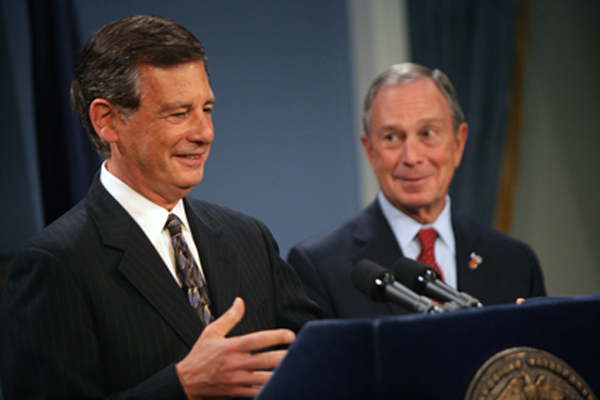
Photo by: Edward Reed/City Hall
Former Indianapolis Mayor Stephen Goldsmith, introduced at City Hall in April by Mayor Bloomberg, has written six books about governing and recently served as a professor at Harvard’s Kennedy School of Government.
When Mayor Bloomberg tapped former Indianapolis mayor Stephen Goldsmith in April to replace longtime aide Ed Skyler as the city’s new deputy mayor for operations, all the talk was about the new hire’s credentials as an innovator at remaking government through privatization. The Times called Goldsmith, a former two-term mayor of Indianapolis who officially started work at City Hall on June 1, “a national leader in the movement to introduce corporate-style accountability and cost-cutting into government bureaucracy.” Bloomberg enthused about his new hire, “Lots of people talk about reinventing government; I think it’s fair to say Steve has actually done that.”
According to some of those who saw Goldsmith’s work firsthand in Indianapolis, however, his record is mixed. The Indianapolis miracle, say many community and labor leaders, was less an indicator of the magic of privatization than of its limits.
Goldsmith was elected mayor in 1991 on a platform of privatizing city services, and immediately set out to put his plan into action. Goldsmith appointed a “Service, Efficiency, and Lower Taxes for Indianapolis Commission” (SELTIC), led by private business leaders, to examine every facet of city government for possible privatization. The core of his philosophy was what in his 1997 book “The 21st Century City” Goldsmith called the “Yellow Pages test”: “If the phone book lists three companies that provide a certain service,” he wrote, “the city probably should not be in that business.”
Despite declaring that “my goal is not to lay off city workers,” Goldsmith immediately announced a series of layoffs, as a part of a massive reorganization of city departments, particularly those overseeing construction and public works. Agencies involved in regulatory oversight were a favorite Goldsmith target. The city’s Equal Opportunity Division lost 14 of its 21 employees; the department responsible for buildings code inspections dropped from more than 400 workers to 341. At one point, Goldsmith directed the city’s Health and Hospital Corporation to use health and safety regulations “only after other alternative measures, including market-based environmental protection, are sufficiently explored.” His predecessor as mayor, William Hudnut, later reported that Goldsmith’s deputy mayor declared the new administration’s motto to be: “If it ain’t broke, break it and then fix it.”
An all-out war
The response of the municipal unions “was predictable,” recalls Steve Fantauzzo, an American Federation of State, County, and Municipal Employees official who was head of the AFSCME district council in Indianapolis during Goldsmith’s time as mayor. “The first eight to ten months of his administration was an all-out war.”
When Goldsmith moved from layoffs to actually privatizing services, his initiatives featured a common theme: City services would be farmed out to a private firm, which would then hike fees. If this raised issues of fairness for low-income residents who couldn’t afford the new rates, the fiscal results weren’t much more promising. After Goldsmith contracted out operations at three public swimming pools, for example, fees soared (more than quadrupling at one especially popular pool), while attendance fell by 30 percent; after three years, the city ended the experiment and returned the pools to city control.
Goldsmith also privatized the city’s golf courses, approving a no-bid contract to turn them over to the golf pros who’d previously run them (for a flat fee), on the argument that they could raise more revenue. According to Indiana Alliance for Democracy president Jack Miller, writing in the 2001 anthology “To Market, To Market: Reinventing Indianapolis,” revenues indeed went up, but only for the private partners: Since the new contracts provided that all capital improvements would be paid for by the city, while virtually all revenues would go to the new private managers, the pros simply hiked greens fees and kept the windfall profits for themselves.
Prior to privatization, the golf courses had been turning an annual $3 million a year profit for the city. Since then, according to longtime Indianapolis community activist Pat Andrews, currently active with the Marion County Alliance of Neighborhood Associations, “parks funding has been very difficult.” SELTIC also tried to get neighborhood groups to take over responsibility for maintenance of the city’s parks–a plan that drew jeers for expecting citizens to mow the grass, and ended with not a single one of the city’s 135 parks turned over to neighborhood control.
At the same time, critics began alleging that rather that truly leveling the playing field for private contractors seeking to bid on public services, Goldsmith was favoring campaign donors and political allies. One of Goldsmith’s biggest contracts went to Oscar Robertson Smoot, a newly formed consortium led by former NBA great and Indianapolis native Oscar Robertson that would go on to give $42,000 to Goldsmith’s election campaigns. In a no-bid contract issued with no prior public debate, ORS was given control over the city’s $530 million infrastructure building and repair program, according to Miller.
The result, according to city internal audits reviewed by Miller, was shoddy work, cost overruns, and construction delays. In one case, ORS put down sidewalks before sewer lines had been laid. In another, after the company failed to complete parks renovation work on time, it farmed out the work to a subcontractor and billed it to the city under a different contract; even after a third contractor was eventually hired on, the work was never completed. Asked in 1996 about the benefits of using ORS to do construction work in the city’s parks, Goldsmith’s parks director Leon Younger replied: “Oh, I wouldn’t say there was a savings … It’s strictly a business decision based on our ability to get it out of our operating budget and over to our capital improvement side.”?
Financing questions
Indeed, to some of his Indiana critics, Goldsmith’s greatest flaw was his reliance on debt financing. “One of the things they did was keep refinancing bonds and never paying them down,” says Andrews. The “poster child” for this, she says, was the Hoosier Dome, the home of the Colts football team: Originally financed with $50 million in bonds in 1984, multiple refinancings by Goldsmith and his successor Bart Peterson left it with $70 million in debt by the time it was demolished in 2008. At the same time, Goldsmith renegotiated the Colts’ lease to give them an out clause, one they ended up leveraging into a new $687 million stadium, 90 percent of which was paid for by taxpayers. (Goldsmith was also responsible for the city’s lease with the Pacers basketball team for the taxpayer-built Conseco Fieldhouse, in which the team pays just $1 a year in rent, while keeping all revenues from events there.)
Neither Goldsmith nor his former aides responded to interview requests for this article.
Privatization was, of course, only part of Goldsmith’s record as mayor. Bloomberg’s office says that before Goldsmith’s tenure, “downtown Indianapolis suffered from years of urban decay, with disinvestment, population flight and difficulties with crime” and City Hall credits Goldsmith as “the leading force behind the rebirth of downtown Indianapolis, rebuilding long-neglected neighborhoods and spurring major investment.”
Fantauzzo, at least, says that Goldsmith eventually backed off of his harshest privatization efforts. “His folks approached us, and wanted to discuss a change in their position away from privatization,” he says, instead setting up a system that would allow existing city workers to bid against private firms for contracts. “The numbers showed what we knew all along: The problem wasn’t that we had too many front-line workers. We had too many middle managers and bureaucratic bloat. For every two guys we had filling a pothole we had two guys watching them.” The end result, he says, is that Indianapolis ended up with fewer middle managers but a larger union workforce after Goldsmith’s tenure in City Hall.
Still, by the end of his eight years in office, Goldsmith could brag that he had successfully reduced city worker headcount in departments other than police and fire services by 40 percent. The result, he claimed, was $190 million in savings. But according to Miller, there were no independent audits made of these claims. His own research of city fiscal records found that any savings were offset by nearly $300 million in extra spending on private services.
New city, new landscape
It’s not clear precisely what Goldsmith’s New York agenda will be. As deputy mayor for operations, he’s been charged with direct oversight of police, fire, transportation, sanitation, buildings and environmental protection. While Goldsmith’s rhetoric certainly shows signs of having been tempered by his Indianapolis experience–when he recently visited Memphis to promote privatizing sanitation services there, he made a point of selling it as a way to cut bureaucratic overhead, not union jobs–he remains an unabashed advocate of the beneficial powers of market-based competition.
Fantauzzo insists that Goldsmith is flexible enough to adapt to new situations. “New York is not Indianapolis,” notes Fantauzzo. “The challenge for Steve will be figuring out how to engage frontline workers in an honest discussion about how the work can be done better. And then engaging top departmental leaders in how to effectuate some of those changes. It’s an easy philosophy, but much easier to say than do.”
Andrews is less optimistic. “If he moves into privatization with the same style as he moved here,” she warns, “you could be in for a rocky run.”




One thought on “New Deputy Mayor's Privatization Push Still Has Critics”
Pingback: Pacers Will Soak Indiana Once more Thank you To The Stadium Grift That Assists in keeping On Giving - Big Andy Recommends