

Photo by: Edward Reed/City Hall
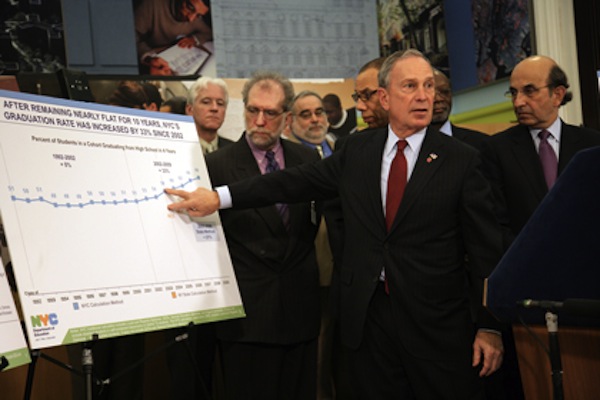
In March, Mayor Bloomberg and Chancellor Klein announced a record-high high school graduation rate of 63 percent in 2009.
The New York City Department of Education’s plan to close 19 schools—on top of 75 it has already closed—prompted a legal challenge that led a state judge in March 2010 to put the plan on hold. In an educational impact statement published last December and a response to public comments released in January, DOE states its case for closing one of the targeted schools: Norman Thomas High School on East 33rd Street. Below are excerpts from those documents. To hear the other side of the argument over shuttering versus salvaging schools, click here.
Based on its consistently poor performance, evidence that the school is ill-equipped to turn around, and very low demand, the DOE proposes that Norman Thomas be phased out beginning September 2010. We are proposing to open two new small schools that will have a high capacity to serve English language learners and special education students. In addition, the DOE will work to ensure that the campus continues to offer opportunities for students that are interested in business careers.
The proposal to phase out and eventually close Norman Thomas is based on the Department of Education’s determination that the school lacks the capacity to significantly improve student performance. Norman Thomas received a D on both its 2007-2008 and 2008-2009 Progress Reports.
In 2009, the DOE conducted an assessment of the school’s capacity to improve student performance and, after consultation with internal stakeholders, determined that Norman Thomas had not made significant progress for its students. Due to the school’s failure to make sufficient progress, the DOE now proposes the phase-out of the school.
The graduation rate at Norman Thomas has stagnated at unacceptably low levels with fewer than half of students graduating on schedule. The 2007-2008 graduation rate was 41.7 percent and the 2008-2009 graduation rate rose only slightly to 42.7 percent. This modest growth is hardly sufficient to reverse the school’s longstanding struggles. The six year graduation rate is only 51.6 percent, still below the citywide average four-year graduation rate of 60 percent. The graduation rate at Norman Thomas has been consistently low for years and although a new principal was recently placed in the school, we do not believe that this leadership change is enough to reverse the trend of poor performance that has plagued the school for years.
Under the DOE’s accountability framework, schools that receive an overall grade of D or F on the Progress Report are subject to school improvement measures. If no significant progress is made over time, a leadership change (subject to contractual obligations), restructuring, or closure is possible. The same is true for schools receiving a C for three years in a row and for any school that the Chancellor has determined lacks the necessary capacity to improve student performance, regardless of the school’s Progress Report grades and Quality Review scores.
It is also important to understand that the Department of Education weighs numerous factors when evaluating schools as candidates for closure. Although Progress Report grades and
Quality Review scores contribute significantly to the decision-making process, they are not the only considerations. The Department of Education takes into account many other sources of information as well, including school performance trends, enrollment data, demand data, and evaluations by superintendents and school support staff who work closely with the school and can evaluate its capacity to make significant improvements within a short time span.
The Quality Review evaluates how well schools are organized to improve student learning. The Quality Review measures educator and administrator actions, which are “inputs.” It does not measure results, or “outputs,” and though it reflects some factors in school success, those are but one set of factors. If administrator actions improve while student progress does not, we still must try to change the outcome. Schools are rated on a four-point scale, with “Well Developed” representing the top category of performance.
But school turnaround is difficult, takes time, and does not always succeed. A score of “Well Developed” might give us confidence that the school has the capacity to rapidly make significant improvements, while a “Proficient” school may only be capable of making incremental gains insufficient to quickly reverse a longstanding history of failure.
Proficient schools possess strengths and weaknesses. In evaluating the Quality Review reports from schools considered for closure, we looked closely at the reviewer’s assessment of those strengths and weaknesses to see how they might impact the school’s capacity to achieve a dramatic turnaround. For example, at many of the schools proposed for closure, evaluators found that instruction lacked rigor or was not sufficiently differentiated to meet individual student needs—both very serious concerns.
Many of the schools we proposed for closure received “Proficient” ratings on their Quality Reviews, and that is good news for current students who will remain enrolled in the school as it phases out. We expect phase-out schools to continue supporting their students and, in fact, outcomes at phase-out schools have historically improved with each successive year. That said, the Department’s comprehensive review of the 19 schools proposed for closure found that none of those schools was equipped to make the dramatic progress needed to quickly transform into truly successful schools where all students can thrive.
Some commenters have asserted that the DOE has targeted schools with high numbers of minority students and at-risk students, including special education students, incoming ninth graders with low test scores, and homeless students. In support of this claim, commenters state that the schools subject to phase-out serve a significantly higher number of at-risk students than schools with similarly low grades that are not slated for closure. They also claim that these students will be displaced as a result of the school phase-outs because the new small replacement schools will not accept or accommodate such students. New schools that have been opened by the DOE serve all students.
The new small schools that have been created over the last six years do, in fact, accept ELLs and special education students and are serving them at a higher rate than schools citywide, with better outcomes. On average the new schools have a graduation rate of 75% and are serving some of the hardest to serve students.
The vast majority of new schools have unscreened admissions policies. During the 2008-2009 school year, ninth-grade enrollment at new schools included 14.2 percent special education students and 13.6 percent English language learners, compared to 12.8 percent special education students and 10.3 percent English language learners citywide. When looking across a school’s entire population, they also serve more special education students and ELL students than the citywide average.
In 2008-2009, new schools served an average of 12.3 percent special education students and 12.6 percent English language learners compared with 11.6 percent and 10.8 percent, respectively, citywide.
Similarly, new small schools serve a higher proportion of low-income students, black and Hispanic students, and students performing below grade-level expectations upon ninth-grade enrollment when compared against citywide averages.
While Norman Thomas serves a challenging student population, there are other schools serving similar students that have achieved far better results. The High School for World Cultures in the Bronx has an 83 percent graduation rate while serving a student body composed almost exclusively of English language learners. The High School for International Business and Finance in Manhattan, also in the Thomas peer group, has a 79.7 percent graduation rate.
The DOE does not anticipate that the phase-out of schools will result in overcrowding at other schools throughout the city. With the phase-out and eventual closure of these schools, including Norman Thomas, the DOE has also proposed the phase-in of several new small schools. The building in which Norman Thomas is housed will not be closed and citywide we will be replacing each seat that is lost.
In the 2010-2011 school year, Norman Thomas will begin phasing out one grade per year. Grade 9 will be phased out in 2010-2011; grade 10 will be phased out in 2011-2012; and grade 11 will be phased out in 2012-2013. Norman Thomas will close in June 2013. All current Norman Thomas students in grades 9-12 will have the opportunity to graduate from Norman Thomas, assuming they continue to earn credits on schedule.