

Photo by: Marc Fader
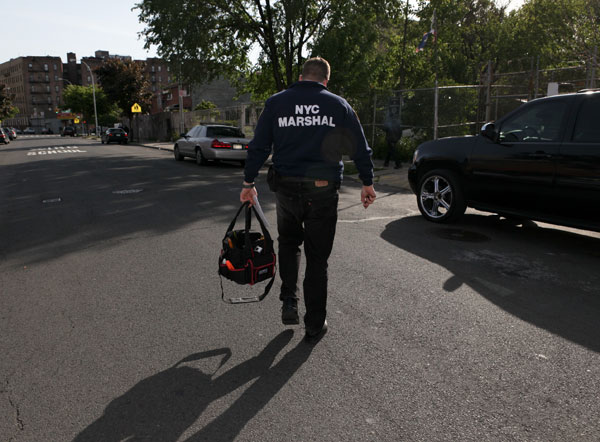
City Marshall Oren Varnai walks back to his car after helping a Con Edison worker seize a gas meter from a delinquent customer in the Bronx. Varnai’s application process to become a marshal took three years until he was appointed by the mayor.
New York City Marshal Oren Varnai wraps loudly on the door of a 9th floor apartment on Flatbush Avenue in Brooklyn one afternoon, ordering anyone inside to come out at once. He stands at above average height with a broad frame, perspiring slightly in the grueling summer heat but maintaining a cool demeanor. He identifies himself as a city marshal, and says that he is there to evict the tenants from the premises. He remains calm, but lowers his right hand near the handgun holstered on his belt.
“Unfortunately when knocking on somebody’s door, that’s always a dangerous proposition,” he said. “But I’ve had several instances where I’ve been threatened with a gun, threatened with a pipe, with knives, with machetes. Sometimes people do desperate things to keep what they believe to be their home, and it is their home, but a lot of times, unfortunately, they take it to the next level.”
No one answers the door this time though, so with the help of the building manager, Varnai makes quick work of the door lock with a power drill, within a few minutes breaking through to the empty apartment. After a brief sweep of the apartment to take inventory of tenant possessions, Varnai finishes his work and moves on to the next eviction site, having effectively turned the apartment back over to the landlord.
As a city marshal, Varnai carries out evictions within the five boroughs. He is one of 47marshals who do the same, providing the final piece in a process that often takes several months to complete, doing his job after the court has reviewed the situation and issued a Warrant of Eviction. Varnai says he conducts about 500 of the approximately 30,000 evictions that occur annually in New York City. The city’s marshals are also authorized to seize cars and money.
Varnai says that during eviction assignments, the chances are about “50/50” that the tenant or homeowner will be present when he arrives. Varnai always prepares himself for the worst, as there is always the possibility, albeit small, that the person behind the door will be ready to violently defend what they still believe to be their rightful property.
But, Varnai says, most of his encounters during evictions aren’t dangerous; they’re simply, “uncomfortable.” At the same time, he takes this part of the job in stride, using a cool demeanor and empathy as he enforces the evictions.
“You’re dealing with people [in this job],” he said. “And you have to know how to communicate with them, you have to know how to be pleasant, but at the same time [you have to] be firm.”
Varnai has had to exhibit this form of interaction with people in some shape or form throughout his professional career, having worked in an ambulance as an EMT and for Legal Aid as a criminal defense lawyer before becoming a city marshal. As an EMT, he learned to rely on himself in any number of taxing situations.
“Working as a medic definitely helped because I had to learn to fend for myself,” he said.
He says his work at Legal Aid also applies to his current work, since it requires him to empathize with all involved parties.
“You have to [be able to] put yourself in somebody else’s shoes,” he said. “If you’re a tenant, put yourself in the landlord’s shoes, if you’re a landlord, put yourself in the tenant’s shoes.”
Varnai says what most attracted him to the job was his desire to combine law enforcement with being outdoors, after realizing that a career behind a desk was simply not for him. He also enjoys being his own boss.
Though New York City marshals are appointed by the mayor, they do not receive a salary and are not city employees, and are instead paid for each separate eviction and seizure they conduct. The money comes from fees paid by the parties to court cases, which can add up to large sums over time. City marshals are in complete control of their own work hours, but many choose to work well over 40 hours per week, and they are paid handsomely for that. According to Department of Investigation Assistant Commissioner Keith Schwam, in 2009, city marshals earned an average of $880,000 per year, though that number was skewed upward by a few marshals who made well over $1 million. Varnai declined to state his own earnings, though Schwam said Varnai was among the majority of marshals who fall below the $880,000 mean.
“People who do this job for the money are doing it for the wrong reasons,” Varani said. “If you do it for the money, then you could potentially end up having money making you do things as opposed to doing things because you’re supposed to be doing them or because they’re the right thing to do.”
Varnai also spoke about often being cast as the ‘bad guy’ in the eye of homeowners and tenants, and how he feels about being the final law enforcement figure who officially strips people and families from their homes.
“Well, you’re not an automaton and you don’t do things without having emotions,” he said. “But I am doing a function that is necessary and certainly legal. When a person has been found to have not paid their rent or to have overstayed their tenancy, or have broken some rules to deserve to be evicted, [that’s where I come in.] And just like the tenant has rights, so does the landlord.”
“I enjoy my job not because I enjoy kicking people out, but I enjoy interacting with people and I enjoy making a difference sometimes,” he said.
He recalled several times when he has gone to evictions only to find elderly, sick people in need of medical attention. In such situations, Varnai says, he has always taken the proper steps to make sure these residents get the care they require, and that he would not evict someone under dire circumstances. In one particular instance, he says, an old woman he encountered was emaciated and could have starved to death had he not shown up for the eviction. Such people typically get a reprieve of two weeks on their eviction, though it can be longer in certain situations, Varnai said.
After finishing his eviction on Flatbush, Varnai heads to his last eviction of the day. It’s at the Ebbets Field apartment building. The site has developed a reputation for illegal drugs and violent crimes, and, in fact, the building managers say a shooting occurred on the premises the night before. However, no one answers the door at the 20th floor apartment.
The hot, humid air hangs stagnant in the hallway as Varnai works with a pair of building workers to get past yet another door. Utilizing a power drill, a screwdriver, pliers, and a hammer to break the lock, Varnai uses a combination of skill and brute force to bust the locks while keeping the door intact. An enormous racket ensues with the grinding of the drill on metal and wood, along with the hammer slamming the locks. Neighbors look on in curiosity as the ruckus goes on for several minutes.
Finally though, Varnai opens the door with a few last twists of his screwdriver, and the door swings wide open. A much-needed breeze flows out into the hallway out of the room.
“I like a challenge,” Varnai says of the door. “Where would life be without challenges?”