

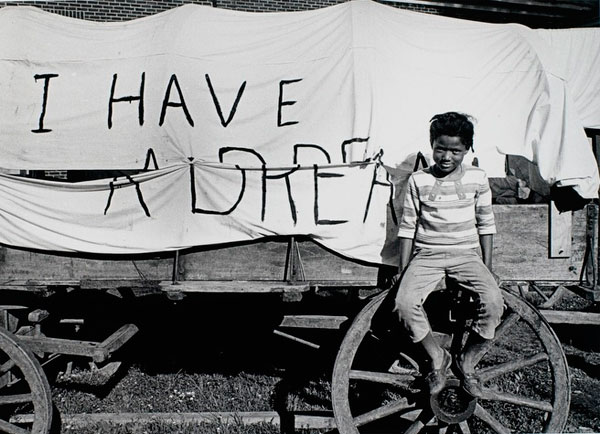
Photo by: Bob Adelman
Photographer: Bob Adelman Mule Wagon for the Poor People’s Campaign, Memphis, Tennessee 1968
There are a lot of ways to learn about the Civil Rights Movement—biographies to read, documentaries to watch, protest songs to listen to—but sometimes, as the old saying goes, pictures are worth a thousand words.
In the Bronx Museum of the Art’s Road to Freedom and After 1968 exhibits, civil rights education is the agenda. Road to Freedom, a collection of photographs documenting the Civil Rights Movement, and its companion exhibit of contemporary art, After 1968, were organized by the High Museum in Atlanta two years ago to mark the fortieth anniversary of the assassination of Dr. Martin Luther King, Jr. They debuted in Atlanta in 2008 and have traveled to the Smithsonian National Museum of African American History and Culture in Washington, DC; the Field Museum in Chicago; and the Skirball Cultural Center in Los Angeles. They opened in the Bronx Museum in March 2010 for their final run. Initially slated to close in early August, the exhibits’ stay has been extended to August 29, 2010.
“Road to Freedom demonstrates the powerful impact of photography and how instrumental the documentation of Civil Rights events was in achieving its success,” says Holly Block, Executive Director of the Bronx Museum. “The photographs served to enlist supporters, increase awareness of the inequalities faced by African Americans, raise funds for the cause, and even free those jailed for resisting discrimination.”
But as the exhibit makes clear, the usefulness of the photographs did not expire when the Civil Rights Movement of the ’60s drew to a close. Documenting key moments in Civil Rights history such as the 1961 Freedom Rides, the Birmingham police brutality of 1963, and the Selma to Montgomery March of 1965, the images weave together a story that is as pertinent to the political climate of today as it was to that of the 60s.
“Do you guys know what democracy is?” asked a teacher as she led a group of elementary school children through the exhibit.
“Democracy is when everybody gets to vote on what’s happening,” replied one of her most eager students.
The photographs, the young teacher explained as she gestured towards an image of the 1965 Watts Riots in Los Angeles, were “to prove that certain things were happening.” She glanced back to the cluster of children next to her before she continued. “It’s like… ‘Hey! I ate my vegetables and this is the proof.’”
But photographs do not just serve as proof; they are also retellings. The idea behind Road to Freedom is to tell a story through images, and the exhibit does that with striking clarity and visual and emotional intensity. Among some of the most powerful photographs are Eric Etheridge’s “Then and Now” images of civil rights activists who were arrested during the Freedom Rides of 1961. The “then” photographs are mug shots taken during their arrests, and the “now” pictures are Etheridge’s own, taken in the early 2000s. The recent ones show what the former Freedom Riders became after the 60s—Baptist church pastors, grocery store owners, and members of the Granny Peace Brigade.
There are also powerful photos, taken by Steve Schapiro and Bill Eppridge, of the search for three activists who had set out across Mississippi to investigate the burning of several black churches, and the discovery of their bodies in a station wagon at the bottom of a swamp.
The exhibit features the work of prominent photographers such as Bruce Davidson, Bob Adelman, and the Bronx’s own Doris Derby, but many less well known artists (whose photographs are no less powerful) are also featured in the exhibit.
Accompanying Road to Freedom is an exhibit of contemporary multimedia art responding to the Civil Rights Movement and to Road to Freedom itself. Curated by Jeffrey Grove of the High Museum, After 1968 features African American artists born in or After 1968.
Sergio Bessa, the Director of Programs at the Bronx Museum, says that the exhibit shows “the legacy of the [civil rights] movement through the eyes of contemporary artists.”
In a Hank Willis Thomas piece called “Unbranded: Reflections in Black by Corporate America from 1968 to 2008,” the artist has assembled a series of images from advertisements detached from all logos and captions. Together, the images (which feature Grace Jones, O.J. Simpson, Whoopi Goldberg, a watermelon, and athletic calves) interrogate the notion of progress in race relations and offer a colorful, large-format contrast to the photographs in the Road to Freedom exhibit in the next room.
Nearby is a sound installation by Nadine Robinson called “Coronation Theme: Organon.” It is an assemblage of nearly thirty speakers that issue forth organ music, sermons, and sounds from protests. The installation, which is both visually and aurally imposing, is meant to commemorate the May 3, 1963 fire hosings in Birmingham.
“What is important for us here at the Bronx Museum,” says Block, “is to not only reach out to the art world but to really strengthen our ties with our community in big ways.” She says that Road to Freedom and After 1968 have together fostered a rare kind of intergenerational dialogue. “In one of the education programs,” she says, “[a group of kids] did a mock demonstration in the gallery where they made banners and slogans about kid power and then had their pictures taken in the galleries with the photographs.”
The Bronx Museum of the Arts, which is currently the only visual arts museum in the borough, was founded by a group of community activists in 1971. The art the museum collects and displays is meant to reflect the diversity that is present in the Bronx itself, but in recent years some members of the community have felt that the museum focused too much attention on Latin American art and not enough attention on African American art. Next year the Bronx Museum will exhibit the work of Elizabeth Catlett, an African American sculptor and printmaker who resided in Mexico. Road to Freedom and After 1968 will be on display at the Bronx Museum of the Arts until August 29.