

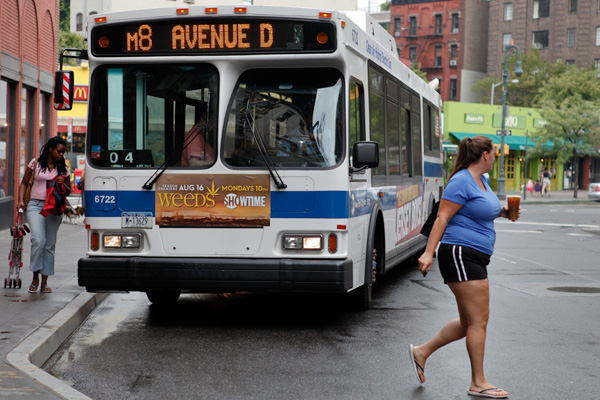
Most of the bus service reductions recently imposed by the MTA cause relatively short delays, 5 minutes here or 10 minutes there. And there's no denying that the transit agency, facing a $400 million budget gap and a dearth of state government funding, needs savings wherever they can be found. For most New Yorkers, the cuts impose a modest increase in inconvenience—perhaps a tolerable tradeoff for avoiding, at least for the moment, even steeper fares.

But for thousands of New Yorkers , the impact of the cuts is not modest. While most commuters might face a marginally longer commute, statistics that apply to the MTA's general bus ridership only hint at the disruption these cuts will render to the most vulnerable riders: the poor, the aged and the disabled, who advocates say, depend on the bus system in ways that others do not.

Here, City Limits looks at five bus routes where cuts are now altering commuters' lives.

  • Manhattan: The M8

            The pleas came from across downtown Manhattan, from the East Village to the West. There were thousands of them of them, ranging from wonky to heart-rending, all collected on petitions in support of one cause: saving the M8 bus.

            The line, which originated as a streetcar route more than 125 years ago and has run along 8th, 9th and 10th streets ever since, nearly met its end last year. Loyal riders protested, appealing to the agency for a reprieve, and their words are a testament to the special place that buses hold in many New Yorkers' lives.

             An 86-year-old widow who has trouble with subway stairs said she took the bus to the doctor. A mother of two from East 7th Street called it the only way to get her children to their after-school program. A disabled man living on Avenue D said that without the M8, he would not have had the courage to return to work on Christopher Street.

            In the end, their appeals brought them a victory—but only a partial one. The MTA scrapped plans to kill the line entirely, instead moving, effective June 27, to eliminate service on weekends and overnight. Some M8 riders would breathe easy; others would find themselves in precisely the position they had feared. In all, the MTA's internal figures say, the cut saves the agency $400,000 annually, a typical rider's trip increases by up to 15 minutes, and 2,360 weekend customers now have to use the M14 bus instead.

            Quinn Raymond, a longtime M8 rider who ran a web site dedicated to saving the line, said the reduced service has been bad for surrounding businesses—and, by extension, for the city’s economy as a whole, at an especially bad time. Raymond, who stressed that he blames state government fiscal policies for the situation, says even a partial service cut causes damage.

            “You get into a vicious cycle, where the less frequently a bus shows up, the less likely someone is to opt for that mode of transportation,” he says. “So what happens is, poor service begets low ridership, which is then used to justify further rounds of cuts.”

  • Brooklyn: The B23

            The B23 bus in Brooklyn, between Borough Park and Flatbush along 16th Avenue and Cortelyou Road, was eliminated entirely. About 1,580 weekday customers and 1,240 weekend customers now have to walk to other lines, a few long blocks away; a typical customer's trip is increased by 15 minutes. The MTA saves $1.2 million a year.