



Photo by: Marc Fader
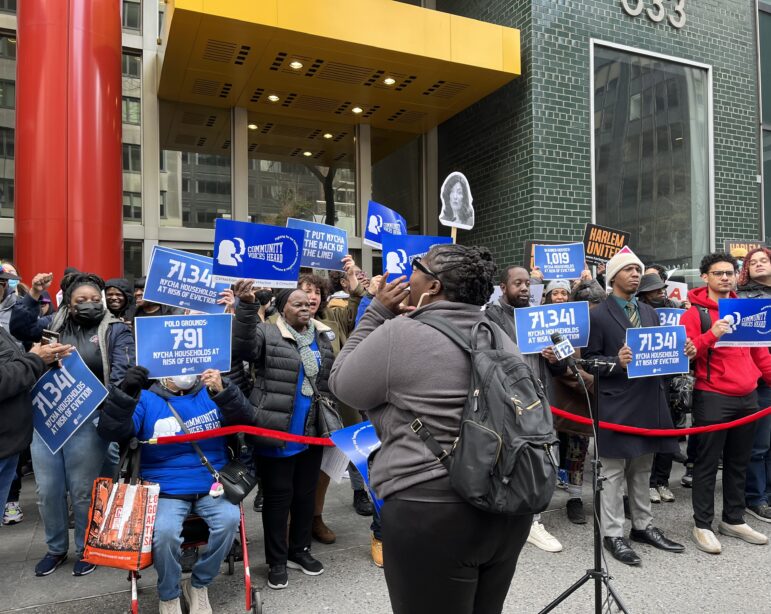
Maureen Ebron of Harlem, a tour leader, speaks about conditions at her New York City apartment building. Diego Quinones, a Sustainable Communities Organizer at Community Voices Heard, holds the microphone.
The money that New York City and some surrounding areas have received from the stimulus bill has provided immediate relief to several low-income families and prevented some from suffering greater pain than they otherwise would have, says Community Voices Heard, an advocacy group of low-income New Yorkers.
Last week the organization led a group of reporters and government officials on a tour of four downstate cities to show them what the stimulus bill has done and to build their case that Congress should pass a second one.
“This money’s gonna be going away, it’s not long-term,” said Chris Keeley, Coordinator of The New York Stimulus Alliance, a statewide coalition of grassroots organizations such as CVH. “So what happens after that? We’re gonna start seeing cuts in services, we’re gonna start seeing people getting laid off. So the Stimulus Alliance is looking towards, how can we get that ‘stimulus two,’ how can we make sure that those jobs are maintained and all of our services aren’t cut.”
New York State received $29.4 billion of the stimulus money, and the three of the four cities toured – New York City, Yonkers and Newburgh — received about $9.4 billion of that, according to a May 10 study released by the Kirwan Institute. But many low-income families are living under conditions that predated the nation’s housing crisis and recession and their lives won’t improve without a significant increase in public investment, the tour’s organizers said. “The money that they gave in the first place was not really enough,” said Anne Washington, a board member of Community Voices Heard. “And it was because of the fact that they dumbed it down so much that only a certain amount was given. But we really need to get more money here.”
City Limits joined the tour for stops in New York City, Yonkers and Newburgh. During it, members said they wanted stimulus money to address issues as mundane as the broken elevators inside their housing developments and as systemic as chronic African-American unemployment.
New York City
About $9 billion in recovery investments were made in New York City. About 36 percent of that money went to county government and schools. Another 31.6 percent went directly to individuals in the form of aid such as food stamps, unemployment benefits and Pell grants.
CVH organizers said New York City’s share of any additional stimulus investment in New York State should be significantly larger than its previous share – the city has 40 percent of the state’s population, but only received one-third of New York State’s stimulus investment and only 15 percent of New York State’s stimulus-created jobs.
Jackie Robinson Park
Suzanne Lavington was a direct beneficiary of New York City’s share of the stimulus. Shortly after the bus cruises past Jackie Robinson Park on 145th & Bradhurst, she gets up and talks about the job she got there through the Parks Opportunity Program (POP), which received stimulus funding. The POP provides people with temporary work, usually six to nine months, trains them and gives them a chance to earn a permanent position.
“It’s better to do a job and get some money than just sit around and get welfare,” says Darryl Pleasant, a former POP participant who helped lead the tour.
Highbridge Gardens, 145th Street and Bradhurst, Harlem
The stimulus also improved the living conditions in some New York City buildings, including the public housing development Highbridge Gardens, which received $4 million in stimulus funding, says resident Linda Williams. When the bus stops there, roofers are repairing leaks that once left some top floor apartments wet during rains. A new playground sparkles. Still, Williams worries that with one maintenance worker for all six 13-floor buildings Highbridge doesn’t have enough. “My sink’s backed up now,” she says. “If I call [the maintenance guy] now, he won’t be able to come ‘til next week. I must well just deal with it myself.”
Wagner Houses, E 120th Street, Harlem
New West Apartments, Phase I & II, Harlem
CVH wants what happened at Highbridge Gardens to happen at other public and private housing developments, such as Wagner Houses and New West Apartments. At Wagner Houses, a New York City Housing Authority development, the elevator is hit or miss, stranding some of the buildings’ disabled elderly residents in their apartments and endangering the lives of anyone needing emergency medical services, says resident Agnes Rivera, a New York City CVH Board Member.
(Thirty-six elevator cars will soon be repaired at Wagner Houses at a cost of $16.8 million, according to NYCHA Communications Officer Sheila Stainback. The money for the project will come from regular federal funding, not through the Recovery Act, Stainback says.)
At New West Apartments, a complex run by Manhattan North Management, Inc., CVH member Maureen Ebron says, repairs aren’t being conducted. Some of the low-income tenants believe the landlord is trying to constructively evict them and replace them with higher-income tenants, she says. Tenants have been meeting with an attorney from Legal Aid to analyze how they may be able to make a harassment case against their landlord. She wants the next stimulus bill to address and prevent landlord harassment.
(Joseph Tahl, principal of the owner of New West Apartments, says Ebron’s accusations are false. New West Apartments recently scored a 93 on its HUD inspection, Tahl says, and the company can’t recruit higher income tenants if it wanted to. “100 percent of these apartments are set aside for tenants who have low incomes,” he says.)
Yonkers
Yonkers received $1 million in CDBG funds through the Recovery Act, which was used to improve living conditions in at least one public housing development, subsidize the operation of a soup kitchen and create jobs. The problem with the jobs, says CVH Board Member Walter Lipscomb, is that most have come from contractors outside the city, who Lipscomb says hire workers from their own cities rather than from Yonkers. “The stimulus money has maintained [the situation],” Lipscomb says. “Here in the projects, it’s maintained these jobs. The jobs that were here, they still got ‘em but they haven’t created no jobs.”
Yonkers Waterfront
Stimulus funds have been used to hire people to clean up the brick sidewalks on the waterfront and in the city as a whole, as well to maintain roads.
80 School Street – Public Housing
Thanks to the stimulus, the two high-rise apartment buildings here now stand behind newly made gates, and resident Valerie Pearson says it is a much safer place to be, partially thanks to the new security booth at the front of the parking lot. A guard now has to open the security gate for residents and guests. Flowers have also been planted along the perimeter of both buildings; new benches have been placed in the area; and the playground has been remodeled. A new intercom system is being installed the gym is being remodeled too.
Sharing Community Soup Kitchen – 1 Hudson Street
This soup kitchen received $30,000 of Yonker’s funding, says Rob Zopf, Executive Director of The Sharing Community Inc. With the money, the kitchen was providing hot lunches to homeless and needy people upon our visit. The Sharing Community also provides people in need with substance, health and mental abuse counseling, job training and other services.
Newburgh
A little over $67 million in recovery money was invested in Newburgh. This represents a little less than a third of all recovery investments made in Orange County, although Newburgh only represents about 8 percent of the county’s population. Within the county, about 32.9 percent of the money went directly to individuals.
The poverty rate in Newburgh is 22 percent, easily higher than the statewide rate of 14 percent. Black poverty stands at 30 percent in Newburgh (21 percent statewide) and 23 percent of white residents are in poverty (9 percent statewide). It is here that the stimulus seems to have had the least effect.
Abandoned Buildings on Chambers Street/Surrounding Streets
Newburgh CVH leader and Board Member Loretta Manning leads the tour here, stressing the city’s dire need for new jobs and job training for low-income residents. Stimulus money created eight transitional jobs at a nearby park. But the area is desolate. Abandoned brick buildings, covered in faded, weathered gray paint line both sides of Chambers Street and others in the area. Huge patches of weeds poke up through cracks in the pavement. Stoops and stairs are either cracked or rotten. The most rundown home in the area, at 45-47 Chambers Street, has a rotten roof and is surrounded by piles of trash.
“I think the community definitely wants to rally behind improving [this] area but it’s really just a question of where their resources are gonna come from to be able to do that kind of change,” says Edward Lynch, the city of Newburgh’s Director of Planning and Development, who was on the tour. “Essentially we’re in a situation where we ran out of money as a city.”
“There are more and more people now who are out of work and have to rely on public assistance just to feed their families,” Manning said. “This is a time when we need more money for public assistance, not less.”



4 thoughts on “How Much Stimulus Money Went To Low Income Areas?”
how much was given to
Chiropractor newburgh ny ?
if everyone got it where is Newburgh wellness treatment center ‘s share?
nice informative read!! such posts keep you updated .
Depth | Newburgh chiropractic
Thanks for writing this post and keeping us updated .
Muler | Newburgh chiropractic