

Photo by: Jarrett Murphy
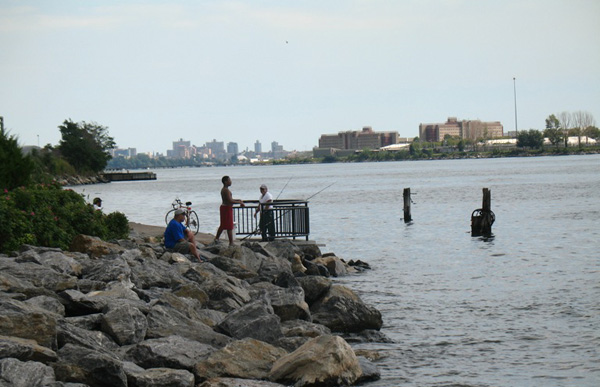
Fishermen at Barretto Point Park in the Bronx, with the buildings of Rikers Island in the distance. A sewage plant, floating correctional facility and half-dozen waste transfer stations are nearby, and the area hosts heavy truck traffic.
When any one of the 700,000 people who live in east and central parts of The Bronx flush their toilets, the product moves to the Hunts Point sewage plant at the East River’s edge. It’s not the only burden Hunts Point’s roughly 11,000 residents bear for their fellow New Yorkers. Down the street from the sewage plant, the Vernon C. Bain Center—a floating jail—is berthed. Within a half-mile are seven waste transfer facilities. And there is always the constant rumble of 18-wheelers on their journeys to and from the massive Hunts Point Cooperative Market.
Two decades ago, New York City set out to protect neighborhoods like Hunts Point from being overburdened by facilities that serve the rest of the city. But advocates say those “fair share” provisions added to the city charter in 1989 did not go far enough. This year, they pressed the Charter Revision Commission to strengthen fair share and bulk up another vital tool, the community planning mechanism known as “197-a.”
Last Wednesday, the advocates—including environmental justice groups, community boards and urban planners—won a partial victory. The charter commission overruled its staff and agreed to put on the November ballot a question about expanding the scope of what city agencies are required to consider when weighing each neighborhood’s fair share.
“This is a good first step,” said Eddie Bautista, executive director of the New York City Environmental Justice Alliance (NYCEJA). “If they had adopted more of our recommendations, it would have been helpful. We’re still pushing.”
Spreading the burden
The current city charter calls for the city to locate facilities in a way that furthers “the fair distribution among community of the burdens and benefits associated with city facilities.” The city is supposed to aim for this fair distribution through a combination of public notification (publishing all its plans for facilities in the Annual Statement of Needs, so that community boards can weigh in on location decisions that affect them) and analysis by city agencies.
In the early 1990s, the Department of City Planning produced rules for how agencies would implement the fair share rules. An agency planning a waste management facility, for instance, is supposed to “take into consideration the number and proximity of existing city and non-city facilities, situated within approximately a one-half mile radius of the proposed site, which have similar environmental impacts.”
Critics of the current system say vague language in the charter and flaws in the City Planning rules have made fair share less potent than they were meant to be.
For one thing, many city projects never make it onto the Annual Statement of Needs. Critics of the fair share system couldn’t name recent examples of the city bypassing the annual statement for a facility with an environmental impact. But the city has pursued other kinds of facilities without giving communities an early heads up, even in cases where the projects’ timing or scope seemed well-suited to full notification, like the movement of Correction headquarters from Manhattan to Queens and the location of the city’s counterterrorism headquarters in a building on Broadway.
Advocates also say that the current rules constrain the view that agencies take of the environmental challenges facing particular neighborhoods. The rules deal with the concentration of similar facilities, and not with the total burden a neighborhood faces from different kinds of polluting infrastructure. Facilities that are funded by the city but owned by a private company that gets the bulk of its business from other sources—for example, an international waste transfer conglomerate with a couple transfer stations in Brooklyn—may not be subject to the rules. And while agencies’ analysis is supposed to consider both city and non-city facilities in determining a community’s environmental burden, one key resource for that agency analysis—the Atlas of City Property—only lists city property, as the name implies.
In its testimony to the Charter Revision Commission, the NYCEJA called for mandating that city facilities be listed in the annual statement of needs, that “all polluting infrastructure” be included in the Atlas and that fair share analyses take explicit account of public health data in location decisions.
The Department of City Planning told City Limits that agencies need the flexibility to proceed with facilities even if they miss the once-a-year deadline for the Annual Statement of Needs. And a City Planning official insists that city agencies look well beyond the Atlas to learn what facilities a neighborhood hosts.
The ballot question approved last week by the charter revision commission asks whether “the location of transportation and waste management facilities operated by the state of New York or the federal government, or by private entities that serve as the city’s counterparts in providing public services” should be added to the city map.
Even that modest victory was problematic for environmental justice advocates: They wondered why power plants hadn’t been included.
The best-laid plans
The 1989 charter also created a mechanism for community boards, borough presidents and others to create “plans for the development, growth and improvement of the city and of its boroughs and community districts.”
Named “197-a” plans after their section of the charter, the plans can apply to a single neighborhood or to an entire community district, and typically revolve around how economic development should proceed, what transportation infrastructure and policies are desired and how zoning ought to be changed. If a community board originates such a plan, it goes to the borough president for a recommendation, then to the City Planning Commission for approval and finally to the City Council for adoption.
Thirteen plans have been adopted to date, the most recent being Sunset Park’s plan, which was approved by the City Council last December and includes detailed recommendations on which under-used city parcels ought to be targeted for development, where truck routes could be relocated and how to “green” the waterfront.
“One of the things we originally called for and was quickly embraced was the need for a waterfront park for our community,” says Brooklyn Community Board 7 district manager Jeremy Laufer, recalling Sunset Park’s 197-a process, which played out over 10 years. There were certainly points of friction, Laufer says: “In some ways they tried to convince us to look at things in a different way and there were points where we agreed to disagree.” But because of the length of the process, Laufer adds, the community board and city planning found common ground on most issues.
But other communities’ experiences with 197-a have been less sanguine. Manhattan Community Board 9 began working on a 197-a plan in 1991. It finally submitted one in August 2005. A key issue in the neighborhood was Columbia University’s controversial ambition for an uptown research campus. The community board wanted to bar the university from using eminent domain to secure the desired property, says Board 9 Land Use Chair Walter South.
City Planning, however, did not release CB9’s plan for public review until June 2007. “[City planning] said that they were getting a plan from Columbia University. They contended that they were not going to have a hearing on our plan until Columbia had their plan. It was almost a year or even longer before they submitted it,” South said. “Of course, Columbia had political muscle.”
City Planning’s timeline—it faces no deadline for acting on a 197-a plan—and balancing of interests is often a sticking point. The 1996 Red Hook 197-a plan, for instance, was changed to accommodate concerns by local business interests, recalls Tom Angotti, a planner and Hunter College professor who worked at City Planning when the plan was being prepared.
And once a plan is passed, communities are often dismayed to see parts of it overridden. In Williamsburg and Greenpoint, the massive residential towers that have sprouted in the past decade are out of step with what community residents thought they were getting in the 197-a plans that passed the council in 2002. Some in Red Hook believe the massive IKEA store that opened in 2008 is not the kind of waterfront development their plan called for. And while Riverdale’s Bronx Community Board 8 was largely pleased with its 197-a plan, it has not been happy with the city’s Board of Standards and Appeals granting zoning variances that contradict the spirit of the plan.
“We have a good relationship with City Planning,” says CB8 chair Damian McShane. “We’ve been disappointed to a certain extent with the Board of Standards and Appeals. Our general feeling is BSA is pro-development and not pro-community.”
To plan or not to plan
The charter does not give 197-a the force of city laws or rules. “The 197-a plan does establish a framework for future action,” says the City Planning official, made available to City Limits on background. “But we’re not slaves of the 197-a framework.” After all, City Planning has to balance parochial neighborhood concerns against citywide needs. And in some neighborhoods where 197-a plans were passed many years ago, the situation may have changed in ways the plans did not foresee.
The trouble is, community boards must devote a massive amount of time to creating a 197-a plan. And to do it well, veterans of past efforts say, requires professional planning support worth at least $100,000 (although this is sometimes donated). “Every community board was supposed to have a planner on the staff,” says Ken Fisher, a land use attorney and former Councilmember, “and now they’re lucky to have a staff member to answer a telephone.”
The combination of limited resources, years of wrangling with City Planning over the plan’s language and mixed results on implementation have turned some planners against what was supposed to be a vital avenue for citizen involvement. Angotti says he no longer counsels communities to bother with 197-a plans. “The system is so broken, it’s a waste of time and deludes people into thinking they’ll have a real impact on policy.”
Still, some 197-a veterans say the plans can make a difference: As upset as Walter South was about the deference shown to Columbia, he says the 197-a plan has led to better zoning elsewhere in the district and consideration of some blocks as potential historic districts. In 2008, the state’s Board on Electric Generation Siting, ruling on a request for a permit to build a power point in Greenpoint, turned down the application, citing the 197-a plan.
That kind of payoff is crucial, says Eve Baron, a private planning consultant. “Communities can spend years doing this,” she says. “They want to see it go somewhere.”
In its testimony to the Charter Revision Commission, the Pratt Center for Community Development said, “City agencies must formally acknowledge 197-a plan recommendations, implement them where feasible, and provide an explanation if they choose to bypass them.”
Ron Shiffman, a veteran planner who’s been involved in a number of 197-a plans, says the city needs to be genuine about giving communities a say in how their neighborhoods evolve. Some plans he has worked on showed more foresight than city officials displayed; for instance, the very first 197-a plan, covering the South Bronx and passed in 1992, called for a higher density of development years before City Hall made that a central part of planning policy. He thinks it’s time to give 197-a plans teeth.
“You make it a policy decision–that once a 197-a plan passes, that it becomes city policy, and you need a super majority on the planning commission to get changes made,” he says.
But the Charter Revision Commission skipped the 197-a issue altogether. As their review would down this summer, charter commission members talked often about what a future charter commission—perhaps even a re-appointed sequel to this year’s panel—might do. Land use could be the chief focus of such a future panel. But it’s unclear whether and when Mayor Bloomberg might appoint a new commission.