

Photo by: Adi Talwar
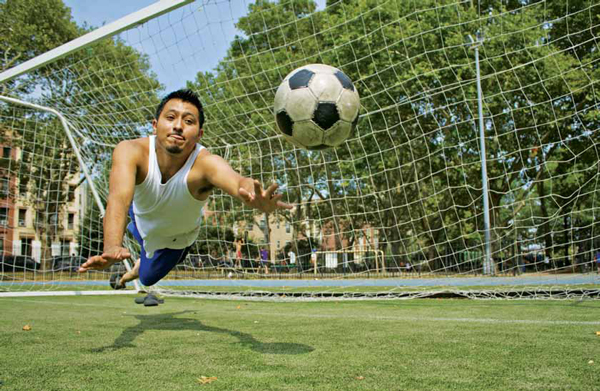
Azael Arturo makes a save at Thomas Jefferson Park in Manhattan, where a turf field had to be closed due to high lead levels.
Soccer players shout at midfield, but not about their game: The field is falling apart. “It’s been like this for five years,” complains Israel Arreola, as he points to the open seams, torn patches and wavy folds in the artificial turf at Flushing Meadows Corona Park. Referees for public school league games already boycott two artificial-turf fields there, citing fears of liability. “This is bad: holes everywhere,” says Arreola, a Manhattan sous-chef who plays in a weekend league. “Somebody’s going to get hurt.”
Over the past 12 years New York City has borrowed an estimated $300 million to put 204 artificial-turf fields at parks, schools and playgrounds. An additional 52 fields are on the drawing board.
The reasons behind this buying binge have been many, ranging from the battle against obesity to an alleged cost savings on field maintenance. Artificial turf is part of PlaNYC, Mayor Michael Bloomberg’s blueprint for an environmentally friendly future. Yet a City Limits investigation has found that overuse and chronic neglect has run turf ragged years ahead of schedule; price comparisons generally favor natural grass, even in the long term; and the health risks of turf—largely dismissed by the city after the destruction of one artificial field for high lead levels in late 2008—are much broader and deeper than previously reported.
After years of rejecting health concerns, the city recently agreed to switch materials and to set up new protocols for testing artificial turf, but the backroom negotiations that brought these concessions actually kept more threatening information from seeing the light of day. It’s not clear that the new testing regime will eliminate the health risks, and the issues of cost and durability have not been addressed. Relentlessly pitched as a financial boon, plastic grass has turned into a pricey time bomb. As more fields hit the end of their useful lives, the city faces the prospect—and increased expense—of reconstructing them.
In a random survey of 56 artificial fields this summer, City Limits discovered 25, or 46 percent, in serious state of disrepair, with gaps, tears and holes forming obvious trip hazards. At least 14 fields had minor damage, but without fixes, their defects are sure to grow worse.
A Parks Department spokesman says the city has no plans to replace any artificial turf, though the agency has solicited bids to swap out two fields in Manhattan for $3.65 million.
THE GROUND GAME
Signs of deterioration at turf fields
The city bought into turf because it didn’t have the operating budget to maintain natural grass, so it borrowed the money instead, issuing bonds to finance turf fields as a capital investment. That’s why, even in a time of falling tax revenues and dramatic budget cuts, the Bloomberg administration is purchasing more artificial turf, repeating—and expanding— an expensive and possibly harmful mistake.
The financial risks grow more obvious as time goes on. Last year the Parks Department floated a proposal for $40 million in federal stimulus funds to replace deteriorated turf. First Deputy Commissioner Liam Kavanagh looked a little embarrassed when he tried to explain away the request at a later City Council hearing, excusing it as “part of a planning exercise” that was dropped from the city’s official stimulus application.
The trouble of rapidly decaying turf may not have been initially anticipated by the Bloomberg administration, yet the city has been aware of the problem since at least 2006—and it kept on buying. According to a 2006 internal Parks Department memo, former head of capital projects Amy Freitag dispatched a team to survey a sampling of fields in Manhattan, Brooklyn and Queens; all of the inspected turf had been installed only three to five years before. “Most fields are displaying problems,” the memo reported back to Freitag, listing nine common defects ranging from disintegrating fibers and “carpet wrinkling” to shredded seams and “playing lines ripped out completely.”
Two of these fields happened to be the same ones Israel Arreola now complains about at Flushing Meadows Corona Park. The 2006 memo pronounced one of the fields “unrepairable” because of “severe deterioration,” and it pegged the price tag for an immediate replacement at $562,500. The other field “can be repaired,” the memo said, but “will require complete replacement in about one year.”
Four years later, neither field has been replaced, but days of reckoning can only be delayed, not avoided. The warranties of most artificial-turf manufacturers last for just eight years. While the two fields in Flushing Meadows Corona Park are now nearly nine years old, the city has no plans to reconstruct them. On a recent Saturday, water collected in puddles and undermined the carpet, which was no longer secured to the ground. Frustrated players picked up the surface and held it over their heads. The white-and- green maple leaf logo of the Parks Department formed a loose and tattered pile at center field.
“We ask the Parks Department for help, and they don’t respond, so we try to fix the field ourselves,” explains William Juca, a limousine driver from Maspeth, Queens, who heads Master Soccer, a league of immigrant players over the age of 40. Juca says his league pays $1,500 a year for a half-day permit and insurance to play on Saturdays over the course of the year, and it spends an additional $3,000 on quick fixes with glue and patches—two times as much as the city’s annual maintenance estimate for an artificial- turf field. “We cannot do the whole thing,” says Juca, who once asked a private contractor to look into making temporary repairs to one field. The ballpark figure came to $50,000. “That’s too much—we’re just a small league,” he says.
The price of a new artificial field has risen steadily over the past decade. By 2007, synthetic turf was fetching as much as $13 a square foot, almost double what the city was spending five years before. When worries focused on the toxic chemicals in fields using rubber crumbs from recycled tires, manufacturers scrambled to find new materials—”virgin” rubber, acrylic-coated sand, coal fly ash, walnut and coconut shells—and they hiked their prices for the new products. The city even returned to buying the old-fashioned carpet-style AstroTurf, which now goes for $21 a square foot. When the carpet-style field in Chelsea Park gets replaced this year, the cost will be $2.3 million, almost twice its original price.
The city’s tab for artificial turf has already surpassed the annual expense budget of the Parks Department, which touts artificial turf as a fiscally prudent alternative to hiring maintenance workers. Today, conditions at four fields in Flushing Meadows Corona Park—two artificial turf, two natural—show what happens without maintenance, providing a window onto the decades-long deprivation of city parks. Without upkeep, both grass fields have turned to bare and hardened earth; a thin layer of dirt sits uneasily on top. Bob Sprance, a coach of girls’ soccer at Forest Hills High School, picks broken glass off the ground.
All four of these fields are included in the referees’ boycott. Still, if forced to choose, Sprance would take the dirt over the artificial turf. “Those fields are just too dangerous,” he explains.
He quickly adds that he hates making the choice: “It’s like death—the outcome is the same.” During practices, managers place orange traffic cones on the artificial turf to warn players of particularly perilous spots.
Sprance walks onto an artificial field between the end of one soccer game and the start of the next. “Look here,” he barks, squatting above the carpet. “See that hole by the goal line? You see that patch they put in? Now look at the fold.” The fold—a jagged crease at least 2 inches high—extends across the entire width of the field, creating a trap for preoccupied players. “You got three problems right in front of the goal.”
A worried look comes across Sprance’s face as he watches the adult leagues that occupy the artificial- turf fields on Saturdays and Sundays. “These men have jobs. What if they tear their knees?” he asks. “They’re in danger of permanent injury— knees, ankles, heads. They could get concussions. What I don’t get is, How can the city let people play on here?”
Another question might be, How did an administration that prides itself on financial acumen dive headlong into a heavy investment in an untested material? And why has it remained steadfastly committed to buying more artificial turf, even when that commitment has meant constantly trying to cover up possible problems, particularly those related to public health?
The answers lie in the story of how New York City became the world’s biggest buyer of fake grass.