

Photo by: Edward Reed, courtesy of City Hall
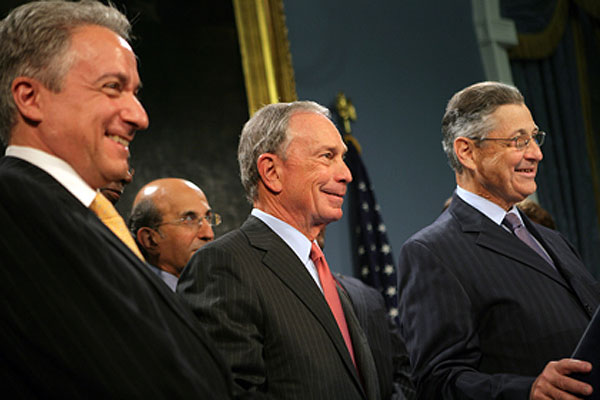
From left to right, state education Commissioner David Steiner, city schools Chancellor Joel Klein, Mayor Bloomberg and Assembly Speaker Sheldon Silver last week celebrated New York State’s selection and award of $700 million in the U.S. Department of Education’s Race to the Top competition.
As the pixie-dust settles from last Wednesday’s announcement that New York State won a $696 million Race to the Top grant and attention turns to how to achieve the goals set out in the state’s ambitious application – and, crucially, how to apply the funds – advocates, educators, critics and bureaucrats are left with more questions than answers.
Neither the city – which will get $250-$300 million of the grant – nor the state have yet articulated precisely how they will funnel the money to proposed projects, including novel innovations in teacher training and evaluation. The state also plans to expand the principal-training institute, the Leadership Academy – famously modeled on Jack Welch’s executive-training program at General Electric – to cities and districts across the state, and to use some of the school closing and turnaround strategies developed by the New York City Department of Education (DOE) across districts statewide.
“The question is, what does the federal government intend to do?” asked Raymond Domanico, Director of Education Research at the Independent Budget Office, in an interview with City Limits. “There’s no local oversight of the money – it’s up to the feds.” Because the funding is a grant (essentially, a no-strings gift), it seems unlikely the federal government will rescind it if the state’s plans don’t materialize.
One thing that is clear, and of concern to many advocates and educators, is that the money isn’t going to particular school based-programs. “It’s going into research and development, into information systems, further development of accountability,” says Domanico. The state and the city might spend all the money doing the research necessary to design new initiatives and programs, he says, or they might spend it to implement their new programs. He says the federal government hasn’t clarified its expectations. “Do they want the state to deliver the system? Or the research?” he says.
Meanwhile, the New York City Department of Education isn’t yet providing particulars on its timetable or explaining how it will measure the success of its efforts. According to spokesperson Barbara Morgan, “Several divisions within the City’s Department of Education will play crucial roles in developing the City’s scope of work. Our entire cabinet will work with the State to create a work plan that fulfills the commitments laid out in the State’s application. Ultimately, Chancellor Klein and State Education Commissioner Steiner will sign off on the final plan.”
The New York State Education Department (NYSED) did not respond to requests for comment.
One reason questions abound about the grant money’s use is that New York State’s application details little of its plan to implement its ambitious goals – and even less about the process, timing, funding or potential consequences for failing to reach milestones.
It’s hard to know what any state will do with the money, says education-reform critic Frederick Hess, of the right-leaning, Washington DC-based think tank, the American Enterprise Institute. That’s partly because the grant awards weren’t based on track records, but on future plans, he says.
It’s also hard to predict what individual states will do because midterm elections could unseat many of the governors and elected officials who won the money. Here in New York, a new Governor in January and a probable new Mayor in 2012 may be less attached to the prior administrations’ reforms.
“Leaders make their names by what they initiate, not by implementing their predecessors’ programs,” Hess told City Limits. “They may not agree with what the state has promised to do.” Race to the Top funding is meant to underwrite initiatives proposed in the State’s application, but if new leaders don’t support the proposed initiatives, Race to the Top funds could be applied in new, as yet unspecified, directions.
“The implementation and the follow-up are the most important things,” says New York City Council Education committee Chair Robert Jackson. “The follow-up is where we must make sure the money is being spent appropriately.”
“We want to see what the action plan is from the DOE,” Jackson says, adding that he anticipates details from DOE “in a couple of months.” In both the City Council and the State legislature, “there has to be clear accountability in spending the money.”
Set against the context of state and city education budgets of $50 billion and $23 billion, respectively, a win of $700 or $300 million enriches the general education coffers, even if it doesn’t mean enormous or direct infusions into cash-strapped classrooms. The city’s portion of the grant will pay out over four years, resulting in annual gains of about $70 million a year, says Jackson. (By contrast, some city high schools have individual budgets of $15-26 million.)
Proponents argue that the essential reforms will shape education for generations. As the Mayor said after New York was named as a winner, “The money is useful, but the recognition is the real benefit.”
Hess disagrees. Race to the Top is “more about grant-writing and presentation skills than about substance,” he says. Some states worked with high-powered (and high-priced) consultants to write their applications; others asked teachers and volunteers to pitch in. If there’s a third-round Race, Hess says, it’s vital to “make sure you hire really good grant writers. I don’t think that’s the lesson Congress wanted states to take away from the process.”