

Photo by: Eileen Markey
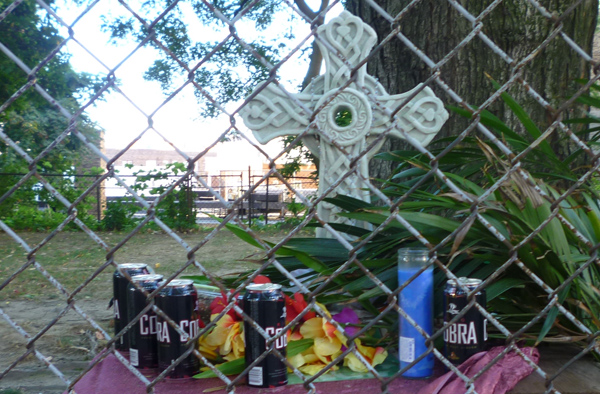
Friends of William Murphy believe the homeless man’s death August 15th was the result of a bias attack. This memorial was erected at Epiphany Lutheran Church in Norwood, where Murphy helped maintain the garden. Police have ruled his death an accident.
He was found on the sidewalk in the Norwood section of the Bronx, an ugly gash on his head, several ribs broken. William Murphy, who lived on the street, died from his injuries at St. Barnabas Hospital August 15th. His friends think he was the victim of a bias attack.
“I think he got jumped. Sometimes when he was drinking he’d fall, but I never saw him get a cut like that on his head,” says Terry, a homeless man who often drank with Murphy. “I really believe something happened to Billy. I really think these kids in this area, they’re focusing on us in Whalen Park [a local homeless hang-out]. They want to show they’re tough, so they beat up on someone who can’t beat back,” he adds.
A few weeks before Murphy’s death, another neighborhood homeless man was severely beaten. He remains hospitalized, says Sonia Decicco, who volunteers at Epiphany Lutheran Church on 206th Street where the men sometimes congregate. “To say Billy died by an accident, no way could that be. He had so many broken ribs, his face all destroyed. [The pastor] could barely recognize him,” she says.
Police have ruled Murphy’s death an accident. But if he was attacked, as neighborhood friends insist
Analyzing press reports and relying on interviews with unsheltered homeless people and with service providers, the study found increasing levels of violence against street homeless throughout the country in the past 10 years.
In the decade ending last year, 231 homeless people were murdered. In 2009, the study’s bloodiest year, 43 homeless people were killed in bias motivated attacks. They were stabbed, beaten with golf clubs, battered with skateboards and set ablaze. California and Florida were the most unsafe states, with researchers identifying 27 and 16 attacks, respectively, in 2009.
New York saw just one attack in 2009, and 34 since 1999. While New York City does not stand out among the most dangerous places to be homeless, those who sleep on the street and people who work with them say the city’s homeless are frequently the victims of crime.
“Unfortunately, there is no comprehensive, statistical data on this, but there is no question that homeless people are much more likely to be victims of violent crimes,” says Patrick Markee, Deputy Director of Policy and Communications for the Coalition for the Homeless in New York, which is independent of the national organization.
Lack of data on the victims of crime and homeless individuals’ reluctance to engage with the police mean many deaths that may be homicides are likely classified as accidents, and many assaults go unreported. “I would imagine many cases fall through the cracks,” Markee says.
The state assembly is mulling legislation that would include attacks on homeless people under the state’s hate crimes law, Markee says. “I expect by the end of the year we’ll see that introduced in Albany.”
For Jean Rice, a leader of the civil rights committee at Picture the Homeless
Police are unlikely to help, Rice contends. “Police harassment leads to an atmosphere of violence against the homeless,” he says.
The National Coalition report makes a similar point, “There is a documented relationship between increased police action and the increasing numbers of hate crimes/violent acts against homeless people,” the report’s authors write. “Many of the cities mentioned in NCH’s bi-annual criminalization report are also cities where hate crimes against homeless individuals have frequently occurred.”
The NYPD did not respond to a request for comment on this finding.
Duwon Bryant, a college graduate and former U.S. Marine who slept on the A train while working as a vendor in Times Square after he was evicted from his apartment in 2005, says New Yorkers need to learn that people without homes are not criminals and not a menace.
“No one wants to accept the fact that sometimes you are homeless just because you are poor,” he says. Bryant, a member of Picture the Homeless, which for years has advocated for vacant buildings in New York to be made into affordable housing, adds: “We wouldn’t have these problems if finding an apartment weren’t so difficult,” he says.