


Photo by: Marc Fader
Bought in 2007 for $35 million by a private equity-backed investor who quickly withdrew services and fell behind on debt payments, the Milbank buildings are emblematic of a slow-moving crisis involving buildings bought at the high of the late real estate boom that have fallen into deplorable repair.
An expert analysis of conditions at 10 troubled Bronx apartment buildings has found it will cost at least $19 million to return the decaying homes to livable standards. Baer Architecture Group prepared a needs assessment report on a group of residential buildings, referred to as the Milbank portfolio, at the request of the Urban Homesteading Assistance Board, which, along with other affordable housing advocates and City Council Speaker Christine Quinn, is trying to influence the immanent sale of the properties.
The report inspected 550 apartments, or 25 percent of the units in each building, as well as lobbies, roofs, boiler rooms and basements, said Brian Baer, the architecture firm’s director. The scope of repair needs is staggering. “All the roofs needed to be repaired. They are, at their youngest age, 40 years old. Most of the brick facades had water flowing through them. Windows in many cases are inoperable. Entry doors in many cases were not locked or had broken windows. Radiators were falling through some floors,” he said. Repairs average $1.7 million to $2.6 million per building.
He stressed that the $19 million to $24 million price tag represented the cost of merely making the buildings livable and code compliant, “Not to make them luxury or even market rate.”
Bought in 2007 for $35 million by a private equity-backed investor who quickly withdrew services and fell behind on debt payments, the Milbank buildings are emblematic of a slow-moving crisis involving buildings bought at the high of the late real estate boom that have fallen into deplorable repair. In March 2009 Wells Fargo began foreclosure proceedings on the properties. The buildings are currently maintained by a bank-appointed special servicer, LNR Property Corp. of Miami, Florida. The buildings carry a whopping 3,325 housing code violations, or an average of six violations per apartment, according to HPD records.
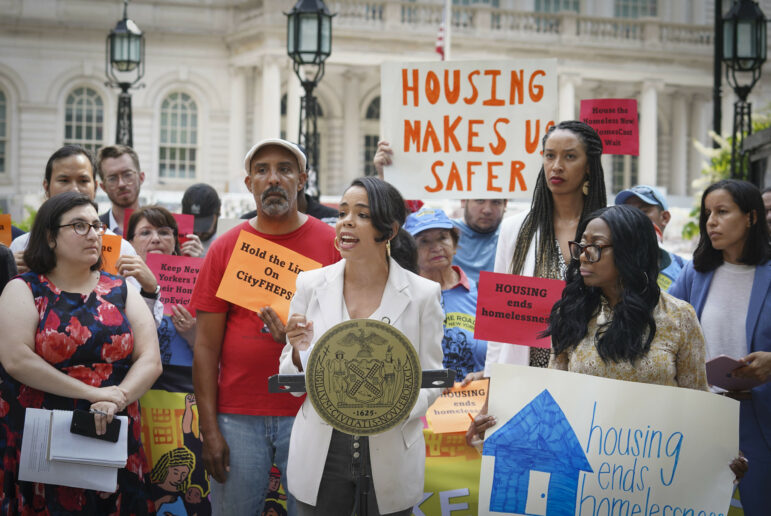
At a press conference on the steps of City Hall Thursday, Quinn said Baer’s professional analysis would be a powerful tool for Milbank tenants and their supporters.
“Today we’re unveiling the report that we believe will shed light on exactly how terrible conditions are in each of the Milbank’s buildings,” Quinn said. The Milbank properties are about to be sold, according to sources who’ve watched developments closely. Tenants and housing advocates want the true cost of necessary repairs to be understood and reflected in the sale price. Otherwise, they argue, the cycle of overpaying and neglect will simply repeat.
Under a new initiative by the City Council’s committee on distressed properties and architecture and engineering firms such as Baer offering pro-bono services, tenants in other buildings will be able to request similar needs-assessment reports on their buildings, Quinn said. “We have one more weapon in our arsenal: information. Having reports detailing the repairs and the cost is essential to helping these tenants. It is bringing knowledge to power,” she added.
The goal is to arm tenants and advocates with professional estimates of the true scope of repairs and renovations and their cost, so that they can more effectively demand services from property owners.
“And [the reports that will be generated] serve[s] as a warning to owners and banks that these are the legitimate needs of the building,” explains Brendan Cheney, senior policy analyst in the speaker’s office.
The release of the Baer report comes just days before the Milbank portfolio is expected to be sold.
But city government does not appear to have any legal authority to prevent or influence the sale. LNR is free to sell to any buyer at whatever price they can achieve. The city’s Department of Housing Preservation and Development, which has leveled a steady stream of code violations on the property owners and performed emergency repairs throughout the past year, tried unsuccessfully to negotiate with LNR and to learn the identity of a potential buyer who has been in talks with the special servicer for months, a source close to the discussions said.
Last week, in a bid to find out who the potential buyer is, HPD signed a nondisclosure agreement with LNR, says Eric Bederman, a spokesman for HPD. The agency wanted to know the identity of the buyer to look at their record of ownership with other buildings, and to possibly offer them assistance from a distressed property rescue fund that HPD controls, Bederman said.
“Our job is to make a data-driven assessment of who they are and what they own, so that we can determine whether this sale is in the best interest of the tenants and the portfolio,” Bederman says. But in addition to having to stay mum on the name of the buyer or what is known about the buyer’s record as a building owner, HPD can’t comment on the terms of the sale, because the agency doesn’t know what they are, he said. HPD might speak out if it knew for certain that the terms of the deal were unsustainable, Bederman says.
Regardless of the terms of any sale—whether the mystery buyer pays a full $35 million for the portfolio or some dramatically reduced price—HPD says it will continue issuing violations and demanding repairs. “We will still be bringing the full forces of code enforcement to bear,” Bederman says. “We’re not sitting on our hands.”