


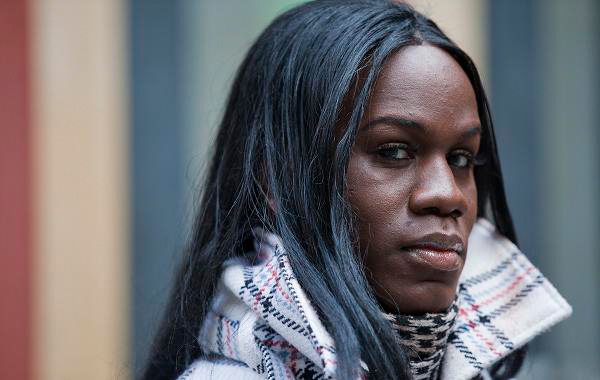
Photo by: Marc Fader
Tiffany Jones is legally a man but identifies as a woman. Thanks to a pioneering New York City policy, she was able to go to a women’s shelter when she became homeless. Were she to go to a men’s shelter, she claims, “I’d be beaten up or raped.”
Tiffany Jones became homeless when she aged out of foster care last year. Although Jones identifies as a woman and takes female hormones, her legal paperwork identifies her as a man. But Jones was pleasantly surprised when she went to apply for help at a men’s shelter last September and was asked if she was transgender and wanted to live in a women’s shelter.
“They saw that I’m a woman,” says Jones, 22, who has been living in a women’s shelter for 10 months. “There’s still some negative attention surrounding living with women. I had a couple fights when I first came in but not anymore. I had to prove a point that just because I’m transgender there’s no way of beating me. But if I were in the men’s shelter I’d be beaten up or raped,” she said.
Jones was fortunate that the staff member who handled her intake at the men’s shelter knew about [ the city Department of Homeless Services (DHS) policy allowing a transgender and gender nonconforming person to choose to stay in the shelter for the gender that he or she identifies as, regardless of whether the person has taken legal or medical steps to align his or her body with that identity.
New York City’s policy was implemented in January 2006 after LGBT advocates lobbied DHS for three years about ending the harassment of transgender women living in men’s shelters.
Besides permitting transgender shelter-seekers to stay in shelters appropriate to their identity, the policy states that “staff will address individuals with names, titles and other terms appropriate to their gender identity” and “staff at Intake/Shelter assignments will receive training on diversity, transgender and intersex issues.”
The policy defines transgender as “an umbrella term that includes anyone whose gender identity and/or gender expression does not match society’s expectations of how an individual assigned a particular sex at birth should behave or appear.” The broad definition includes people who are androgynous, drag queens or kings and cross-dressers.
The policy was implemented as a four-year pilot program in January 2006 at three men’s and three women’s shelters. The written policy has not been updated since the program’s inception. But it now applies at all homeless shelters that receive city funding.
New York City, which operates the largest homeless shelter system in the U.S., housed 36,654 people on November 26, the most recent night for which statistics are available. The system links city-run intake centers, which determine whether people are eligible for shelter, with residences operated by 150 private providers who have contracts with the city.
A National Issue
Transgender and gender-nonconforming people are more likely to be homeless than the general population. The National Transgender Discrimination Survey’s report on housing, to be released at the end of this year, showed that of the 6,560 people surveyed nationwide,19 percent of survey participants have experienced homelessness.
Many transgender people have less of a social safety net. They are less likely to have support from parents, who might kick their nonconforming children out of their homes. In addition, job-related discrimination leads to unemployment. The National Transgender Discrimination Survey found 97 percent of the 6,560 people surveyed faced job-related discrimination, and the survey respondents faced unemployment at double the rate of the general population.
The survey found 19 percent of participants have experienced homelessness. Of that group, 29 percent were denied access to a shelter, 42 percent were “forced to live as the wrong gender to be allowed to stay in a shelter” and 47 percent decided to leave a shelter because of poor treatment. Twenty-five percent have been physically assaulted or attacked by resident or staff and 22 percent have been sexually assaulted by residents or staff.
Across the country, access to safe shelter is a barrier to transgender people. Unlike in New York City, most shelter systems don’t have to respect the gender identity a person chooses.
“Some cities say you have to live with people of the gender of your birth, which flies in the face of a very certain preference, a comfort level and rightness factor,” Neil Donovan, executive director of National Coalition for the Homeless, says. “The way they address the problem is not addressing it.”
New York City is now considered to have one of the most transgender-inclusive shelter systems in the country, according to advocates. Donovan says New York, San Francisco, Boston, Los Angeles and Sacramento as are cities that have implemented positive polices.
Early results, new questions
DHS has not tracked transgender people in shelters, and thus can’t analyze the policy’s results with precision. However, the agency says it is pleased with its outcome.
“Homeless Services and advocates of the transgender community worked together to ensure development of a fair and progressive policy for transgender clients which is today fully implemented and successfully assisting those transgender clients who come to Homeless Services in need,” says DHS spokeswoman Heather Janik.
Advocates say they have received fewer complaints of violence and harassment since the policy’s implementation.
Patrick Markee,senior policy analyst at the Coalition for the Homeless, says his organization has received fewer complaints of “real harassment” since the policy’s implementation.
“There are fundamental realities about living in congregate shelters,” Markee says. “People share a bathroom and bedroom with people who are effectively strangers to you. All of these things create problems every day of the week. I don’t think anyone expected a miracle. But it was definitely a positive thing.”
The policy states that all shelter residents have access to all restrooms, bathrooms and showers. However, “any resident concerned about privacy should be directed to the restrooms, bathrooms and showers that have more privacy.”
The chief success of the policy is that it has allowed transgender women (people who are legally male but identify as women) to stay in women’s shelters, where they are less likely to experience violence.
However, according to advocates, men’s shelters continue to be an unsafe place for both transgender men and women. So many transgender men (women legally,but identifying as male) still stay in women’s shelters for fear of violence and harassment if other residents found out their identities.
“I spoke to a transgender man who wanted to go to a men’s shelter, as much as I protested,” said Jay Toole, Director of the Shelter Project at Queers for Economic Justice. “I told the shelter I was sending a transman in to just be aware for safety. A day later, he called and said he can’t stay there. It’s too unsafe. If the other residents ever perceived [him]as a transman, it would be unsafe.”
And while transgender women have the option of staying in women’s shelters, many are not aware of their choices.
“I see a lot of transwomen who go into the mens’ shelters because they still don’t know this policy,” Toole said. “The mens’ shelters should have signs up that say, ‘If you identify as female and want to go into the female facility here’s what you should do.'”
Because the last training for the policy took place four years ago, many shelter staff are unaware of the policy, advocates say. With high turnover among staff in the shelters, Toole says it’s not realistic for every staffer to be trained, but adds, “Shelter directors and clinical directors should inform front line staff more often about the policy that transgender folks can choose which side of the shelter system they can go into.”
Deeper needs
Homeless transgender men and women need not more than shelter—they need services. And while there are well-established resources for LGBT homeless youth, adult LGBT people have less support. The LGBT support groups Queers for Economic Justice runs at three shelters—which allow residents to discuss their problems in a safe space—are the only structured support in place for this population. Case managers in shelters are often unaware of the specific health needs and discrimination they face.
Toole, who was herself homeless for 20 years, is attempting to set up a non-profit to tart a transitional shelter for homeless LGBT adults.
“There’s definitely a need,” she said. “Some people just can’t survive. It’s an uphill battle right now.”
As for Jones, she is working to get permanent housing and get out of the shelter system as soon as possible. “I’m trying to get housing somehow. I’m not where exactly I want to be,” she said. But she is grateful to be able to wait it out among women. “I have female friends I can look upon for advice. I’m comfortable being here with females so that’s fantastic.”



2 thoughts on “For Transgender Homeless, Choice Of Shelter Can Prevent Violence”
Pingback: This Post Has Nothing to do With Caitlyn Jenner | NYC Informer
Pingback: Right-Wing Fantasies About Gender Are Killing Trans People