

Photo by: Spencer Tucker/City Hall
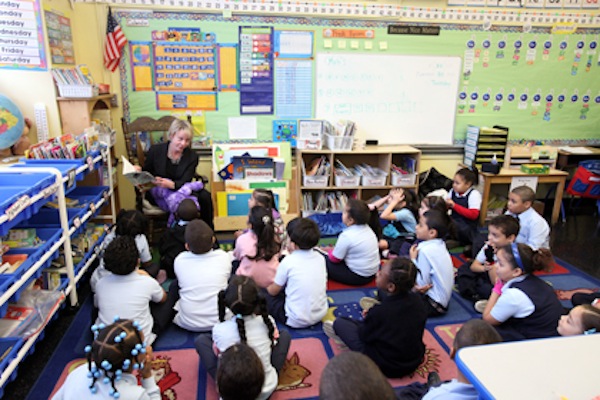
Chancellor-designate Cathie Black reads to a class at PS 109 in the Bronx.
By Helen Zelon
New York City school students’ test scores dropped steeply this year but standardized tests remain the device of choice for the nation’s largest school system to measure progress.
On January 3, after a bumpy introduction to New Yorkers, the Chancellor’s baton is scheduled to pass to Cathie Black. The magazine magnate has survived a credentials challenge from the state’s education commissioner, and she will likely surmount lawsuits by parents and legal activists protesting her selection for the job. But those are just the first—and perhaps the easiest—tests that Black will face.
Her predecessor Joel Klein oversaw a period of unprecedented reform, made possible by mayoral control of the schools. There is furious debate over whether Klein’s changes were wise or have been successful. But there is no question that his successor will confront a litany of wrenching decisions.
City Limits wondered how Chancellor-designee Black and readers might fare on an utterly non-standardized test of city-schools knowledge and the legacy of reform—and controversy—that Black stands to inherit. Black (or you, for that matter) can take the quiz in about the same amount of time that most students have for a single class: 45 minutes.
Section 1: Multiple Choice
10 minutes
1. Charter-school development has been a signature reform of the Klein chancellorship. Because real estate is in short supply, DOE often places charter schools in existing school buildings. This “co-location” has sometimes created tensions between parents, school leaders and school communities. In how many other cities in New York State do charter schools share traditional public school buildings?
A. All cities and towns in New York state co-locate charters in traditional public school buildings
B. The Big Five cities in New York—NYC, Albany, Syracuse, Buffalo and Schenectady—all co-locate charters in school buildings.
C. Albany and New York City both co-locate charter and traditional public schools.
D. No other cities in New York state practice co-location.
Correct answer: D
2. Roughly 80,000 United Federation of Teachers union members are currently working in the city schools without a contract. Mayor Bloomberg and Chancellor Klein broke ground with a previous UFT contract that significantly raised teacher salaries, as a strategy to attract talent . What are the most pressing goals for a new contract?
A. Data-driven performance measures for all teachers
B. Financial incentives to reward teachers who work in difficult schools
C. Lifting the hiring freeze that’s been in place since 2009
D. Re-evaluating pension/insurance costs and the pledge of guaranteed income to excessed (laid off) teachers
E. All of the above
F. None of the above
No correct answer.
3. Mayoral control of the schools permitted the restructuring of the school system’s hierarchy. Klein shattered the 32 school districts that had long governed as often-corrupt fiefdoms (but also gave parents access to education leaders above the school level). He created and then phased-out a set of administrative regions. He gutted the power of superintendents but gave principals more autonomy, while consolidating at DOE headquarters a range of once-local practices, like enrollment, high school choice, principal hiring, gifted and talented testing, purchasing and contracts. Educators and experts have a range of opinions on what mix of autonomy and centralization is ideal. Which of the following is true?
A. School autonomy and centralized control go hand-in-hand, as in the current mix.
B. More autonomy and less centralization would permit schools to craft approaches that best suit their unique student populations.
C. Autonomy must be limited because it confers undue risk on students whose schools have weak leaders and shields DOE’s leaders from accountability.
No correct answer
4. In 2009, 82 percent of city students in grades 3 through 8 passed their state math test and 69 percent passed their state reading test. This year, 54 percent passed the math exam and 42 percent passed the English exam. DOE officials knew that the scores would drop citywide, as New York State Education Department leaders planned a recalibration of the test scores after an analysis by Harvard-based researchers that cast doubt on previous years’ results. Based on this information, which of the following statements is true?
A. The math score dropped by 34 percent between 2009 and 2010
B. The English score dropped by 39 percent between 2009 and 2010
C. The reliance on standardized testing to evaluate students, teachers and schools warrants more consideration.
D. All of the above.
Correct answer, D.
5. Chancellor Klein’s DOE has closed more than 90 public schools and seeks, this year, to close an additional 26, including some small schools that were created during his tenure. Prior to the renewal of mayoral control in 2009, DOE closed schools without public hearings or significant advance notice. More recently, limited public hearings have been held, but legal challenges to the DOE’s educational impact statements thwarted DOE efforts to close 19 schools last year. Going forward, will Chancellor Black:
A. Look to engage parents and school leaders in conversations about school improvement and potential closures ahead of legally-mandated public hearings
B. Aim to more equitably distribute school closures across the city’s five boroughs (to date, the Bronx has experienced the greatest number of closures, Staten Island the least)
C. Develop high-quality, academically rigorous neighborhood (“zoned”) middle and high schools to replace the numerous zoned schools DOE has shuttered
D. Continue to use School Progress Reports as a school-closing instrument.
Answer: unknown
Section 2: Short response
20 minutes
6. Chancellor Klein recruited high-level staffers from the worlds of business and law who developed “accountability” practices to measure, reward, and punish school performance. This has made life at the city’s schools increasingly data-dominated. Most recently, the DOE has faced legal challenges over its possible release of internal teacher rating scores, which they earlier agreed should be held in confidence. Critics have noted that the scores can be based on flawed data, treat some teachers differently and don’t apply to most teachers in most classrooms. How should the city evaluate its teachers? Does the public right to know how teachers perform outweigh teachers’ privacy rights as employees?
7. Both Chancellor Klein and the mayor frequently advocate transparency and openness in city government. But last year Chancellor Klein and State Education Commissioner David Steiner struck a back-room deal approving increases in class size—despite explicit legal mandates to the contrary. Earlier this year, school progress reports were curved to make scores less grim than they would have if previous years’ “cut scores” were used. And Black’s own appointment came after a secretive selection process by the mayor. Compare and contrast the city’s stated principles of transparency with its practice.
8. Early in 2010, the School Construction Authority’s 2010-2014 Capital Plan outlined the need for 30,000 new classroom seats. In November 2010, however, the School Construction Authority posted an amendment to that plan, and proposed the addition of another 20,000 classroom seats, anticipated to cost an additional $972 million. How did SCA so dramatically underestimate the need for new seats? And how will DOE fund the additional ones, given the condition of state and city budgets?
9. In February 2010, Chancellor Klein announced special-education reforms designed to raise achievement—and, not coincidentally, to address the wide disparity in special-education student populations among city schools, which vary from one-fifth of students in some schools to less than 3 percent, in the same district. These reforms, Klein wrote, mandate that by 2011-12, “all of our schools will be ready to accept and successfully educate more children with disabilities.” (Similar goals were articulated in the pre-Klein era by then-Board of Education president William Thompson, and they have long been part of the requirements to which DOE was supposed to hold schools.) How will Chancellor Black assure that all schools enroll and serve special-education students in fair proportion? How will she make sure that new, small schools have the capacity to deal with more students from this high-need population?
Five-Paragraph Essay
15 minutes
10. DOE’s policy of opening small high schools while closing large, comprehensive schools has led to a welcome rise in the overall graduation rate. But many remaining large high schools continue to founder. Some of the new, small schools face DOE closure because they’ve performed poorly. And long-standing race- and gender-linked achievement and graduation gaps persist despite the small-school model. In addition, a rising standard for high school graduation—soon, all students will have to earn Regents diplomas—threatens the city’s recent grad-rate gains.
In your essay, address the following:
A. How will Chancellor Black maintain and build on graduation-rate gains since 2003?
B. How will Chancellor Black address the achievement gap, especially as it concerns high-poverty students and boys?
C. How will Chancellor Black sustain the city’s graduation rate, when more than half of recent graduates did not qualify for Regents diplomas?
CaluculatingYour Score
The best teachers return test results back to students quickly. But scoring this exam will take time.
Today’s high school seniors were in the fourth grade when Klein became Chancellor. By the time fourth-graders of 2010 graduate high school, Mayor Bloomberg’s successor could be starting his or her second term.
In that vein, a future assignment:
Prepare a 10-page term paper on the impact of Joel Klein and Cathie Black on New York City students, teachers, parents and schools.
Due date: December 15, 2018