

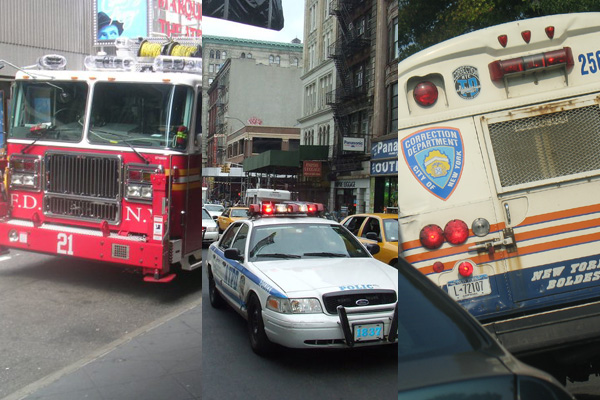
Under an obscure state statute, personnel records of police officers, firefighters and correction officers are off-limits from the Freedom of Information Law.
Late last year five New York media organizations filed a Freedom of Information request with the city’s Department of Education demanding internal teacher evaluation records. The DOE was set to comply, but the United Federation of Teachers sued to stop the release, arguing the records were inaccurate and that releasing them would be an invasion of privacy. In mid-January a state judge rejected that suit, ruling that “the release of job- performance related information…does not constitute an unwarranted invasion of privacy”—even if the information is wrong.
The UFT has appealed. It’s unclear what chance it has of reversing the first ruling. What is clear, however, is that members of other city unions—like the Patrolmen’s Benevolent Association, the Uniformed Firefighters Association or the Correction Officers Benevolent Association—will never have to wage a similar fight.
There’s an obvious public interest in how teachers are educating the next generation of city residents. The performance of police officers—who have the power to detain, arrest and use deadly force—firefighters who are responsible for saving lives and correction officers who wield total control over people who’ve been deprived of their liberty also seems a subject of legitimate public interest.
But a recent City Limits Freedom of Information Law request to the NYPD was rejected because a state law specifically exempts police, fire and corrections personnel records from disclosure.
The NYPD Patrol Guide refers to Annual Performance Reports prepared for every “member of service.” We requested the most recent annual reports on all NYPD members holding the rank of patrolman or detective. The NYPD politely declined, saying: “I must deny access to these records on the basis of Public Officers Law section 87 (2) (e) and Public 0fficers Law 87(2) (a) in that such records consist of Police Officer personnel records and are therefore exempt from disclosure under the provisions of Civil Rights Law section 50-a.”
Public Officers Law section 87 bars the release of any records that “are specifically exempted from disclosure by state or federal statute.”
And, indeed, Civil Rights Law section 50-a says that “All personnel records, used to evaluate performance toward continued employment or promotion” for police officers, corrections officers, firefighters and firefighter/paramedics and parole officers “shall be considered confidential and not subject to inspection or review without the express written consent of such police officer, firefighter, firefighter/paramedic, correction officer or peace officer within the division of parole except as may be mandated by lawful court order.”
According to Robert Freeman, the executive director of New York State’s Committee on Open Government, the exemption applied only to police officers when it was enacted in the late 1970s in response to a court ruling in Broome County that made public records of reprimands of police officers. (Ironically, that Broome County decision was cited in the recent ruling allowing teachers’ records to be released.)
“The basis of the law is simply wrong,” Freeman says. “The notion was that embarrassing information should not be brought out when a police officer is on the stand.” But “The judge has control over the courtroom. If something is irrelevant, the judge will say, ‘Sorry, this doesn’t come in.'”
What’s more, COOG notes in its annual report, “Other employee groups have contended that if police officers enjoy confidentiality protection, they should as well, even though their work would rarely involve being placed on the stand in a litigation context, and they would rarely, if ever, be placed in a situation in which they would be victims of the embarrassment sought to be avoided. Those amendments now extend section 50-a to correction officers, professional firefighters, firefighter/paramedics and peace officers within the Division of Parole.”
COOG has recommended the exemption be repealed. “The other huge, huge difficulty with 50-a is that the result is that the people who have the most power over our lives—at least those in government—are the least accountable.”
For now, 50-a means about a fifth of the municipal workforce (there are 35,000 police officers, 11,000 firefighters and 9,000 corrections officers on the city’s 275,000-person payroll) is exempt from the kind of exposure that city teachers will soon face—although as City Limits has previously reported, the majority of teachers in the city are themselves not covered by the internal rating system at the center of the court fight.