

Photo by: StoryCorps
The Sandy Ground Historical Society has managed to preserve the memory of a unique chapter in black history in New York City, despite little funding and development pressures in the area.
The slight, bespectacled old man sat on the enclosed front porch of his house and answered our questions for an hour or more. Frail but lucid, he recounted his younger days in a rural landscape within the borders of greater New York.
“When we was growing up – course, we don’t have winters like we used to – boy, that bay used to freeze up and the wild game and everything would come from Jersey over here,” he said. “We used to sleigh ride down the Arthur Kill, and we used to be runnin’ away with rabbits, man – opossum, pheasant – oh man, they all used to come across the bay.”
William “Pops” Pedro was 100 years old when I met him on that spring day in 1982. As a young assistant editor at City Limits, I was part of a team that interviewed Pedro at Sandy Ground, an African-American enclave on the south shore of Staten Island where he had spent his entire life.
My own family has lived on Staten Island for generations, yet until I met Pops Pedro, I had never been to Sandy Ground. Like most people in New York City’s most homogenous and insular borough, I’d scarcely heard of it. Meanwhile, the grassroots Sandy Ground Historical Society had already been working for years to preserve this small but significant slice of black history.
And make no mistake about Sandy Ground’s significance: Established in the 1770s, it is widely recognized as the nation’s oldest continuously inhabited settlement founded by free blacks. Today, a small museum operated by the historical society bears poignant witness to the community’s determination to keep its unique identity alive.
City Limits spoke to Pedro in 1982 for a story about a campaign to place Sandy Ground on the National Register of Historic Places and thereby protect it from encroaching suburban development. Although the registration effort succeeded, historic status was largely symbolic and did little to hold back the developers. As a result, the area’s rural character – which was still evident three decades ago – has since been obliterated by a sea of cookie-cutter townhouses.
But other initiatives have provided some genuine safeguards for historic Sandy Ground over the years. In the late 1970s, for example, the Landmarks Preservation Commission granted protective status to the cemetery beside the hamlet’s Mount Zion A.M.E. Church. Just last month, the city landmarked the church itself, as well as three surviving 19th-century cottages nearby.
Drawn by news reports of the recent landmark designations, I returned to Sandy Ground on a Sunday afternoon in February. It was my first trip back since that long-ago chat with Pedro.
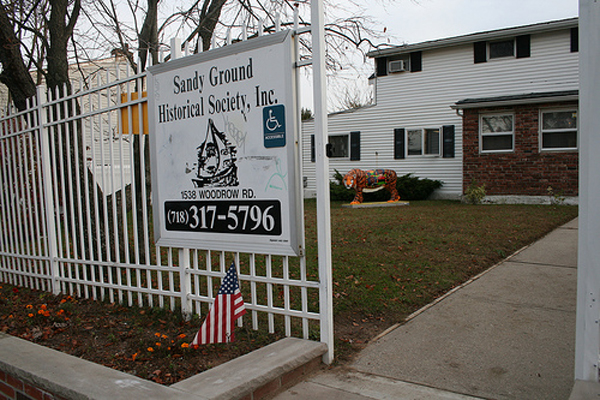
The Sandy Ground Historical Museum is easy to miss. In fact, I did miss it on my first pass down Woodrow Road, a former country lane that was one of the old town’s main thoroughfares. Located in a modest, refurbished house, the museum announces its presence only with a small sign on the fence out front.
Inside, artifacts from more than two centuries of folk life fill four small rooms – from 18th-century property records to ornamental grillwork hammered out in a blacksmith shop that was still operating at Sandy Ground when City Limits first stopped by. (The shop burned down in October 1982, just a few months after our visit.) The museum’s most ambitious current exhibit, “Faces of the Underground Railroad,” uses locally made quilts to depict prominent figures behind the network of safe houses – including some at Sandy Ground – that sheltered fugitive slaves on their escape route north to Canada.
Unfortunately, the limited size of the exhibition space doesn’t allow for an in-depth exploration of the social, economic and cultural forces that shaped the community. But “The Sandy Ground,” a half-hour video available to visitors, goes at least part of the way toward filling the gaps. Supplementing the video is a trove of documents about the black experience on Staten Island that the historical society provides for researchers.
Taken together, the museum’s exhibits and archives trace the fascinating arc of history that bent in the direction of this unassuming place. They tell a story that is at once celebratory and bittersweet – a story of African-American independence against the odds, but also of vulnerability to the caprices of society at large. Without quite acknowledging that much of its legacy is already lost, the low-key repository of past times at Sandy Ground makes a moving case for preserving what remains.
Sandy Ground began as a farming village populated by free blacks, taking its name from the sandy soil that was ideal for growing strawberries. The settlement expanded after slavery was finally phased out in New York State in 1827. It later absorbed a wave of African-American emigrants from the Chesapeake Bay region. While nominally free, the emigrants were fleeing harsh racial restrictions on their livelihood as oystermen in the antebellum mid-Atlantic states.
Sylvia D’Alessandro, a descendant of one of the old families and a grandniece of Pops Pedro, is the Sandy Ground museum’s director. She is also a longtime advocate for reclaiming the hidden history of African-Americans on Staten Island. D’Alessandro makes the case that land ownership was chief among the factors that made the Sandy Grounders unusually autonomous for their time.
“These people came and built their own community, built their own houses, started their own church, set up their own two schools,” she says in an online interview, one of her frequent appearances to tend the flame of memory. “They bought the land and they were allowed to build a community without negative influence from the outside.”
The black oystermen from the Chesapeake Bay who settled at Sandy Ground had yet another advantage: They had been working seasonally for many years in the Staten Island waters, where they planted oyster beds for white-owned shellfish supply companies. “So when they came up, they were able to establish themselves in the oyster industry fairly easily,” D’Alessandro explains. “They went on to become captains operating their own boats and hiring other people to work for them.”
And rural isolation benefited the people of Sandy Ground. When the Civil War draft riots of 1863 broke out in New York City, leading to an urban conflagration and the mob lynching of African-Americans in Manhattan, the black residents of southern Staten Island were unscathed.
“It didn’t happen out here,” says D’Alessandro. “Who’s going to try to come all the way out here to burn down a house or kill some black people?”
By the 1880s, when Pops Pedro was a boy, Sandy Ground boasted a population of about 150, sustained by a robust oystering industry. Despite the persistent racism and discrimination of the era, local black families achieved economic self-reliance by harvesting oyster beds along Staten Island’s shores. They sold the shellfish in bulk to wholesale merchants in lower Manhattan.
“It was the middle of the bay out there where they oystered,” Pedro recalled during the 1982 interview. “Oh yeah, it was big business one time.”
Although his father was in the business, Pedro didn’t become an oysterman – presumably because oystering was in decline when he came of age. By the 1890s, the Sandy Ground entrepreneurs were suffering under competition from large commercial fishing firms. In any case, as the region’s waters grew increasingly polluted, oystering became untenable. In 1916, the New York City Board of Health condemned the beds off Staten Island when oysters tested positive for typhoid bacteria and industrial waste. The areas last oyster beds, in Raritan Bay, were shut down in 1927.
The demise of the community’s core industry spurred its slow but inexorable diminution, as residents moved away in search of factory work. A massive brush fire swept through the area in 1963 and hastened that diaspora, destroying about a dozen homes at Sandy Ground. Today, only a handful of the original families remain.
The museum’s movie, “The Sandy Ground,” relates this tale with some real pathos, especially since the video is 30 years old and the dire threats it foresaw – rampant development and further decline – have largely come to pass. Still, the very existence of the museum at Sandy Ground inspires confidence that its essence will survive somehow.
With easy access from the West Shore Expressway, an arterial route that opened in 1976, Sandy Ground is no longer the sheltered, even idyllic outpost it once was. This point became painfully clear when I left the museum and took a short walk to Bloomingdale Road, where three of the recently landmarked structures can be found.
On the west side of the street sits the solid brick Mount Zion A.M.E. Church, traditionally Sandy Ground’s spiritual and social center. Set back amid its churchyard and cemetery, the building is still a commanding presence. On the east side, however, two newly protected wood-frame cottages – compact, saltbox-style houses with small windows and tall chimneys – are all but squeezed out by their newer, aluminum- and vinyl-clad neighbors.
The other oystermen’s cottages that used to line this same stretch of road, surrounded by gardens, fields and forest, no longer stand.
Of course, Pops Pedro is gone now, too. But like Sandy Ground itself, he was unsuited to slipping quickly or quietly into oblivion. Pedro lived on as the community’s presiding elder for several years after our interview. He died in 1988, at the age of 106. If his preservation-minded descendants have anything to say about it, neither Pedro nor the halcyon days of the place he called home will soon be forgotten.