

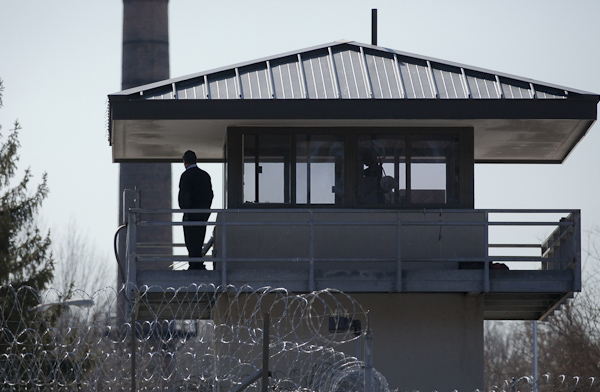
The guard tower at Bedford Hills Correctional Facility.
This project was conducted with generous support from the Fund for Investigative Journalism.
One day in the visiting room of New York State’s Albion Correctional Facility, LaTrisa Hyman heard her friend and fellow inmate shriek, “He proposed to me! He proposed to me!” Looking across the room, she saw her friend’s elated new fiancé, still on one knee, saying, “She said yes!” The bride-to-be was beaming. She had told Hyman, during previous walks in the recreation yard, that she was in love, but Hyman didn’t expect her engagement. Hyman and the other inmates jumped up from their tables to rush over to the couple and congratulate them but sank back into their seats when the correctional officers guarding the room began yelling at them.
The officers needed to maintain order in the room, but their reaction may also have been colored by the identity of the man asking for the inmate’s hand: He was one of their own—a correctional officer.
“Sit down!” they yelled.
Thirty minutes later, when visiting time ended and the inmates queued up to return to their housing units, the newly engaged inmate showed Hyman the ring, a gold band with a sparkling, roughly half-carat diamond in the center and smaller stones along the sides. The bride-to-be explained that her intended was retiring from his job in one week, would most likely be able to avoid discipline for having what prison officials considered an inappropriate relationship with her and was already entitled to his pension either way. The bride-to-be also told Hyman they’d never had sex, an act that would have been a crime.
Jeanette P. also got a ring from a correctional officer while doing time in a New York State prison, and they did have sex—regularly for about two years. She and the officer, Peter Z., fell in love at Bayview Correctional Facility, a medium-security prison on the West Side of Manhattan. Other inmates knew they were having a romantic relationship. One saw him leaving her room with his shirt untucked and scolded him, “Fix your clothes, boy!” But by the end, Jeanette alleges, he was hitting her, and she was afraid to report him to prison officials out of fear he would harm her more.
Sexual encounters between inmates and officers can also begin violently, with officers forcing inmates who have never loved them or wanted to have sex with them to submit. That’s what a former inmate alleges happened to her at Albion Correctional Facility in 2007, and in August federal judge David G. Larimer agreed. (City Limits is referring only to inmates and officers who have been named in previous media accounts). On two occasions, once in May and once in June 2007, the then officer, Donald L. asked her to report to a school building to clean it. When she arrived each time, Donald tried to rape her, the judge found. One time, Donald succeeded, ripping her clothes and bruising her, the judge said. Citing her substantial emotional and psychological suffering—including anxiety, flashbacks, hopelessness and trouble resuming a healthy sexual relationship with her husband—the judge in August ordered Donald, who never showed up in court, to pay the inmate $500,000 in damages. In an earlier criminal trial, Donald pleaded guilty to third-degree rape, not forcible rape.
Last month, officials from the New York State Department of Correctional Services, or DOCS, were summoned to Washington to testify before a federal panel. The subject: inmate allegations of sexual abuse by prison guards. When surveyed anonymously in 2008 and 2009, 11 participating U.S. correctional facilities posted the highest rates of inmate alleged staff sexual abuse. Three are New York prisons.
One New York State prison—Bayview Correctional Facility—has the highest rate of inmate-alleged staff sexual abuse in the country. With 11.5 percent of inmates there reporting it in 2008 and 2009, the prison’s rate of inmate alleged sexual abuse was more than five times greater than the national average for women’s prisons, 2.2 percent.
About 57 percent of the participating Bayview inmates alleged being forced into the sex or threatened with force. Also calling on DOCS to account for its prevalence of staff sexual abuse are the inmates themselves. The state of New York is embroiled in at least five inmate-initiated federal or state lawsuits about the issue, and for the past eight years, two New York City Legal Aid Society attorneys have been demanding, through a federal lawsuit they filed on behalf of 15 female prisoners, that DOCS implement changes.
Through spokesperson Peter K. Cutler, DOCS officials declined to comment for this story, but they have defended their policies and practices in various forums. A 1996 New York State Law holds that any person in custody in a New York State correctional facility cannot consent to any sex act with an employee who provides custody, medical or mental health services, counseling services, educational programs, or vocational training for inmates. A 2007 law expanded the definition of employee to include any person, including volunteers and contract employees, providing direct services to inmates. DOCS has sought another expansion that would apply the law to all DOCS employees. DOCS has taken action against several officers who have broken this law. According to the agency, between 1996 and 2002, 19 male prison employees were convicted of violating it.
In addition, DOCS has attempted to combat staff sexual abuse by implementing several new measures over the years, including the placement of surveillance cameras in prisons. DOCS has maintained in court proceedings that it appropriately hires, supervises, trains and fires prison employees who don’t follow the rules and the law.
And data that the agency has reported to the federal Bureau of Justice Statistics, or BJS, suggest that DOCS keeps officers in line. The bureau defines staff sexual abuse as all sexual contact—including that in which an inmate is a willing participant—and all verbal sexual harassment and voyeurism. According to DOCS, abuse is rare in the state’s facilities—with only 79 substantiated incidents from 2005 through 2009—and rarely involves force or threats of force—six incidents during that time period. At Bayview, DOCS reports that there were two substantiated incidents of staff sexual abuse during this time, and one of them, in2005, involved physical force.
But a City Limits investigation found that DOCS’ official numbers may not tell the whole story.
Documents obtained via the Freedom of Information Law indicate that prison officials never forward many inmate complaints to the prison system’s inspector general, who is officially responsible for investigating them. At the seven facilities serving women, 15 percent of allegations lodged from 2005 through 2009 were not reported to the inspector general.
And when DOCS substantiates a romantic relationship between an employee and an inmate, it does not include that relationship in its annual federal tally unless sexual contact has also been substantiated, officials say. The practice of excluding such incidents complies with BJS guidelines, but critics say it masks the state’s real prevalence of staff sexual abuse.
In addition, DOCS’ handling of one year’s recent sexual abuse reports casts doubt on the accuracy of the data it gave the federal government that year. In 2007, the agency reported 47 incidents of staff sexual abuse, then withdrew 23 of them, saying they didn’t meet BJS criteria. (DOCS did not allow City Limits to review those 23 cases, preventing us from confirming that they didn’t belong in their annual federal tally.)
Advocates for prisoners also criticize DOCS’ approach to determining whether allegations of staff sexual abuse are true, saying the burden of proof is too high and that investigators don’t give ample consideration to the history of complaints against certain employees. The 79 substantiated cases of staff sexual abuse from 2005 to 2009 came from a pool of some 1,100 inmate allegations. Critics also charge that DOCS fails to appropriately discipline many employees involved in substantiated incidents of sexual abuse. While DOCS points to its record of prosecuting staff who break the law, it did not refer workers for prosecution in 16 of the 44 incidents from2005 through 2009 where the worker ostensibly violated state statutes. And in 15 out of the 60 incidents in which sexual contact occurred between 2005 through 2009, the employee wasn’t fired and didn’t resign the year that the incident was substantiated. In one case, the only sanction applied was “discipline or reprimand.”
Officials from the state’s two corrections unions—the New York State Correctional Officers & Police Benevolent Association and the New York State Law Enforcement Employees Union, Council 82 —did not respond to requests for comment.
Hyman doesn’t know whether her friend and the officer ever married, but if they did, they would be the exception to the rule. Inmates in romantic relationships with staff often “date” or have sex with them in exchange for relatively benign and inexpensive contraband—such as gum, food from the outside and sneakers. But sex and romance between inmates and staff can have disastrous consequences.
An employee in love with or sleeping with a prisoner compromises his authority to discipline and control her. He may start to show her preferential treatment, bringing her contraband and allowing her to break rules for which he disciplines others. (Or allowing him to break rules for which he or she disciplines others—any combination of pronouns works, since female guards also fall in love with inmates.) Such favoritism can foment violence between inmates.
Mental health experts have argued that staff-inmate romantic and sexual relationships aren’t good for the inmates either. If the relationship sours, the inmate can’t always physically distance him- or herself from the employee and is subsequently at his or her mercy.
These concerns are especially keen for women inmates. For at least 35 years, legal advocates, prison officials and corrections unions have wrestled over how to protect female inmates from sexual abuse when male officers—who dominated the profession in New York State in 2010, making up 75 percent of prison guards—are given vast control over female inmates’ lives and bodies. While staff sexual abuse occurs in men’s and women’s prisons and jails, it disproportionately affects female inmates, who are a stark minority in the state’s prison system. According to DOCS, 25 percent of all substantiated incidents involved female inmates—who constituted a mere 2,500, or 4 percent, of the 58,000 people in custody on Jan. 1, 2010.
According to DOCS data, when female inmates are sexually abused, the perpetrator is almost always a male officer. From 2005 to 2009, all but one substantiated incident involving a female inmate involved a male employee. Over the years, many corrections officers and DOCS officials have been sued in connection with the allegations. The inmates often lose. But occasionally inmates win, as did Donald L.’s victim in August. Another former Albion prisoner won in February when she negotiated a $75,000 settlement of a lawsuit alleging she was raped in 2005 by a corrections officer who pled guilty to sexual misconduct and official misconduct. And in a 2001 inmate victory, a New York State Court of Claims judge found that DOCS was 100 percent liable for the repeated forcible rape of a woman by an officer at Bedford Hills Correctional Facility in Westchester County. The state settled the case by agreeing to pay the woman $225,000.
The trial in one of the other ongoing lawsuits, the one about the affair between Jeanette and Peter, ended in November. The parties are waiting for a judge to decide whether New York State bears any responsibility for what happened to Jeanette. Two more pending cases are expected to go to trial this year.
A major ruling could also be issued this year in Amador v. Andrews, an eight-year-old federal lawsuit filed on behalf of 15 New York State women demanding policy changes within DOCS. The pending suit alleges that the sexual abuse of women in New York State prisons isn’t just a series of unrelated incidents perpetrated by prison employees. The Southern District lawsuit alleges numerous ways in which it says DOCS’ system for hiring, training, supervising, monitoring, investigating and firing officers fails to protect women. The parties are waiting for an appeals court judge to issue a ruling that could determine whether the case has a chance of securing any changes or will be confined to assessing whether individual officers violated individual inmates’ civil rights.
The federal government, meanwhile, is close to issuing national guidelines for preventing sexual abuse in prisons. But states are not required to follow them, and New York State prison officials have taken issue with several of the draft regulations released in 2009. In a May 2010 letter to the U.S. Department of Justice, DOCS commissioner Brian Fischer wrote, “Unfortunately, the proposed standards are based more on academic research than on operational practicalities and will likely contribute to many more years of debate and litigation.”