


Photo by: Meredith Hoffman
Leticia, 17, came to the United States alone at age 14. With the help of her two lawyers she won Special Immigrant Juvenile Status, so she can stay legally in the country.
Leticia was 15 when Border Patrol agents climbed on her Greyhound bus in rural Louisiana and started asking people for papers. The Guatemalan girl panicked. She spoke almost no English and carried a recently expired six-month visa. After days traveling alone she was almost to her sister’s Texas home, but the agents pulled her out to the humid afternoon and brought her to an office with other undocumented immigrants. “I thought I’d definitely be sent back,” recalled Leticia (whose real name won’t be printed to protect her identity) of that day in January 2009.
Leticia’s story is one that occurs every day and frequently to young immigrants in New York. The Department of Homeland Security (DHS) picks up about 8,000 unaccompanied, undocumented minors each year, according to the Office of Refugee Resettlement, and 85 percent of them come from Guatemala, El Salvador and Honduras. These immigrant youths then face deportation proceedings—and over half must do so without a lawyer.
Section 292 of immigration law, gives immigrants the right to representation—but not to free, government-appointed lawyers. And because undocumented youth usually have no money, they must rely on pro-bono lawyers to step in for defense.
Growing concern about lack of counsel
In May, Judge Robert A. Katzmann of the 2nd U.S. Circuit Court of Appeals drew New Yorkers’ attention to the lack of counsel in immigration court when he released the New York Immigration Representation Study, the culmination of research by the Katzmann Immigration Representation Group and the Vera Institute of Justice.
The report found that about 60 percent of all immigrants in New York court lack counsel. And counsel makes all the difference: Immigrants who haven’t been detained have a 74 percent success rate in court if they have legal counsel, while those without lawyers have only a 13 percent success rate.
Mayor Bloomberg pledged $2 million for the Immigration Fellows Program, an initiative paying more experienced attorneys to teach young lawyers immigration law. However, the program hasn’t yet begun due to budget difficulties, said Fatima Shama, Commissioner of Immigrant Affairs. The government, working with Katzmann and other players, hopes to announce a new resource for immigration representation by the end of the year, Shama said.
Meanwhile, New York’s Department of Youth and Community Development funds legal assistance for immigrant minors each year through organizations like the Legal Aid Society and the Door , a non-profit youth services provider. But with the increase in the detention of unaccompanied minors, there aren’t enough attorneys for everyone.
Without a lawyer, even if immigrants speak no English, they must represent themselves in court. And even if they do speak English, they are completely unfamiliar with complex immigration law. For minors who may not understand their defense for staying in the country, the process is even more labyrinthine.
She’s spared detention
Leticia already felt perplexed by her situation when she went to the Department of Homeland Security station in St. Charles, Louisiana. Kept outside the office because she was a minor, she peeked into the building. Inside, fellow immigrants were yelling and some stood with shackles on their feet.
Evening came and the adults inside were carted to a detention center, while Leticia was placed in a holding room in the office.
“It had bars on the outside, and I slept on the floor. A woman watched me. She stayed awake all night,” said Leticia. “They said someone had to get me by 11 a.m., or I’d be taken to detention, too.” Leticia’s aunt, with whom she’d been staying, flew down immediately and brought her back to upstate New York. Though Leticia did have family in the United States, she had no legal guardian, and so was seen as an unaccompanied youth by the law.
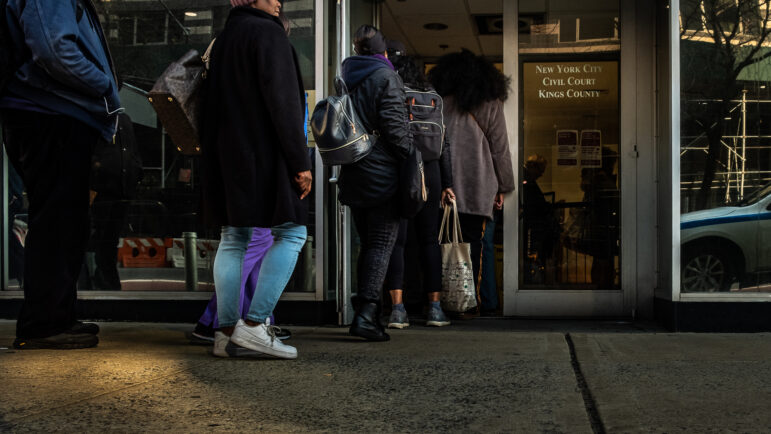
Leticia then went with her aunt to her first immigration hearing in New York City, and, after it ended, an immigrant rights advocate named Anna Marie Mulcahy approached Leticia in the building to inquire if she had a lawyer.
“I didn’t—we couldn’t pay for one. I was so surprised someone cared,” recalled Leticia. Mulcahy was from the organization Kids in Need of Defense (KIND), a non-profit co-chaired by Angelina Jolie that trains lawyers to do pro-bono immigration law for youth. KIND matched Leticia with lawyers Rosanne Baxter and Mauricio Gonzalez from the firm Boies, Schiller and Flexner, and they began working on her case, to help tell her story to the court.
Multiple avenues, all difficult
The Department of Homeland Security (DHS) apprehends children, and keeps them in federal custody for about 72 hours before handing them to the Office for Refugee Resettlement (ORR), says KIND’s executive director Wendy Young. ORR houses children—even those with legal representation—in shelters, foster homes or detention until the end of their deportation proceedings. Then, if the child loses his case, a deportation officer accompanies him to the airport of the home country, where hopefully the government there takes him.
“How it’s done can be very dicey,” said Young, citing the disorganized repatriation efforts of governments receiving the children. Young knows children who have been killed upon return to their home country, and others who began attempting remigration to the United States as soon as they were deported.
Immigrants who are unaccompanied minors can get lawful permanent residency in the U.S. by obtaining Special Immigrant Juvenile Status (SIJS), which they can qualify for if they face “abuse, neglect, or abandonment” in their home.
Other paths to remain in the United States are asylum status, T-Visas for trafficking victims, U-Visas for crime victims, and temporary protective status for victims of natural disasters or other crises.
Asylum, the most common, requires a proof of political threat in the immigrant’s home country, and KIND’s executive director Wendy Young said asylum is particularly hard to prove as a youth.
“Kids often don’t know something may have political implications…This is all not just about knowing immigration law, it’s about kids’ lack of capacity to know what’s going on,” she said. Fighting for SIJS status is equally difficult. “With abuse and neglect, you have to draw the story out without further traumatizing the child.”
Seeking broader change
Leticia’s lawyers argued that she should receive SIJS, on the grounds that she felt unsafe in her family’s home. Back in Guatemala, she had started working at age 12 to afford school. After two years of court proceedings, she won SIJS, and now has legal permanent residency. She lives in Dutchess County—about two hours north of New York City—with her aunt and attends school there.
Since KIND began in January 2009, it has trained over 2,200 lawyers in youth immigration proceedings. Though the organization’s efforts are expanding, supplementing the already-existing pro-bono services of the Legal Aid Society, thousands of children remain unrepresented. In fact, 3,000 more unaccompanied children were taken into custody in the year 2010 than the previous year.
“It may be since it’s harder and harder to cross the border as an adult, so many kids are crossing alone,” speculated Young. She said that KIND wants not only to help more youths, it wants to assure representation for them all. She said that section 292 of immigration law —which says that people have the privilege of legal counsel in removal proceedings—might be interpreted to mean free council, especially for vulnerable populations. “We believe it should be free for kids. The odds are so against them.”