

Photo by: Jarrett Murphy
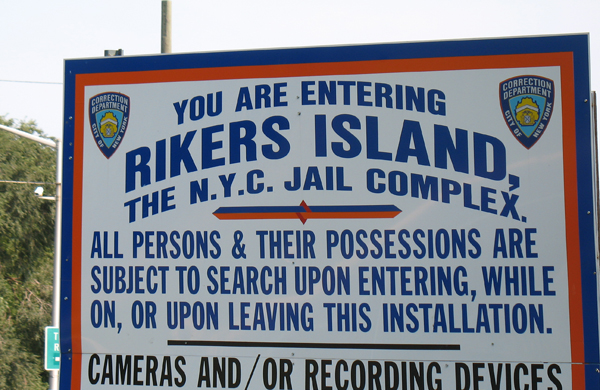
The city’s jail system consists of a network of facilities, including two secure hospital wards, a floating jail anchored in the Bronx and borough lockups in Brooklyn, Queens and Manhattan. The bulk of the city’s prisoners—who are either awaiting trial or serving sentences of a year or less for misdemeanors—are housed in one of the 10 jails on Rikers Island.
Every day about 200 new inmates arrive from courthouses across New York City to be booked into Rikers Island. Generally within 24 hours, they undergo a process that can have life-and-death consequences, the intake process.
During intake, an inmate performs the mundane tasks of making phone a call, getting his photo taken, showering and storing his personal property with jail officials. But he also undergoes critical medical and mental health screenings and answers questions that will help jail officials establish his risk for violence—including suicide—and strategically avert it.
Thus far, the current intake process works smoothly and has “stood the test of time,” the Department of Correction’s Luis Rivera, who oversees intake at Rikers, said in May.
So it’s ironic that at the same time, jail officials have been saying since at least August that the intake process needs a major overhaul, one that involves the construction of a new $660 million, 1,500-bed jail.
Coming at a time when the city’s crime rate is near an historic low and many say the city needs the money for other projects, the proposed new jail has some criminal justice advocates balking. Meanwhile, the Department of Correction (DOC) has recently revised its own projections of how many people the city is likely to put behind bars in the future.
An evolving plan
The city’s jail system consists of a network of facilities, including two secure hospital wards, a floating jail anchored in the Bronx and borough lockups in Brooklyn, Queens and Manhattan. The bulk of the city’s prisoners—who are either awaiting trial or serving sentences of a year or less for misdemeanors—are housed in one of the 10 jails on Rikers Island.
A new jail has been in discussion since at least 2006, but the city’s plans have evolved substantially since then. First, the city unveiled plans to build a new jail in the South Bronx and expand its use of the Brooklyn House of Detention, with the aim of replacing deteriorated jail space on Rikers Island and keeping prisoners closer to courthouses and families. When the proposed Bronx jail met stiff community resistance, the focus shifted to building a new facility on Rikers Island.
Throughout that process, part of the rationale for the jail has been replacing decaying jail infrastructure on Rikers Island. But DOC also sees the new facility as part of a revised approach to prisoner intake.
That overhaul, which is scheduled to begin this summer, will ultimately convert the jail’s intake system from one run by corrections staff working at seven jails across the island to one run by corrections staff who are intake specialists operating at one central intake facility, inside the new jail, scheduled to open in 2017.
Department of Correction spokesman Sharman Stein says the changes will speed up the intake process and make it possible for the jail to collect more information about inmates, improving safety and easing the inmate’s reentry into society after their jail term.
Commissioner Dora Schriro says the overhaul will also make the jail run more efficiently, but says the plans are too embryonic yet to quantify those efficiencies. “Because we don’t have an architect yet and haven’t begun any design, we have some general forecast of what the staffing of the new facility would be. But to give you those kinds of specifics, we’re certainly a ways out from that,” she says.
In a May interview with City Limits, Schriro added that while it’s important for the city to invest in education and in community and economic development, it’s also important to spend enough on jails. “Some segment of the population is always going to be incarcerated,” Schriro said. “So the city also has a responsibility to confine that population in facilities that are safe and secure.”
Sizing up newcomers
Accurately assessing an inmate’s mental and physical health and establishing his risk profile is one key to preventing suicides. It also helps prevent inmate-on-inmate violence, by facilitating the separation of aggressive inmates from more docile ones. (In 2010, the jail had two suicides. This year, thus far it has had one. In the first four months of fiscal year 2011, there were 1,345 inmate fights, including 19 slashing or stabbing incidents.)
Correctly identifying each inmate’s risk for violence also reduces the costs of building and maintaining jails, because maximum security buildings cost more than minimum or medium security ones.
But it can be hard to accurately screen and assess inmates for a variety of reasons. In some cases, jail staff members don’t pay enough attention to the inmates during intake, following the scripts and questionnaires given them by supervisors in a rote fashion, said Jennifer Parish, a legal aid attorney who advocates for the civil rights of mentally ill jail inmates. “When you’re assessing people, it’s not just asking them questions,” Parish said. “You’re reading non verbal cues, reading their body language. I think it’s pretty different from training people to go through a script.”
In other cases, “people who are suffering from depression may not be forthcoming about their condition,” said board of corrections member Catherine Abate at a recent meeting of the board, which oversees city jails and the DOC. Inmates may also attempt to obscure other conditions and risk factors.
The jail’s new centralized intake system could increase the accuracy of intake screenings and assessments. Under the new system, the jail staff responsible for assessments and screenings won’t be distracted by other job duties. Because the number of jail staff involved in screening and assessing new inmates will fall, it will be easier for their managers to ensure that they’re doing it correctly, Parish reasoned.
In addition, the specialists will have more time to observe inmates before sending them to their permanent housing, Schriro said. With 900 intake beds, newly admitted inmates will be able to remain under the observation of these specialists for up to four days.
Overhauling the intake system could also help the jail improve its efforts to help plan for the release of inmates, says Michael Jacobson, executive director of Vera Institute of Justice, a think tank that researches criminal justice issues, and a former commissioner of the DOC.
In 2003, Parish negotiated with the city a settlement that requires the jail and various city agencies to improve their efforts to help mentally ill inmates continue their treatment when they leave jail. Since then, court monitors have determined that DOC’s efforts to plan for the post-release treatment of mentally ill inmates have improved, but are still insufficient. Jacobson says Schriro “really wants to start looking at how the stuff you do at intake can impact what they do when they leave and ensure they don’t come back.”
During the first phase of the overhaul of the intake system, jail staff will add some new questions to their assessment screenings and add more assessments. During the second phase of the overhaul, set to begin in the fall of 2012, the intake process will begin to occur in one central location for the first time in DOC history, in a group of renovated sprungs and modulars, temporary buildings that once served as inmate housing. During the third phase, set to begin in 2017, the intake process will start occurring in the new jail.
The intake process could probably be improved without centralizing it in a new jail, but the DOC’s plan is best, Jacobson says. “If it wasn’t possible to do it centrally, you can obviously do it,” he says. “But if you have the opportunity to design something specifically for intake as opposed to jamming it into some 50 year old facility, as opposed to doing what you have to do, why not take it?”
How many inmates to plan for
Improving intake remains only part of the argument for constructing a new jail. The city has also consistently argued that many of its current supply of jail beds are not usable. What is unclear is whether the city believes there will be increased demand for those beds, after years of decline.
Between 2001 and 2010, there was a sharp drop in serious crime in New York City, with index felonies falling 35 percent. For years, this trend influenced New York City’s decreasing jail population, which on Tuesday morning was 12,402, reflecting a drop of 40 percent between 1993 and 2010.
At a September meeting of the board of corrections, Schriro explained that one reason New York City needs a new jail is that the city’s jail population is expected to increase slightly. She projected that average daily population, would increase from 13,200 to 13,500, and that peak population would be 14,750. (She did not supply a timeframe for either projection.)
Ultimately, she said, the system won’t have enough usable beds for the future unless more are built. “The devil that we deal with today is having the wrong number of beds: either not enough beds or not enough beds that afford constitutional conditions,” she said.
But DOC spokeswoman Stein now says the agency’s most current projections show no population growth. She said she didn’t know the updated average daily population projections, which are scheduled to be released in about a week.
DOC has previously argued that even under current conditions, the city’s peak population cannot be properly housed. Of the system’s current 19,400 beds, only 14,750 are usable, Schriro says. That’s not enough to accommodate the peak capacity of 14,750 Schriro projected in September because some of those beds are in the infirmary or segregation, areas where inmates should not be housed without a valid reason. The new jail will raise the number of usable beds to about 16,500, enough to accommodate peak capacity. It’s unclear if the projection of peach capacity is also changing.
Advocates split
Kate Rubin, the director of public policy for the Bronx Defenders, says she supports renovations of Rikers Island that are necessary to ensure humane conditions of confinement, but would prefer that the city not build a new jail. “I don’t like this jail being built. I don’t agree with it. I can think of five or six things where the money can be spent. This jail is not our biggest priority,” she says.
The city’s plan entails a net decrease of about 2,800 jail beds. Because the DOC will have to clear some acres to build the new jail, thousands of the unusable beds will be eliminated before it is constructed. Rubin acknowledged that many jail beds are in decrepit buildings, but questioned the logic of building a new jail if the DOC’s ultimate goal is fewer jail beds. “They say this is part of our grand plan to downsize and our line on that is, ‘You don’t add to subtract,'” she said. “If you want to reduce the capacity, why are you building a new jail?”
Too many of the people taken into correctional custody in New York City are mentally ill and shouldn’t be jailed at all, said Dr. Robert Cohen, a member of the Board of Corrections, at a recent board meeting. “The Board of Corrections should be concerned that our responsibility increasingly becomes to take care of people who shouldn’t be in jail,” Cohen said. “The danger is that if you build it they will come. It would be a shame to use these limited funds increasing the size of the detainee population in New York City.”
Advocates say the jail beds are filling largely because of unjust policing strategies that target low-level misdemeanants in black and Latino communities, particularly those possessing marijuana. Last year, there were 50,000 arrests for marijuana possession, more than for any offense, comprising one in seven arrests in New York City, according to the Drug Policy Alliance, an organization that promotes alternatives to the drug war. Eighty-eight percent of those arrested for marijuana possession in 2009 were black or Latino, according to a study published in 2009 by Harry Levine, a Queens College sociology professor.
“When you ask why we’re spending $60,000 a year to lock someone up on a marijuana charge it doesn’t make sense,” said JoAnne Page, executive director of the Fortune Society, a non-profit that promotes successful reentry from prison and alternatives to incarceration. “We ought to be locking up fewer people.”
Despite her reservations, Page supports the DOC’s plans to build a new jail, pointing to the overall reduction in jail beds under the plan and the need to upgrade Rikers’ decaying housing stock.
“I want us locking up fewer people, but to the extent that we are locking people up, I want to see no expansion and better facilities,” Page said.