

Photo by: Marc Fader
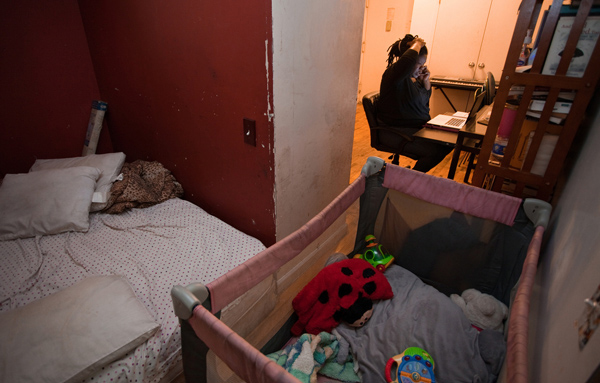
Tanya Fields is a college grad who is starting a nonprofit focusing on food activism. For the time being, she counts on public benefits to support herself.
More Americans are poor than ever before, and the national poverty rate is at its highest level since 1994. Meanwhile, one in five New Yorkers lives in poverty. But poverty is absent from our civic discourse. Everyone is tired of talking about poverty, it seems, except poor people. Perhaps that’s because the rhetoric around the topic has rarely resembled reality. The latest issue of City Limits explores the lives of four low-income New Yorkers, including Tanya Fields.
It’s Monday, Jan. 31, and as usual, Tanya Fields is having a hectic morning. The Bronx mother of four has already had to juggle her schedule after her babysitter called in sick, forcing her to be late for an important appointment in downtown Brooklyn. But on this occasion—unlike her daily work running a nonprofit star-tup or her prior years as an environmental advocate—there’s no calling in sick or asking to reschedule: This appointment is for trying to keep her welfare benefits.
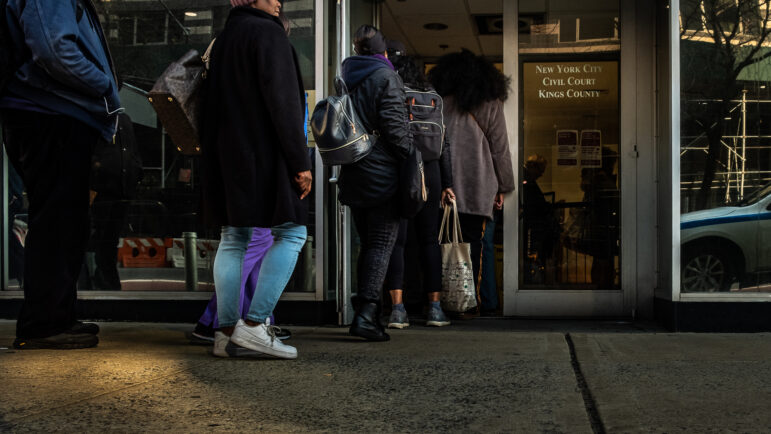
Fields is a blur as she sweeps into the lobby waiting room at 14 Boerum Place, the glass-and-steel downtown Brooklyn building where low-income New Yorkers must come to apply for “fair hearings”—in which a judge can rule on challenges to decisions handed down by the Human Resources Administration, the giant city agency that oversees public benefits like welfare, food stamps and Medicaid. She passes through the metal detector that greets visitors at the door and rushes up to the window, where she talks calmly but animatedly with the worker on duty.
A minute later, shaking her head, she approaches the table of Project FAIR, the service staffed by Legal Aid lawyers that offers pro bono advice and referrals to fair-hearing applicants. Fields begins telling her story. The previous month, she explains, HRA cut o the welfare benefits and rent assistance she had been receiving since she stopped working full time two years ago during a difficult pregnancy. She’d filed for a fair hearing to object to the cutoff , and her hearing date was this morning. Unfortunately, by the time she’d arranged for a substitute for her sick sitter, she’d missed her hearing, and now just what is she supposed to do?
It’s the kind of story that could be told by any number of the people who have packed the Boerum Place waiting room to bursting and now patiently wait for their numbers to be displayed on an overhead LED board. According to the most recent official figures, more than 130,000 fair-hearing requests are filed in New York City every year, almost double the total from five years earlier. Fields, though, is somewhat exceptional, and not just because of the thick red braids and ever present sunglasses that make her stand out in any crowd. She also has a tale to tell that involves both extraordinary personal turns of events and byzantine bureaucratic headaches—though at Boerum Place, the latter are pretty much par for the course.
From work to welfare
Eight years ago, as a 22-year-old first-time mom, Fields graduated from college with a political science degree and was working at her first job, as an administrative assistant at NorVergence, a company in New Jersey that sold discount Internet and phone service. She had just rented her first apartment. “I was so excited. I came in and paid three months’ rent in advance,” she recalls. “I was like, ‘I’m not going to be a statistic. I’m never going to have to move home, and I’m never going to need to get on welfare. I’m going to take care of me and my child.’ “
Instead, she says, the company folded. “It was a scam. It was all over the news. Three months after moving in, I lost my job, and I didn’t have any savings. And I went and I opened a PA case.” (Welfare benefits go by many names—public assistance, cash assistance or Temporary Assistance to Needy Families—but in the language of both the welfare bureaucracy and the people who receive the benefits, they’re inevitably called “PA.”) Fields’ first stint on PA lasted a little less than a year. Since then, she says, her life “has been about trying to backtrack and get on footing from seven years ago.” She was, she says, “always robbing Peter to pay Paul. If you don’t have a down period where you can regroup and get it together—which I have really never had—it’s very difficult to try to play catch-up.”
By the summer of 2009, Fields was at least partly caught up, earning $40,000 a year working for an environmental organization in the Bronx, and pregnant with her fourth child. She developed complications with her pregnancy, however, and ended up taking disability leave from her job.
To supplement her disability insurance—which is capped at $170 a week in New York State—a state disability worker suggested that she apply for welfare benefits. With only minor bureaucratic hitches—”I was eight months pregnant when I applied, and they made me go see their doctors to verify that I was, in fact, pregnant”—she was soon receiving food stamps (now renamed Supplemental Nutrition Assistance Program, or SNAP), Medicaid coverage and $237 in cash every two weeks, plus $450 a month as “shelter allowance” to help her pay her $727 monthly rent on the one-bedroom apartment in the South Bronx that she shared with her children.
After her baby was born that fall, Fields returned to her job, only to ¬find her hours had been cut to only 10 to 20 a week. She quit in January and found another part-time job, with the intent of spending her spare time launching a nonprofit organization to start green economic-development projects for poor women, an issue that she’d grown interested in at her previous position. Instead, she says, she found herself spending much of her time wrangling with the city Human Resources Administration over her PA benefits, which she’d kept to supplement her reduced income.
First, HRA informed her in April that it was withholding part of her PA benefits for “concealment,” or hiding income. This, it turned out, was the echo of an old charge from 2005 that HRA had withdrawn after Fields filed for a fair hearing. (Such withdrawals are extremely common: Nearly 60 percent of fair-hearing cases end with the city withdrawing charges, according to HRA figures.) Now, ¬five years later, HRA was reviving the old withdrawn allegation and wanted to cut Fields’ PA benefits—which had already been reduced to $90 every two weeks when she returned to part-time work—to $23 every two weeks.
Fields applied for another fair hearing to challenge that finding several weeks later but missed it, she says, when her daughter got sick. And in any case, she wasn’t sweating the PA money, since she still had a paycheck.
“In all fairness, I wasn’t really hard-pressed. e most important things to me were the health insurance, SNAP and the shelter allowance.” Those hadn’t been cut, so she decided to live with the biweekly $23 welfare check and dropped the fair-hearing request.
A business decision
Last November, Fields got laid off from her part-time job and went on unemployment. It was at this point that, she says, she decided to “forge full ahead, go back to school for my MBA, as well as really taking time to build this organization and get it to the point where it could be self-sustaining and where I would be self-employed.” Within a week, though, she received a notice from HRA telling her she would need to “recertify,” the process by which the agency tracks changes in people’s financial circumstances: If you’ve gained or lost income, it will show up on a recert, and your benefits will be adjusted accordingly.
“I figured, this is perfect timing, because I could go in and use this opportunity to let them know about the change in my income,” as a result of her leaving her job and planning to go back to school. If anything, she thought, she might get a little more temporary help while she got her new business going.
Instead, she was told that her PA case had been closed three days before. The problem: Her $1,100 a month in earned income from her now-ended part-time job, the city said, exceeded the $1,062 monthly maximum for PA eligibility. This meant she would lose that last $23 a week in PA benefits—but more important, her $450-a-month shelter allowance too.
Fields was left with only $1,008 a month in unemployment insurance to live on—plus $698 in food stamps—out of which she had to pay household expenses plus her $727 monthly rent. Her immediate solution: She stopped paying rent. “There was no way for me to pay the rent without us all going hungry and broke.”
It was at this point that Fields filed the fair-hearing request that has brought her to Boerum Place this day in January. The Project FAIR paralegal on duty has some hopeful news for her: HRA was supposed to have disregarded half of her earned income for purposes of calculating her eligibility, and it looks as if they failed to do so. Now, though, she has missed her appointment and must wait for a new one in February— which means, in all likelihood, the rent will go unpaid for another month.
Demographically, according to HRA figures, Fields is fairly typical of welfare recipients in New York City. At age 30, she is smack in the middle of the 25-to-44-year-old demographic that makes up 41 percent of welfare recipients; like 43 percent, she is black; like 82 percent, she is a woman. (Her four kids are an outlier: Among recipients of TANF, the welfare program for families with children, the average number of children per household in New York City is 1.68, according to HRA data.) But in other ways, she is anything but typical: As a graduate of Brooklyn Tech and Baruch College, she has a level of education that is rare among the city’s poor.
“I don’t come from the cycle of poverty,” she says, noting that she was raised in Harlem by a blue-collar-worker father. “I have certainly had people in my past who have utilized the welfare system. But it wasn’t something in our family that we were ever proud of. I don’t remember my father ever using food stamps. It was very entrenched in us that you make your own way in life.”
It’s that drive that motivated her to start the BLK ProjeK (or “the Black Project”), her nascent nonprofit, and throw all her time and energy into it despite the risks of giving up her only source of steady income while raising four kids. The organization’s goal is to build grassroots economic-development projects around issues of food and the environment. “I didn’t know if it was called food justice or food racism,” she says of the ideas that prompted the project. “I knew it was called ‘I’m spending too much damn money on food that doesn’t taste that good and is making me fat.’ ” She is full of ideas: encouraging urban farming on a plot of land near her Bronx apartment (something she says she’s gotten a pledge of $250,000 from Councilmember Maria del Carmen Arroyo to help launch), creating cooperative housing, making connections with rural farmworkers, getting a license for a Green Cart and using the cart as a worker-training program for local women, setting up healthy snack carts outside schools to compete with shaved-ice vendors.
Since leaving her last job, she’s worked from home. Still, her two children who are too young for school are in daycare—she tried working with the kids at home, she says, but found it impossible. “It was great—don’t get me wrong. But I’d take a break and play Mega Bloks, and then I’d look up and half the day would be gone.” Instead, she sends them to a neighbor who runs an informal child care business—paying the cost for the past year and a half with the help of child care subsidies provided by HRA—and contents herself with occasionally visiting them for lunch.
Fields admits to feeling “shame and disappointment” at receiving welfare. “I have friends who are teachers and lawyers and going back to get their doctorates and own real estate,” she says. “Being surrounded by that oftentimes makes me feel very lonely.” Rushing to keep up with both her work life and her PA case, she says, gives her constant reminders of her straddling two worlds: “It’s beyond ironic to be in the welfare office and be on a conference call with a councilwoman. There’s something about that that’s so funny, it’s not funny.”
Fields also knows well that she’s an odd case, as someone who’s chosen to strike out on her own rather than seek another wage job. But she insists she’s no different from other New Yorkers who decide to start their own businesses: “e reality is, if you don’t have significant savings, if you don’t have some top-line credit you’re willing to put up as collateral, if you don’t have a home you can maybe take out equity on—and now, that’s not even an option—this whole patriotic American idea that we’ve got of small-business owners, that’s not reality. For a low-income person, when you don’t have some real societal investment and some real hand-holding, you are taking an enormous risk that can cost you everything—your home, your children and everything. And that is the point that I’m at right now.” And she’s indignant whenever city caseworkers suggest that because she’s working for herself, she shouldn’t be receiving PA. “This is a case of me having a hardship that is not permanent, that is temporary, and using a safety net to get through that. This is what you are supposed to exist for,” she says.
Her father, she says, will occasionally encourage her to just get a job, any job, and save her nonprofit work for her off-hours. Fields says she thinks about it—”I bartended and waitressed in college”—but she tried that path before, and it wasn’t working. Instead, she’s mulling how to turn her expertise into speaking fees or other income.
“I’ve got a good brain in this big ol’ head of mine,” she wonders aloud. “How do I use this?”
Hunting for help
On the last day of March, two months to the day after her missed fair-hearing appointment, Fields is late yet again, this time for a meeting at the Legal Services of New York office in the busy South Bronx shopping district of the Hub; she explains that she “needed to print some things out.” Asked for a court paper, she shuffles through a two-inch-thick yellow folder until she finds it.
This time, it turns out, being punctual wouldn’t have helped: She can’t get an appointment until the end of the next month. That’s a problem, because she’s facing a Housing Court date the following Monday—a product of her decision to stop paying rent when her welfare and shelter allowance were eliminated. She wants help from LSNY at the hearing, but on learning that won’t happen, she shrugs and heads for the train downtown to Union Square, where she needs to visit the mammoth city social services center at 109 East 16th Street to deal with the latest complications in her HRA case.
At her rescheduled fair hearing in February, she explains, no immediate decision was reached. However, the HRA representative recommended that in the interim, Fields was welcome to reapply for benefits.
And so, in early March, Fields went to her local job center—as city welfare centers have been rebranded since the Giuliani administration—to submit an application to open a brand-new PA case. “I told the gentleman that I’m self-employed, that I’m getting unemployment, but that I have a job that I’m working more than 35 hours a week.”
That 35 hours is a key threshold for anyone applying for public assistance in New York City. The main legacy of welfare reform is its work requirement: According to the 1996 law, states must show that at least half of all “job ready” individuals receiving welfare are working at least 30 hours a week (20 hours for those with children under 6 years of age). HRA upped that to 35 hours in 1999, according to agency spokesperson Carmen Boon, in order to “create and reinforce strong work habits through a 35-hour week comparable to a regular workweek.”
At the Ryder Job Center in the South Bronx, Fields received two surprises: First, while her part-time salary had been considered earned income, her unemployment insurance was tallied as unearned income—and that counted differently toward calculating her PA. (The city allows an “earned-income disregard” that ignores half your work income for the purpose of deciding whether you’re eligible for PA; unearned income, including UI, gets counted in full.) Her benefits under this new PA case, she was informed, would be just $92 a month— including both her PA and shelter allowance—though she would still be eligible for child care subsidies and food stamps.
Second, Fields may have been working hard at starting the Black Project, but it was an odd kind of work, with no pay stubs or other proof of employment of the kind HRA usually expects. “So he says, ‘Well, I don’t know how to put this in the system. So I’m going to send you to the Back to Work program. I want you to play nice, and they’ll give you an exemption.’ ” Fields knew enough about the welfare bureaucracy to be wary of Back to Work. The centerpiece of HRA’s strategy for moving individuals off welfare and into jobs, it has been allocated more than $300 million since it was instituted in 2006 and has been a lightning rod for criticism. The low-income membership group Community Voices Heard charged in 2008 that only 8 percent of people referred to Back to Work end up placed in jobs for at least 30 days. (HRA has strenuously objected to CVH’s conclusions, noting that some participants drop out because they ¬find work on their own; according to HRA data, 20 percent of people “enrolled and assessed” by Back-to-Work end up in jobs that last at least 30 days. Of those placed in jobs, the agency says, 77 percent stick with them for at least 90 days.) “I knew something about this didn’t sound right,” she says. “But it’s 8 o’clock at night, I’ve been there for six hours, I just want to get out of there, so I say, ‘OK.’ “
Once she arrived at her assigned Back to Work vendor—the city contracts out all its job-readiness work to a handful of large private not-for-pro¬ t organizations—she was told to attend a required orientation, which turned out to be a three-hour test of, she says, basic reading and math skills.
“Surprise, surprise, at the end of the test, they’re like, ‘Wow, you did really great. I don’t think we’ve had anyone who ever came in here and had these types of scores.’ And I’m like, ‘Well, I have a college education, and I have a job. I have a solid work history. That’s what I came here to speak with you about.’ ” Eventually, she was able to contact the agency director, who recognized her from her previous job. But he had bad news: He couldn’t give her an exemption. She’d need to go through the Back to Work training and job search; otherwise, her case would be closed for “failure to comply.” She managed to wrangle a five-day extension and headed back to the Ryder Center. “And guess what—the case is FTC’d anyway.”
FTC, for failure to comply, is the catchall term that the city gives to any infractions against welfare rules, whether quitting job training or failing to show up for an appointment because the notice never arrived (or the babysitter got sick).According to figures that HRA provided to Councilmember Brad Lander last November, in the first nine months of 2010, 44 percent of PA applications were denied; of those, nearly two-thirds were for failure to comply. Fields says the Ryder worker could neither tell her why she’d been FTC’d nor do anything about it. “Once that happens, they all become slaves to the machine: ‘Well, the computer automatically did this, and there’s nothing we can do, other than tell you to start it all over again or ask for a fair hearing.’ “
Even after her PA case closed in December, Fields remained eligible for transitional aid, since she had, in HRA’s eyes, “transitioned” from being poor enough to be eligible for PA to a paying job. For three months, she still received about $1,000 a month in transitional child care vouchers. With the FTC, those have been cut off . Her goal today on East 16th Street is to see if she can somehow get them reinstated.
“The whole system is messed up”
A half hour after leaving the LSNY office in the Bronx, Fields arrives at her destination, the third-floor office for applications for child care subsidies. The waiting room is packed with bored women and their even more bored children. A 2-year-old sleeps across two faded blue metal chairs, a stuffed dinosaur in a green T-shirt sitting beside him. A printed sign offers advice about transitional child care, which it says is available to anyone who has gotten three months’ consecutive PA in the past year and is currently working: “If you do meet these guidelines, call 311 and ask for the ACD program.” In pen, someone has corrected the word do to don’t.
Fields marches up to the desk and recites her saga of aid cutoffs and fair hearings and failure-to-comply notices, in truncated form, to the worker there. “Right,” Fields concludes, “it’s a mess.”
She returns to the waiting area, where the kids are growing even more bored—if possible—by the minute, as are their parents. It’s like a pediatrician’s waiting room, only with no toys or magazines. Fields mutters that somebody should at least provide juice boxes. e last time she was here, she recalls, was seven years ago, when the office was open on Saturdays; that’s since been ended. It’s a policy that strikes her as insane, given that she’s here to apply for transitional benefits, which are specifically for people who are transitioning o benefits after finding a job: “If I’m working, I can’t be here.” Fields has a meeting set up for later in the afternoon with a potential intern for her project. She’s now afraid she’ll have to cancel. She’s hopeful, though. Workers like to clear out the waiting room by noon, she says, so they can go to lunch.
Sure enough, she’s soon telling her story yet again, this time to a different worker, whose eyebrows go up as she listens to the tale of Fields’ journey from full-time employee to part-time worker getting supplemental benefits to self-employed nonprofit founder with a welfare case open, then closed, then open again with reduced benefits, then FTC’d. The worker nods sympathetically and purses her lower lip. Fields hands over paperwork from her yellow folder: a letter from a board member of her organization, a letter from the program that donates her office space.
“Do you have your W-2?”
“No, that’s the thing. I’m self-employed.”
The worker disappears into an inner office, then returns. She huddles with Fields behind a pillar by the counter. Finally, Fields returns to the sea of chairs with an oddly bemused expression.
“So they’re not going to restore my benefits, because I need more proof of my income,” she says of the transitional benefits that were cut o in March, . “But … “
She holds out a computer printout: her results from the rescheduled fair hearing back in February, which the worker has just looked up; they were released, it turns out, only this morning. The judge has agreed with Fields—and her Project FAIR adviser back in January—that HRA miscalculated her eligibility when it closed her old PA case in December.
This makes the dispute over her transitional benefits moot. Now she will be getting all her original benefits restored, including child care and housing, retroactive to December. She will still need to work on getting it sooner rather than later—HRA has 30 days to comply with fair-hearing verdicts—but now she can at least go in to her Housing Court hearing on Monday and promise that money is coming soon.
“And,” she says excitedly, “now I can make my meeting!”
As Fields enters the elevator, two young women get on as well. One is complaining loudly to the other: “They’re trying to get me off public assistance, and I have to go back on public assistance to get child care? That don’t make no sense!”
Within half a minute, Fields has given the woman her card. “The whole system,” she advises her, “is just messed up.”
This article is the second chapter in our July magazine exploring the complexity of low-income life as it is lived by individual New Yorkers. To read the third chapter, click here. To read the rest of the feature, begin here.