

Photo by: Marc Fader
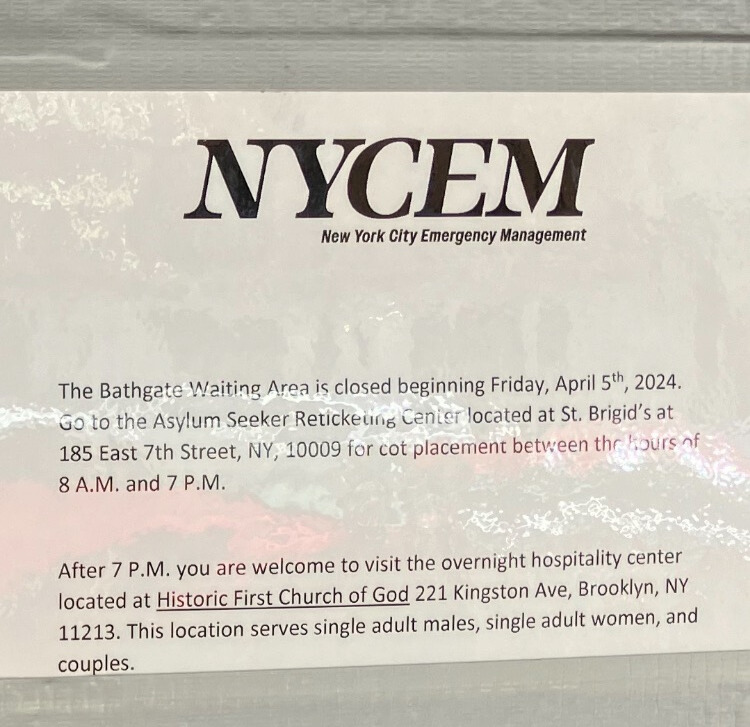
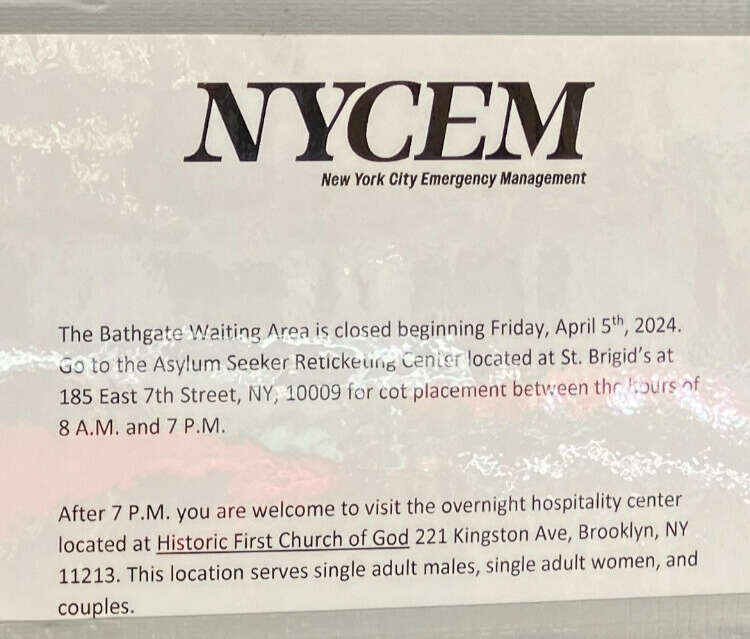
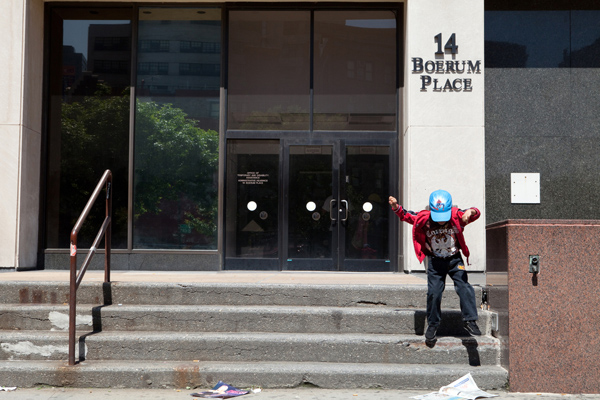
Public benefits recipients who wish to challenge a decision by the city’s social services agency go to the fair hearing site at 14 Boerum Place.
More Americans are poor than ever before, and the national poverty rate is at its highest level since 1994. Meanwhile, one in five New Yorkers lives in poverty. But poverty is absent from our civic discourse. Everyone is tired of talking about poverty, it seems, except poor people. Perhaps that’s because the rhetoric around the topic has rarely resembled reality. The latest issue of City Limits explores that lives of four low-income New Yorkers, including Walter Greene.
Walter Greene is, at least, set for groceries. On this drizzly Saturday morning in February, Greene has just made his first visit to the Metro Baptist Church’s weekly food pantry. Every Saturday, about 150 people patiently queue up outside the century-old church, hard by a Lincoln Tunnel entrance ramp in the wasteland blocks west of Times Square, before entering and showing free membership cards that entitle them to enough food to provide three to four days’ worth of meals for each household member. On this day, Greene emerges with a shopping bag stuffed with boxes of cereal, canned goods and even some fresh produce for himself and his wife.
Now all he needs is somewhere to cook it. “We’re in a non-cooking facility,” explains Greene, who looks younger than his 51 years. “In the shelter, the [Department of Homeless Services] police come in there and they search everybody’s rooms. Stuff that they ¬find in there that we ain’t supposed to have in there, they throw it out. Like our hot plates, the spoons and forks, and stuff like that.”
Greene, like the other estimated 3.3 million New Yorkers designated “food insecure” because they don’t always know where their next meal is coming from, has another option: He could go to a soup kitchen to eat. Unlike food pantries, which use a combination of government grants and private contributions to supply groceries, soup kitchens serve prepared meals, at least until the food runs out.
But Greene would rather prepare his meals himself, especially since he has diabetes. “Me and my wife, I’m able to cook, she’s able to cook. I just can’t eat everybody’s cooking.” Instead, he says, he sometimes risks the wrath of the Department of Homeless Services (DHS), which runs the shelter at 317 West 45th Street where he and his wife have lived for the past year, and sneaks in a hot plate: “But we’ll clean up behind ourselves, ’cause that room is very clean, the little room that they give us.”
One tough year
This has been a difficult year in Greene’s life. In early 2010 the moving company in Brooklyn where Greene worked suddenly shut down. “He just closed down completely—he didn’t want to run it no more,” he says, his southern drawl betraying his North Carolina origins. (His family moved to New York City when he was 6.) He tried finding jobs doing the same things he’d been doing in his 30-year working life—moving, roofing, driving a forklift, “working on cars every now and then”—but he says he had little luck in the current economy. Soon, he and his wife were forced to vacate their Brooklyn apartment and begin their tour of the homeless shelters run by DHS.
The move gave them membership in a recently less exclusive club. The exact number of homeless New Yorkers is a matter of intense debate. The city, citing figures from its annual Homeless Outreach Population Estimate—or HOPE—in which volunteers fan out across the city each January to count people living in the streets, says street homelessness has declined 40 percent since 2005, to 2,648 individuals. Advocates for the homeless—particularly the Coalition for the Homeless, whose senior policy analyst Patrick Markee has waged an annual media war against the HOPE figures—insist that the city’s count misses numerous people, especially because it’s taken in the dead of winter, when many otherwise street homeless may be tempted to enter a shelter for the night.
The one thing the two sides agree on, though, is that the number of shelter dwellers, while down slightly from a couple years ago, is still near an all-time high. The city’s current shelter census is over 35,000. Forty percent are children; of the 8,000 or so single adults, nearly three-quarters are men.
Greene says the first two shelters he was housed at, the El Camino Inn on Jamaica Avenue in Queens and the Park View Hotel on Central Park North, weren’t so bad. Then, after a brief breakup with his wife in which he stayed with his mom at a senior facility in Brooklyn, they reunited and were assigned to the DHS shelter in the former Aladdin Hotel on West 45th Street.
This shelter, Greene says, is a nightmare: “It’s nasty. People throw shit out their window. I been in one before, but it wasn’t like this, with people throwing food and throwing feces out the window. It’s totally pathetic and nasty.”
A prewar brick building on an unassuming block in the theater district—across the street from both a Broadway show and a “gentleman’s club”—the Aladdin (formerly the Longacre, as its faded sign still identifies it) gives little indication from the outside that it’s home to 117 homeless couples. On closer inspection, though, one sees the guard posted in the lobby and the signs pasted to the front door: “New curfew: 8 p.m.-4 a.m., Effective 4/7/11.”
As if on cue, a woman emerges and asks what the interest is in her building. “You have to tell everyone how terrible this building is!” she says, giving her name as Lakiya. “It’s stinky. We got bedbugs.” The city pays $3,000 a month to house couples there, she alleges, when for $1,000 a month they could be providing vouchers for private housing.
Life at the Aladdin
Visitors to the building—those who are allowed past the guard—pass through a lobby with vending machines for snacks and prepaid phone cards, as well as stacks of drywall and tiles waiting to be installed. Much work is being done on the former hotel, building manager John Warren explains as he helps lead a DHS-organized tour, following its conversion into a Next Step shelter in March.
Next Step is a program for homeless individuals who, explains DHS deputy commissioner Barbara Brancaccio, “just aren’t getting it” in terms of following an independent-living plan. To that end, residents at Next Step shelters are offered extra social services—at the Aladdin, Volunteers of America is contracted to supply 15 staffers, including housing specialists and a “client responsibility coordinator”—and also extra rules: the no-hot-plates edict, says Brancaccio, is part of an attempt to eliminate “distractions.” The overall message, she says, is “Now you have to get it together. Now your work is you.”
And does this result in people getting it together faster, and thus shorter shelter stays? “We would hope,” says VOA program director Jack Clark.
Inside, the Aladdin looks not unlike any other slightly run-down Manhattan apartment building, albeit with tiny rooms barely large enough for a bunk bed. ( is is a particular complaint of Greene’s, who misses the old double beds, even if they took up most of the room: “I got to take the top bunk in order for me and my wife to lay down, so when we sit up, we don’t be hitting our heads.”) There are no immediate signs of vermin.
The worst thing on display on this day—at least in the small sampling of unoccupied rooms offered up for perusal on the tour—is a broken sink covered in a trash bag. In another bathroom, the bathtub is clean but covered in chip marks; Brancaccio makes a face, with an expression that almost exactly matches that of a New York City real estate agent explaining, “All that will get cleaned up before you move in.”
In a small meeting room lined with computers that, Clark explains, will soon be available to shelter residents for them to work on résumés and the like, shelter officials say they’re working to improve conditions at the Aladdin. The problems with people throwing things from the roof, Brancaccio suggests, could have been because residents were climbing scaffolding on the front of the building, since removed. A second DHS official, program administrator Marian Moore, says more security cameras have been installed, plus “window bars, so folks can’t throw stuff out of the window.” Another new rule that’s helped, says Moore: limiting TVs to no bigger than 19 inches, which she says has kept down the noise, as well as resident arguments about the same. Greene has no complaints about the lack of large-screen TVs, but he does about the curfew, which had been set at 10 p.m. at all city shelters since 2009 and is now 8 p.m. at all Next Step shelters. (This, Brancaccio explains, is another attempt to remove “distractions.”) Anyone not in by curfew, says Greene, gets “signed out” and must go back to DHS to be re-placed. “Then they’ll keep you down there two or three days. If they don’t -find you nothing, you got to sit there. You can’t lay down in the chairs or do nothing.”
“I’m trying to just get out of the shelter system, period,” he says. “There’s too much stuff going on in the shelters—people walking the halls all night with drugs in the building. I don’t want to be around that stuff .” His wife, he says, did drugs in the 1980s but is now clean. “I don’t want her to fall back and go back to that stuff again. We’ll be in the same boat we was in before.”
Can he work?
To get out of the shelter system, though, Greene needs money. And that is turning out to be a problem. After his layoff, Greene applied for public assistance and was rewarded with $76 a month in cash bene¬fits, plus food stamps. In February, though, his bene¬fits were unexpectedly cut off.
The troubles began, he says, when he was called in to work a one-day moving job on a military base. He dutifully submitted his pay stub to his local Job Center (the city offices that handle public assistance cases), he says, to report the $136 in income. “The next month,” he says, “I went to go get my food stamps and my cash on my card, and they said I was turned off , that I was making too much money. So I said, ‘How am I making too much money? I only worked one day a week.’ “
Greene eventually concluded that the HRA worker had incorrectly entered his one day’s pay as his daily rate for a full-time job. But it was too late, he said. His case had been closed. There was nothing to do but reapply and start the process all over again.
Thus began weeks of visits to various government agency offices. First, he was sent to ARBOR, one of the main HRA contractors, for eligibility veri¬fication review, the procedure by which the city determines who is eligible for bene¬fits and who among them must be enrolled in work programs.
“They wanted me to go to a job program, which I can’t do because I got high blood pressure and I’m taking pills and stuff for my leg,” says Greene. (In addition to his high blood pressure and diabetes, he says, he has a sore shoulder from working moving jobs and a bad knee that keeps him from walking more than a few blocks without pain.) “They said, ‘That doesn’t matter. You can still work.’ “
Greene says he was also doubtful about the kind of work that HRA could offer. “I don’t read that good, to tell the truth. I don’t know too much about computers, because I never went to school to go on computers. When I get work, I go to a tire shop. I change tires on a car. I do an oil change. You know, greasy work, that’s what I like to do. But all the stuff they tried to give me, I could not do it.”
Eventually, a test came back showing high blood sugar, which kicked him over to a new set of appointments with WeCARE, the city’s program of medical and psychological evaluations. (WeCARE, run under a contract with HRA by the private groups FEGS and—again—ARBOR, has earned criticism for poor oversight from the city comptroller’s office; it is the same program that forced Tanya Fields to make a doctor’s appointment to prove that she was eight months pregnant.)
Apparently it was determined that Greene needs dental work. He answers one phone call with what sounds like a mouth full of cotton: “I just got three teeth pulled.” For now, he spends his days alternating between doctor’s visits and job-training classes, though he has doubts the latter will ever -find him a job he’s qualified for.
But for the interim, at least, Greene and his wife have their PA benefits restored. It’s hardly a fortune: $194 a month in cash aid plus $244 in food stamps, for Greene and his wife combined. Still, this is actually about 20 percent more than it would have been three years ago. In 2008 the state legislature agreed to a 30 percent hike in the PA grant, which hadn’t been adjusted—even for inflation—in 18 years. The last 10 percent of the hike, though, was canceled as part of Gov. Andrew Cuomo’s budget cuts, costing Greene and his wife about $20 a month in extra income.
“It’s not enough for us,” he says—especially since without a kitchen or a refrigerator at the shelter, he can’t cook. “It’s crazy.”
This article is the third chapter in our July magazine exploring the complexity of low-income life as it is lived by individual New Yorkers. To read the fourth chapter, click here. To read the rest of the feature, begin here.