

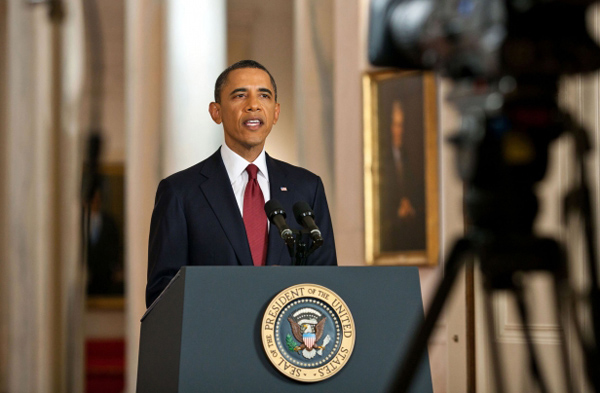
Photo by: White House
In his budget battles with Congress, President Obama has defended two new antipoverty programs, Choice Neighborhoods and Promise Neighborhoods, that both use an array of programs to fight poverty in small geographic areas.
Amid the partisan battles that erupted over this year’s $3.4 trillion-dollar federal budget, few observers noticed the skirmish involving President Obama’s anti-poverty programs. In their budget plan, House Republicans zeroed out all three parts of the president’s Neighborhood Revitalization Initiative: the school-centered Promise Neighborhoods, the housing-focused Choice Neighborhoods and the law enforcement-oriented Byrne Criminal Justice Initiative.
While Byrne ended up unfunded, Promise and Choice survived with $30 million and $65 million apiece—far less than Obama requested but more than might have been expected in a political environment where concern for the poor is absent.
“They were trying to kill everything in sight,” says Patrick Lester of the United Neighborhood Centers of America. “What ended up happening is the president pushed hard.”
Obama began to chart his antipoverty approach in a 2007 campaign speech in which he praised the work of Geoffrey Canada and the Harlem Children’s Zone, an effort launched in 1994 to provide comprehensive services to all residents of a low-income, 97-block area of central Harlem. About a decade into that effort, the HCZ launched the first of two charter schools that have become the hub of the entire Harlem project. Promise Neighborhoods is an effort to take that idea of school-generated neighborhood change and replicate it in other communities.
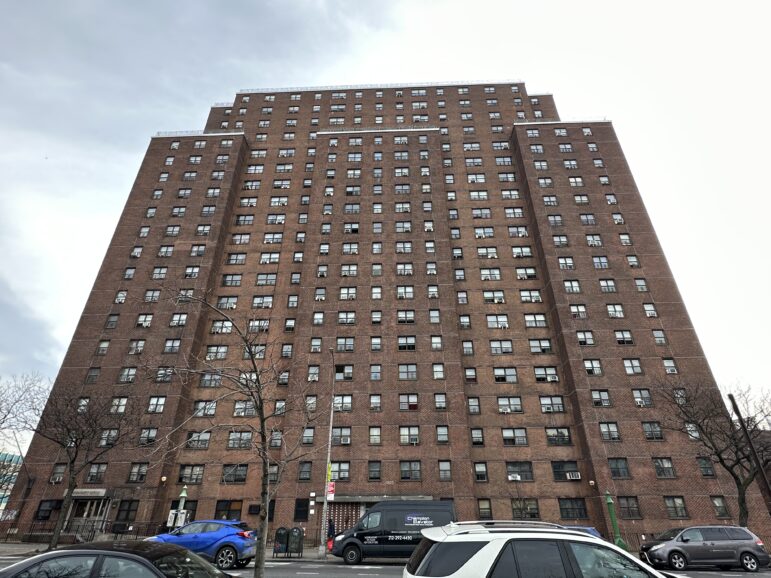
Choice Neighborhoods reflects a similar approach but has a different ancestry: It grew out of experience with the 1990s HOPE VI public housing renovation program. HOPE VI was launched to deal with distressed public housing developments, and it succeeded in destroying tens of thousands of units of failed housing (as well as some that were not in failure).
But many HOPE projects did not replace the demolished housing with anything that truly improved the neighborhood or the prospects for its public housing residents, in part because the program looked narrowly at housing and not at the other elements—economic development, schools, public safety, health care—that make a neighborhood viable. As HOPE’s shortcomings became apparent, latter-year HOPE grantees began to employ a more comprehensive approach, one that evolved into Choice Neighborhoods.
“Some of the best HOPE VI innovations were strategies that went beyond the housing and that went beyond the walls of the development” to look at education and the labor market, says Luke Tate, special assistant to U.S. housing secretary (and former New York City housing chief) Shaun Donovan. “It necessitated reaching into the neighborhood in a more integrated way rather than having public housing separate and apart from the neighborhood.”
Similarly, the Byrne Criminal Justice Initiative was an outgrowth of the Department of Justice’s weed-and-seed program, which combated localized crime by combining law enforcement and community restoration.
All three programs reflect the administration’s belief in place-based strategies that coordinate multiple agencies and programs to improve a particular neighborhood, city or region. This approach undergirds not only anti-poverty funding but also Obama’s urban-planning strategy, where the Partnership for Sustainable Communities is pooling funding from the Department of Housing and Urban Development (HUD), Environmental Protection Agency and Department of Transportation to address interlinked housing, transit and environmental challenges that particular places face. In 2009, the White House ordered all federal agencies to conduct a place-based review of their policies to see where arbitrary borders between departments might be adjusted to make programs work better and cheaper.
On the poverty front, that means that while the Department of Education has a lead role on Promise Neighborhoods, and HUD on Choice Neighborhoods, both programs might end up tapping into very broad—and very similar—sets of federal programs. Both Promise and Choice also put a premium on leveraging private investment to augment public dollars.
Last September, the DOE named 21 winners of Promise Neighborhoods planning grants (out of 339 applicants) of up to $500,000 each. Winners included a Boston Promise Neighborhood based around the 23,000-resident Dudley Street neighborhood, and a St. Paul, Minn., effort that will reach 250 blocks.
Choice Neighborhoods is also at a nascent stage. Because some communities had, through HOPE VI and other mechanisms, already developed a local planning process to develop local initiatives, HUD offered two streams of Choice funding this year—planning grants, which 119 communities applied for and 17 won, and implementation grants, which 42 communities applied for, with six being asked to submit more detailed plans for a final round of consideration.
In these early days, it’s unclear exactly what the Neighborhood Revitalization Initiative will look like once it is implemented because it will involve unique mixes of programs at different sites. More will be clear when the planning grant winners apply for a second of grants for implementation.
Among anti-poverty experts, Choice and Promise are greeted universally as interesting ideas. There’s debate, however, over how significant they’ll be. Sheldon Danziger, a leading poverty researcher based at the University of Michigan, isn’t sure that the Harlem Children’s Zone model will translate to other cities. “One would have to think that (questions about) our ability to replicate programs that are uniquely run by a talented and charismatic leader leads one to be skeptical about replication,” he says, referring to Canada, HCZ’s passionate, high-profi le leader, who has recruited politicians and hedge fund magnates alike to help the children’s zone succeed.
Danziger’s skepticism extends to the relatively small size of the programs, which are dwarfed by traditional safety net offerings like food stamps and the earned-income tax credit—programs that, he says, “are smashingly successful and more successful than those [new] programs could ever be.”
Lester is more optimistic. “It’s easy to conclude that these are tiny programs that in the long run aren’t going to change very much,” he says. But he adds, “These two programs are integrated into and touching these much bigger funding streams,” of existing DOE, HUD and other federal programs that, ideally, Promise and Choice will better coordinate. “What’s going to happen is, these much bigger funding streams are going to be dramatically transformed along the lines that are being addressed by these much smaller programs.”
That’s assuming, of course, that the new programs continue and expand to more low-income urban neighborhoods and rural areas. Obama has requested $150 million for Promise and $250 million for Choice in the fiscal 2012 budget. To date, Congress has given him nowhere near what he sought for either program; this year’s Choice money is actually being carved out of a different budget line. What’s more, Obama’s proposed 2012 budget halves funding for the Community Services Block Grant, which funds vital anti-poverty projects at a scale Choice and Promise don’t approach. More cuts will come if people averse to both deficits and tax hikes tighten their grip on Congress. As Lester points out, “The outcome of the next election will very significantly affect where this goes.”
This article appears in our July magazine exploring the complexity of low-income life as it is lived by individual New Yorkers. To read the rest of the issue, begin here.