

Photo by: NYS DOL
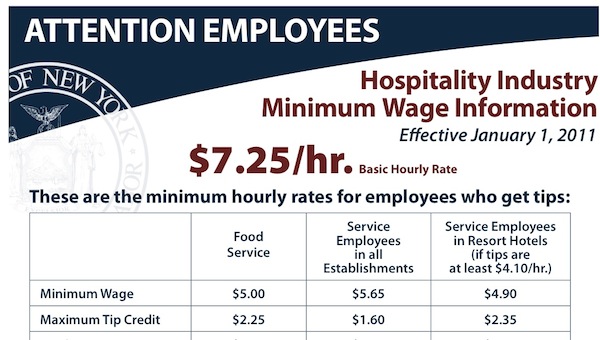
C says this poster, which employers are required to display, is prominently posted and routinely ignored at her place of work.
Like many students at Hunter College, C. is in her mid-20s, is working on her degree after several years in the work world and commutes to class from a shared apartment in Queens. But she stands out in one way, though it’s not one she goes out of her way to mention to classmates and teachers.
“I would love to be able to tell people, ‘You know, I’m undocumented,’ ” she says, “because I think it would shock them. My accent is not too strong. I’m young. I’m going to school. They would never characterize me as undocumented. The problem is, I am.”
A Canadian citizen born in Latin America, C. left Montreal at age 15 to escape an unstable family situation, landing in the living room of a young aunt in Brooklyn who was already raising a 3-month-old baby in a one-bedroom apartment. As she got settled and struggled to learn English, she says, “everybody forgot about the legal situation. But as a child, you’re not impacted by it—you don’t need a credit card, you don’t need loans. And then once I reached 18, everybody woke up and was like, ‘Oh, what do we do now?’ “
Immigrants are often seen as a reason for New York City’s high poverty rate. As the Manhattan Institute’s Steven Malanga wrote in 2007, “New York has a far greater stream of foreign-born residents arriving each year, relative to its population, than does the United States as a whole. And 27 percent come without even a high school education. No surprise then, as Census data shows, that 30 percent of all recent immigrants are poor (though less so than back home)—an average of about 23,000 new recruits to the ranks of the city’s poor every year.”
Yet according to Census data, the poverty rate for immigrants is actually slightly lower (17 percent) than for New Yorkers as a whole (19 percent), while noncitizens were only marginally higher (21 percent). And the Economic Policy Institute has estimated that immigrants have a higher employment rate than native New Yorkers.
Of course, undocumented immigrants often elude Census tracking. And being employed doesn’t mean being employed well. C.’s undocumented status turned out to mostly manifest itself in limiting the jobs she could apply for.
College offers a path
Without a green card or any hopes of getting one, she took whatever jobs she could: secretary, receptionist, restaurant cashier. She eventually started waitressing, which she says she likes best of all: “Behind the counter, you have to do a lot of cleaning, and you feel even more lower. It’s bad enough to work in a restaurant, but it feels even more inferior to have to clean while your bosses are staring at you.”
After four years of low-wage work, C. discovered that a 2001 state law would allow her to enroll at CUNY as an in-state resident, no questions asked, within five years of graduating from a New York high school. She promptly enrolled at Hunter and set out to figure out how to juggle schoolwork and enough paid work to afford her tuition—as an undocumented student, she’s ineligible for TAP or Pell grants or even book money.
“Every semester, it’s a puzzle,” she says. “I’ve tried only school on my day off, but that doesn’t work, because you’re exhausted. I’ve tried going to school in the morning and working at night. That kind of works—it’s just a very long day.” This semester, she’s managed to keep her course load limited to three days a week, which gives her two mornings a week for schoolwork before heading off to her 3-to-11 waitressing job.
It’s homework, she says, that is the backbreaker. “I could take seven classes if it was just going there. The problem is the work.” On days that she has no classes, she gets up at 9 a.m. and studies until she has to leave for work at 2 p.m., not returning home until after midnight; on school days, she reads on the train, on her lunch break, whenever she can squeeze it in. The MTA’s proposed ban on eating on trains, she observes, would present her with major logistical problems: “That would really affect me,” she says. “You’re running all the time. It’s hard to eat a sandwich when you’re taking notes.”
Plenty of work, an absence of rights
C.’s life is already complicated by her fluctuating income: She receives no base pay, only tips. “Sometimes the bosses are nice enough, and they give you a base salary,” she says. “I’ve known a lot of restaurants that just give you $10 [a day], basically to show up. And the restaurant that I work at, they don’t give anything. You just depend on tips. Some nights in winter, when it’s really bad, I walk home with $35 in my pocket, for an eight-hour shift.”
This is, of course, flagrantly illegal. New York State labor law requires that food workers make at least $5 an hour in wages, before tips. But no one at her restaurant, says C., has ever complained. “They know you’re stuck,” she explains. “I’m not talking about a restaurant like McDonald’s or Applebee’s that are corporations, that have laws. I’m talking about mom-and-pop restaurants that usually the people that work there, they have no other choice.”
The one nod to the law, she says, is a large “Know Your Rights” poster that’s posted in the kitchen. “It’s even in Spanish. It’s so wonderful. The dishwasher, as they’re cleaning the dishes for $3, $4 an hour, they’re reading that.”
Her latest dilemma: Her restaurant has started requiring uniform shirts but has only provided its staff with two apiece, leaving full-time workers to buy additional shirts out of their own pockets. “Everybody’s talking about it, but what can you do? Do you really want to mess around with your job for a shirt?”
Stalled legislation would help
There has been a raft of legislation in the City Council over the past few months targeted at low-income workers: a failed bill last year that would have required all employers to provide sick leave, another this year that would mandate a living wage for employees of companies that receive city development subsidies. C., though, is skeptical that such measures could work. She has never called in sick, she says: “One time I was really sick, my voice was really hoarse, and my nose was red. I was talking to my boss, and she was holding a piece of paper in front of her mouth. And I was like, Really? You need to cover yourself, but you’re going to let me work and serve your customers? I didn’t understand that.”
In all, C. estimates she earns a little over $20,000 a year, which puts her at about twice the official poverty line for a single adult with no children. With that, she pays for all of her expenses, including the $600 rent on her room at an apartment she shares with two other people. She figures this leaves her about $500 a month for school, which just about pays for her Hunter tuition.
She gets by, she says, until she needs to go to the dentist or fill a prescription. (Since the 1996 welfare reform law, illegal immigrants have been ineligible for Medicaid.) “This is when it becomes tricky: When I put my budget on paper, everything seems manageable. But then life gets in the way.”
Now two years in toward her B.A. (she is pursuing a double major, on the honors track), she’s been nominated for a private scholarship designed to support minority students through higher education, as far as a Ph.D. if possible. But after that, she’s uncertain. “I will get a degree, and then what do I do with the degree, since I don’t have documents?” After all this, will she still be stuck working as a waitress? That, she says, would be “really lame.”
“I think it’s very sad,” she says. “As a 24-year-old female, I’m doing all the right things to get out of poverty, and I can’t qualify to have papers? But the government says that I can marry anyone, and in three months they send you your [Social Security number]. I think it sends the wrong message.”
City Limits’ July issue is an in-depth look at poverty’s causes and consequences as faced by individual low-income New Yorkers. To read their stories, click here.