

Photo by: Marc Fader
Even more than sewer overflows, routine emissions from water pollution control plants are a hazard to Jamaica Bay’s health.
The July 20 fire at the North River Wastewater Treatment Plant, on the shore of the Hudson River in upper Manhattan, shut the plant down for 64 hours while workers toiled feverishly to repair it. During that time, an estimated 200 million gallons of pure untreated sewage flowed directly into New York City’s waterways – a little more than the capacity of two medium-sized oil tankers.
It was the city’s highest-profile sewage disaster in years, but whether it was the worst is a matter for debate. Another– though less spectacular – candidate for that honor is the ongoing overflow of sewage and stormwater runoff that happens as a matter of course whenever there is heavy rain.
These releases, known as combined sewer overflows, or CSOs, stem from an antiquated city sewage system that channels household waste and storm runoff through the same pipes. When rainwater washing in from city streets fills the sewage system and threatens to overwhelm the treatment plants at the end of those pipes, officials divert the mixture into the city’s rivers and bays.
The release is not as concentrated as the undiluted sewage from the North River spill, but it is dirty in other ways – besides the sewage, the storm runoff contains trash and chemicals from streets and storm drains. Also, there is more of it: about 27 billion gallons, or roughly 320 of those same oil tankers, into New York Harbor alone each year.
The good news, city officials say, is that they are working on the problem. In May, a $400 million facility opened at Paedergat Basin, in Brooklyn, that will temporarily store overflow in holding tanks underground, preventing the discharge of some 1.2 billion gallons a year into Jamaica Bay. Moreover, last September the city’s Department of Environmental Protection unveiled its Green Infrastructure Plan, which aims to reduce overflows even further by stemming runoffs, using features like green roofs and permeable sidewalks on public and private sites around the city.
The bad news – aside from the hundreds of gallons of sewage and storm runoff in the water every year – is that implementing the plan will take time, and environmental advocates are raising questions about major parts of the city’s approach. That, they say, fits with the overall story of water quality in the city – one of tentative steps forward against the backdrop of a queasily familiar status quo.
Plan faces hurdles
The Green Infrastructure Plan aims to reduce CSO volume by more than 12 billion gallons a year by the time it is fully implemented – a process that would take 20 years. Before the clock starts ticking on that implementation window, though, the plan must clear several procedural hurdles.
One is with the state Department of Environmental Conservation, which regulates city-run sewage treatment plants and the city’s CSO abatement program, and which must grant its approval for the city to incorporate the Green Infrastructure Plan by amending existing rules. Negotiations between the city and state surrounding that approval are confidential, a DEC spokesman says, and have been going on for the last year. They are expected to yield a draft version of the new regulations soon, the spokesman says.
Even on matters that do not require state approval, the process of translating the concepts and broad goals of the Green Infrastructure Plan into detailed, binding law is laborious. Because much of the land where green infrastructure components can be installed is privately owned, the city is proposing an extensive set of incentives and regulations aimed at encouraging better stormwater control on private property. Many of the requirements – which would apply to new developments and modifications of existing buildings – are still in draft form, in a Department of Environmental Protection document called “Guidelines for the Design and Construction of Stormwater Management Systems.”
That document, some environmentalists say, is one place where the city’s implementation of sewage overflow-prevention measures falls short of its lofty goals.
In a letter to the DEP this month, the Natural Resources Defense Council said it was “deeply concerned”that the draft guidelines not only would not encourage property owners to install green infrastructure, but could actively discourage them.
Among the group’s objections, says Eric Goldstein, the group’s director of New York City environment, is an emphasis on slowing the rate at which stormwater flows into the sewage system, rather than reducing its overall volume. The distinction is important: Slowing the water’s entry into the system is a partial solution for controlling floods in some storms, he says, but would not do enough to reduce overall water pollution. Nor, he says, is there proof that simply delaying the release of stormwater into the sewage plants – rather than permanently diverting it, to be re-used, evaporated or absorbed elsewhere – will be enough to reduce CSOs.
“The whole heart and soul of green infrastructure,” Goldstein says, “is to capture stormwater on your property and use it for other purposes, not simply to send it at a lower rate to sewage treatment plants.”
Besides, says Phillip Musegaas, Hudson River program director at Riverkeeper, reducing the volume of pollution should be the ultimate goal. In a recent regional water-quality sampling project, he said, the river failed tests for swimmable water quality 21 percent of the time – in contrast with a 7 percent failure rate for beaches nationwide.
“They have to be able to have a plan that really sets out a roadmap to getting back to clean water and making these waters fishable and swimmable,”he says. “Everyone agrees that the goal is reducing stormwater pollution. But we want to make sure they reduce it to the point that the Hudson River and the harbor meet water quality standards.”
Questions around incentives
Because of the guidelines’ emphasis, the NRDC argues, developers who want to install green infrastructure elements like green roofs or other planted spaces receive little incentive from the city, and in fact may have to spend more money complying with regulations that the group calls misdirected. One example: the guidelines provide incentives for developers to build underground or rooftop storage tanks – which detain water only temporarily – but not green space or permeable pavement, which can absorb it permanently. And the proposed guidelines impose regulations on where infrastructure can be installed on private property, and the manner in which soil borings must be done, that strike the advocates as unnecessarily restrictive.
Larry Levine, the senior attorney in the group’s water program who wrote the letter, has argued separately that green roofs are much more cost-effective in preventing runoffs than the city has estimated. According to one study by Columbia University researchers, he writes, the city may overstate the roofs’ overall cost dozens of times over. Consequently, he adds, they present a more viable option than city policy currently recognizes, and therefore the incentive for installing them – currently a tax credit of 25 percent of the installation cost – should be even higher.
The larger benefit of green infrastructure, says Musegaas, is that even in dry weather, when it is not controlling stormwater, it serves other purposes, like reducing air temperatures and humidity and even beautifying the city.
In contrast, he adds, “A holding tank in Jamaica Bay isn’t doing anything to make parts of the Rockaways and parts of Queens more livable.”
Even so, and even though green infrastructure is much less expensive than such facilities, environmentalists said it is not enough on its own to solve the city’s CSO problem. Nonetheless, the goal, Musegaas said, is to maximize its use. The Green Infrastructure Plan’s target of installing water-absorbing elements on 10 percent of the available public property that can accommodate it, he argues, could be higher. And the city’s assumptions about the pace of private development and developers’ embrace of the plan’s incentives, he says, can seem ambitious.
Then, he says, there are the sewer overflows north of the city, in municipalities throughout the Hudson Valley, that eventually find their way downriver in to city water. Many of those are the result of aging facilities, faulty pipes, corrosion and leaks. The city has allocated $735 million in its 10-year capital budget to begin implementing the Green Infrastructure Plan, and this year has given out $3.8 million to private developers to build green infrastructure. That, though, is only a fraction of the amount that will eventually be necessary – and smaller municipalities north of the city have even less money to work with.
“The solution is an infrastructure solution and it’s a funding solution,”Musegaas says. “So it’s certainly a big challenge.”
A bad summer for the Bay
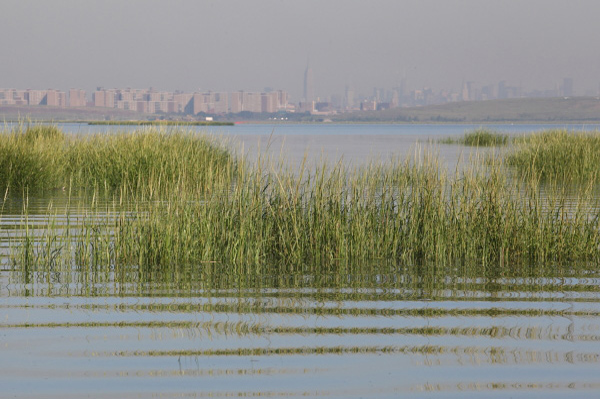
The challenge is large, too, in Jamaica Bay, the site of the new CSO containment tanks. During this summer’s hottest days, the bay was the site of a huge algae bloom – a result of high water temperatures and excessive nitrogen, a byproduct of sewage treatment. The algae, in turn, eats up oxygen in the water, creating dead zones that kill marine wildlife. The blooms are a regular occurrence in the bay in hot weather, but water-quality advocates said this year’s was one of the worst in memory.
“We had thousands of dead crabs on the surface. We had dead fish. We had dissolved oxygen levels of zero in some areas of the bay,”says Dan Mundy, a battalion chief in the city fire department who is also vice president of the conservation group Jamaica Bay Ecowatchers.
Nitrogen is not directly related to the CSO problem – it is discharged on a regular basis from city sewage treatment plants, which leave it untouched in household waste even as they remove biological contaminants. But even more than sewer overflows, Mundy says, its routine emission is a hazard to the bay’s health, as more than 250 million gallons a day of treated water flows out of the four sewage treatment plants that release water into the bay. That, he said, amounts to about 40,000 pounds a day of nitrogen.
The problem became so bad that two years ago that Mundy’s group and others, including the NRDC, filed a federal lawsuit against the city under the clean water act. This June, the two sides settled, announcing that the DEP will make $100 million in improvements to the four Jamaica Bay sewage plants by 2020, with the goal of cutting nitrogen outputs in half. Another $15 million will go to marsh restoration, and the city will set up five new water testing sites.
Mundy calls it an incomplete victory – the monitoring of the bay over the next decade will show how much other work is needed – but a critical one. Similarly, he says the city deserves credit for the CSO storage facility in Brooklyn, which he said is already yielding visible results, with less floating trash in the water immediately after rainstorms. And while Mundy, like other environmental advocates, believes that a combination of green infrastructure and traditional holding tanks will be necessary to address future CSOs, he called the city’s large expenditure on the facility important for symbolic as well as practical reasons.
“They kept telling us, ‘Well, we’re doing the Paedergat Basin at $400 million,'”he says. “It was hard to argue that they weren’t putting the commitment in.”
Enlisting the public
Other environmentalists, too, say the city is heading in the right general direction, even if progress has been halting at times. But Musegaas, of Riverkeeper, says that local governments should to more to publicize the dangers of sewer overflows.
“This is a long term problem, it’s not going to be solved overnight, and we really need to have a better system of informing the public of these water-quality problems when they occur,”he says. His group, he added, “firmly believes that if you inform the public about the challenges and your efforts to overcome that, you can get their support.”
On the implementation of the Green Infrastructure Plan, Goldstein, of the NRDC, was guardedly optimistic, emphasizing that the stormwater control guidelines that have drawn his group’s objections are still open for debate.
“This is just a draft,”he says. “There’s plenty of time for these specific guidelines to be revised to that the detailed legal language matches the laudatory rhetoric.”