


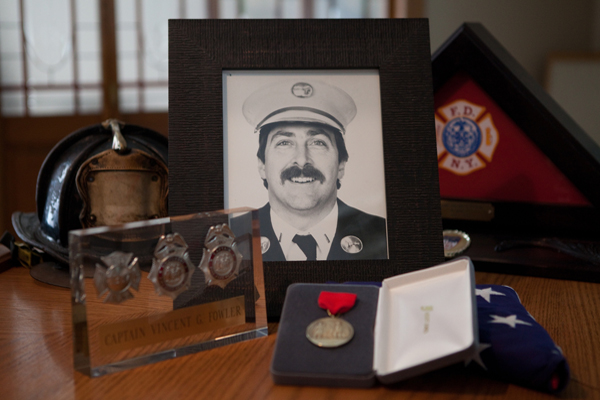
A memorial in the home of the late Captain Vincent Fowler, who died in a 1999 fire.
This is an abridged version of the fourth of five chapters in an investigation supported generously by the Fund for Investigative Journalism and the George Polk grants for investigative reporting administered by Long Island University.
During his 20 years in the New York City Fire Department, Vincent Fowler had thought more than most firefighters about death. A veteran of four different fire companies during his time on the job, Fowler developed a step-by-step protocol for firehouses to follow when one of their members is killed at a fire. “One of the first things he told the men surviving was to call their wives,” Ramona Fowler recalls. However, Fowler did not speak of the possibility that he might die. Nor did his wife dwell on the dangers of his job. “After you get through a certain amount of time, you figure that it’s not going to be him,” she says of the father of three.
Though he’d reached the point where he could have left the job and started drawing a pension, Fowler had decided not to even consider retirement until his three daughters finished college. He needed the salary, and he liked the work. Fowler had attained the rank of captain and was studying for the battalion chief’s test when, on June 3, 1999, he responded to a house fire at 150-28 127th Street in South Ozone Park, Queens. He went into a cellar, ran out of air and collapsed. Soon after, Ramona Fowler received a phone call, but not from her husband. The next day, Capt. Fowler’s death notification procedures were executed for his own demise.
Fowler was one of 43 New York City firefighters to die in the line of duty in the decade before and the decade after the Sept. 11 disaster. Ten died of heart attacks or other acute medical problems. Ten perished in collapses and four from falls and 18 died of burns or smoke inhalation. One was killed in combat as an Army reservist in Iraq, but his passing was considered a line-of-duty death.
Each death involved a unique person and unique circumstances. But according to investigations by the FDNY and the National Institute for Occupational Safety and Health, common contributing factors link many of the deaths. City Limits obtained FDNY investigation reports on 25 of the 1991-2011 deaths and NIOSH findings on 21 of the deaths during that span, including eight fatalities not covered by the documents that FDNY provided in response to our freedom of information requests.)
The FDNY has moved to address some of these factors. Other problems have proved more difficult to solve. And some, of course, might be inseparable from the risky work of fighting fires and saving fire victims.
Sometimes it was wrong information
Jan. 23, 2005, was a brutally cold day—so icy that Jeanette Meyran opted to walk to the grocery store near her Long Island home rather than risk driving there. Her husband, Lt. Curtis Meyran, had gone to work at a firehouse in the Bronx. He had been promoted to lieutenant two years earlier and was covering shifts at different firehouses to fill in for officers who were on leave or vacation until a permanent spot was found for him.
Walking back with her groceries in hand, Jeanette got a call from her son at home. There was an FDNY captain at the house. She dropped her groceries and moved as fast as she could across the frozen ground. All the captain told her on the drive to St. Barnabas Hospital was that her husband was hurt.
She remembers being hustled into a hospital room, where she saw a small man. “I know this man,” she recalls saying to herself. “Who is this man?” The man came over to her, put his arm around her and said, “I’m so sorry.” She still did not recognize him. “What are you sorry about?” she asked. Anxious glances were exchanged around the room; the men there suddenly realized that she hadn’t been told the full story. The small man turned to her again: “He didn’t make it.” Soon, Jeanette Meyran realized that the small man was the mayor of the city of New York and that her husband was dead. He and five other firefighters had been driven by fire out of a fourth-story window on 178th Street in the Bronx. Meyran and Firefighter John Bellew, a member of Ladder 27 under Meyran’s command, were killed in the fall. The other four were critically injured.
Bellew and Meyran were only the FDNY’s first casualties on what would come to be known as Black Sunday; a few hours later, Firefighter Richard Sclafani would be pulled unresponsive out of a cellar in Brooklyn, where he’d been overcome by smoke.
The deaths at 178th Street were blamed largely on an illegal subdivision of apartments that created a deadly maze for firefighters. A jury in 2009 acquitted the tenants, and last year a judge threw out on technical grounds a lower court’s conviction of the building owner. The Bronx district attorney is appealing the latter decision.
But several other factors played a role in the deaths on 178th Street. The FDNY investigation, for instance, found that “there were many failures” of communications procedures. “In many instances, members aware of important, even life-threatening information, did not transmit the information properly, did not get an acknowledgement, or simply never transmitted the information to anyone.” For instance, firefighters inside the building didn’t tell the incident commander that the fire was getting worse, and the commander didn’t pursue information about searches going on inside. And “when officers on the floor above realized that there were members trapped, they failed to notify the incident commander.”
The findings do not surprise Al Turi, a retired 34-year veteran of the FDNY who served as chief of safety in late 2001 into 2002. “Communications always played some kind of role in almost every firefighter fatality that I looked at,” Turi says. “Sometimes it could have been handie-talkie or radio problems. Sometimes it could have been information that wasn’t received by the chief at the command post. Sometimes it was information that was not received by the individual units or members. Sometimes it was wrong information.”
After the 2008 death of Lt. John Martinson on Bedford Avenue in Brooklyn, investigators found that “handie-talkie communications at the scene did not give a clear and concise picture of fire conditions or the actions taken by units.” The same was said of the third Black Sunday death, that of Sclafani. Often, the radio confusion is a result of the number of voices trying to crowd onto a single channel. At the Deutsche Bank fire, investigators found, commanders waited too long to establish a “command channel” that would have allowed chiefs to separate their strategic discussions from the jumbled, step-by-step talk on the channel used by rank-and-file firefighters.
Maydays are a particular subject of concern. In several deaths over the years, investigations cited a failure of firefighters to issue Maydays or commanders to acknowledge them. One fire lieutenant, who did not want to be quoted by name, says that before Sept. 11, firefighters avoided issuing Maydays because there was a stigma associated with them. It meant you frightened too easily or were a bad firefighter who had gotten himself into trouble.
At deadly fires in 1994 and 1998, investigators pointed to the absence of an emergency tone that would have allowed commanders to take control of the radio network in the event of a Mayday. The lack of such a tone was also cited in the McKinsey report on Sept. 11.
Over the years, the Mayday stigma has faded. “I always told my guys, ‘Give the Mayday. We can laugh about it later,’ ” recalls one retired chief. The lieutenant says of his men, “It’s embedded in them now: If you feel like you’re in a situation and you try to get out yourself, you waste time.”
Fred LaFemina, a recently retired FDNY chief with 16 years experience in rescue companies, says, “I heard more Maydays in 2005 [after the Black Sunday tragedies] probably than I heard in my whole career.” According to the fire officers’ union, every night at least one FDNY company conducts a drill to practice Mayday procedures.
On the technical side, there has also been progress. Firefighters now have a button on their external microphone that allows them to boost their radio signal when they are in danger. And fire officers can now conduct “electronic roll calls” to see if any firefighter is in trouble.
But firefighters still tend to delay transmitting a Mayday. Studies indicate that it takes an average of 22 minutes to locate and remove a lost firefighter. That means if you issue a distress call when you have but moments to spare, it is too late.
Getting lost, falling down
Since 1977, firefighter deaths in the U.S. have averaged 100 a year. National firefighter fatality statistics point to common patterns in firefighter deaths. For instance, many firefighters die traveling to or from a fire. Many other deaths are blamed on overexertion. Getting lost is another frequent factor in fatalities.
That’s what happened to Firefighter Thomas Brick, a 30-year-old with two years on the FDNY, on Dec. 16, 2003, when his ladder company was sent into a second-floor furniture warehouse on Manhattan’s Tenth Avenue to look for the “seat,” or location, of what was eventually a four-alarm fire. There was a lot of stock in the store, creating a kind of maze, and the smoke was so heavy that Brick and two of his company mates had to crawl around the merchandise to try to find the fire. After 10 minutes in the room, the ladder company officer ordered his men out. After escaping, the officer quickly realized that Brick hadn’t made it down to the street and alerted the chief in command. About the same time, two firefighters directing a hose stream toward the fire thought they heard a scream and turned off the water to call and listen, but they heard nothing more. For several crucial minutes, Brick’s officer thought Brick had been located and was safe. By the time the mistake had been discovered, other firefighters had evacuated the building. They eventually found Brick face down in a pool of water. He was the first firefighter lost in action after September 11.
“A lot of firefighters are dying … because they got lost,” FDNY Battalion Chief John Salka told a podcast interviewer at Fire Engineering magazine earlier this year. Salka runs training sessions around the country, some of them focusing solely on how to avoid getting disoriented when smoke has plunged a room into total darkness and you need to get out. He teaches firefighters to “map the room” as they enter it, to feel the furniture between the door and wherever they go, so they can feel their way out when it’s time to leave.
Along with navigating smoke-blanketed rooms, operating at heights is another integral part of the firefighters’ job, and it also comes with risks. In February 1992, Thomas Williams, a lieutenant in Rescue 4, fell out of a second-floor window at a fire in Queens. The exact cause of the fall was never determined. In 2007 a 23-year-old firefighter named Daniel Pujdak climbed a ladder to the roof of a burning building in Williamsburg, Brooklyn, with a tool in each hand and a roof saw slung over his back. When he reached the top of the building, he tried to jump from the ladder to a parapet wall that ringed the roof. The saw apparently shifted as he made his leap, and he lost his balance, falling 60 feet to his death. A federal investigation of Pujdak’s death found that he might have had a safer way off the ladder than jumping to the parapet wall. But it also noted that “fire departments should consider reducing the amount of equipment that fire fighters must carry while climbing ladders.”
A firefighter’s “bunker gear”—jacket, pants and boots—can weigh 35 to 40 pounds. Add that to a 15-pound air tank and a helmet of perhaps five pounds and a firefighter is lugging around 55 to 60 pounds before he or she even picks up a hose or tool. “The amount of gear a firefighter carries and wears is becoming a safety issue. They carry too much gear,” veteran fire chief Vincent Dunn says. “There will have to be a limit to equipment weight carried by a firefighter.”
But a significant amount of the weight that firefighters carry today is safety equipment. The specially insulated bunker gear was introduced after a 1994 fire in Soho at which Captain John Drennan and firefighters James Young and Christopher Seidenburg were killed in a backdraft—an explosion that occurs when a door is opened to a room in which an intense but oxygen-starved fire lays waiting. The new equipment helped reduce firefighter burns dramatically, from 1,545 in 1993 to 241 in 2010. “We do feel that we have the best gear but we are always in search of something potentially better,” Deputy Commissioner Frank Gribbon, the FDNY spokesman, says.
Other equipment issues have proved easier to solve, albeit after some costly lessons. Earlier this year, the FDNY moved to replace the gloves used by firefighters after several members sustained burns; it turned out the manufacturer had switched materials, making the gloves less reliable. And after the Black Sunday fire on 178th Street, the FDNY restored personal safety ropes, which had been removed from service in 2000. Critics claimed the ropes were withdrawn as a cost-cutting move, but the FDNY says they were pulled because few firefighters used them, although after the 178th Street tragedy. The Safety Battalion, however, pointed out the foolishness of the department’s having firefighters continue to wear the harness for the ropes but not the ropes themselves. The newly issued rope is less bulky and, Gribbon says, has come in handy in a few emergencies. (In a pending case, Jeanette Meyran has sued the city over the role the missing ropes played in her husband’s death.)
Running out of air
Investigations into the deaths of at least 10 FDNY members since 1991 have put some of the blame on firefighters themselves for not using their self-contained breathing apparatus. At the fire that killed Bellew and Meyran, for instance, firefighters didn’t leave the danger zone even after a Vibralert—which buzzes when a firefighter’s air is running low—sounded. Robert Ryan’s removal of his mask was cited in his 2008 death. At the Deutsche Bank fire, probers found that some firefighters opted to take occasional hits from their air tank rather than keep their mask on, a dangerous practice that appeals to firefighters because it allows them to fight a fire for longer.
It’s important to recognize that FDNY investigations of fire tragedies are a case of an entity probing itself. While many of these reports do implicitly criticize department policy, the findings are sometimes distrusted by the rank and file and by family members who see them as attempts to shift blame to the victim or from a higher officer to a lower-ranking one.
When Lt. George Lener was found unconscious in a basement of a burning building on Tribeca’s Worth Street in June 1994, he was not wearing his mask (his “facepiece”) and in the cellar, investigators also found a “cheater”—an unapproved device that firefighters use to breathe without donning their full mask, because the mask can make seeing and communicating hard.
Lener died six weeks later. The report on Lener’s death found that he had failed to follow department procedure for air use. But his widow, Maura, doesn’t believe that. “Every man that ever worked with him said, ‘Absolutely not.’ Because they said, if anything, they used to laugh at him because they’d be out on an open street at a car fire and he’d still be putting the mask on. There was no way he was using a cheater mask,” she says.
After-action reports can sometimes miss the factors that might lead a firefighter to make a move that, out of context, seems foolish. The death investigation for Capt. Fowler listed as a direct cause the fact that he “failed to follow SCBA procedures by not exiting the fire area when the Vibralert alarm … sounded.” It added: “Upon depletion of his air supply, he removed his facepiece and inhaled high levels of products of combustion.”
But Fowler’s widow, Ramona, believes that he remained in the basement because he did not want to leave one of his men, a probationary firefighter, alone. “There’s no way he would have not stayed behind. Especially if you knew Vinnie Fowler.”
Of course, sometimes firefighters do take unnecessary risks. And sometimes a family just can’t say with certainty what happened in their loved one’s final moments. When Dawn Clancy met her future husband, John, in college, they were both studying to be accountants—not a risky profession. But John Clancy’s dad was an FDNY battalion chief. Accounting was just a fallback after Clancy’s fire department entrance exam was held up by litigation over women joining the department. “When he finally got the call, that was it for accounting,” Dawn recalls. John loved “adventure, living on the edge. He liked to scuba dive,” his wife recalls. And he loved being a firefighter. “I wasn’t thrilled about it, only because of the danger aspect of it. But he loved it, and I knew that he was going to be much happier being a firefighter than being an accountant.”
John Clancy was only 35 when he died at a fire in a vacant house on New Year’s Eve, 1995. A floor collapsed under him and plunged him into a flaming basement. Afterward, investigators said one of the direct causes of his death was the fact that he was not wearing his face-piece. His widow simply cannot be certain he was wearing it. “He might not. I would hope that he would have worn it. I can’t say for sure,” she says. “That was his personality. He was rebellious.”
Current and retired firefighters acknowledge that in the past, many firefighters failed to wear their breathing masks properly. In part, this was because of problems with the equipment, especially in seeing and communicating. But it also reflected macho attitudes and ignorance of the risks posed by a fire’s fumes. Word is, those attitudes are changing. “Guys would try to be tough, suck up the smoke,” says the lieutenant. “What’s actually burning now, all the plastic and stuff, it’d be crazy. If you suck up a TV that’s on fire, that’s 10 years off your life.” He notes that today’s masks are easier to see and talk through.
But behavior by firefighters is not the only issue. Many death investigations point to problems with the breathing equipment itself. Most New York City firefighters wear 45-minute air tanks, but they rarely last that long. How long they last depends a lot on a firefighter’s size, physical condition and age. “If you’re out of shape,” says the lieutenant, “you’re going to suck down a bottle a lot quicker.”
However, at several deadly incidents, even taking these individual characteristics into account, air tanks have provided a surprisingly short span of protection. At the fire where Fowler died, several firefighters ran out of air after spending durations as short as five to eight minutes in the building. Robert Ryan ran out of air in only six or seven minutes at the 2008 fire that killed him. The hose on Richard Sclafani’s air pack may have split, causing his air supply to escape with deadly speed. After Robert Beddia died at the Deutsche Bank building, his family sued the city for, among other things, “negligently failing to provide the decedent or otherwise to ensure that the decedent was equipped with the proper equipment, including but not limited to a proper and functional respirator or other breathing apparatus.” The case is pending.
But Gribbon insists that the FDNY has the best air supply available: “We feel that there’s nothing better out there.” Federally funded research is driving toward a lighter, smaller “flat pack” that contains more air, but it’s likely to be years before that device is available.
Similar questions surround the personal assist and safety system, or PASS, alarms that firefighters wear. These are meant to help firefighters locate a missing colleague; they go off automatically when a firefighter stops moving for 30 seconds. A firefighter can also sound his PASS alarm manually if he or she is in danger.
At some earlier incidents, like Clancy’s death, PASS alarms were not armed by their wearers, so now they arm as soon as a firefighter’s breathing tank is used. But at some more recent deadly fires, the alarms failed to sound or were too soft to hear. In other instances, firefighters appear to have ignored the alarms because they go off so frequently. The FDNY recently spent $6.6 million on the latest generation of alarms meant to save a motionless firefighter.
When buildings fail
Firefighter Harry Ford used to play the lottery, and on one occasion this habit made him vulnerable to a practical joke in his Brooklyn firehouse. His buddies learned the numbers he’d played the night before and posted them on the bulletin board as that day’s winners. When Ford saw that he’d hit the jackpot, he addressed his brethren. “He said to them, ‘I’m out of here!’ ” and started up the stairs to clear out his gear. Suddenly sheepish that their joke had so totally fooled such a beloved friend, the guys broke the truth to Ford. He was, his wife says, totally unfazed. For one thing, he was pleased that “for 15 minutes I knew what it felt like to be a millionaire.” For another, Ford had never expressed a desire to do anything other than fight fires. He’d had a career as a grip on movie sets before joining the fire department—you can actually catch a fleeting glimpse of him in The Exorcist—and still did that work on the side. But he loved “the job,” talked of staying in the department for up to 35 years and never showed any interest in becoming an officer, despite getting encouragement to do so.
Ford was one of three firefighters who died in the infamous Father’s Day disaster—a cruel prelude in June 2001 to the mass death that awaited the FDNY family in September of that year. Along with Brian Fahey and John Downing, Ford responded to a fire at a hardware store on Astoria Boulevard. The fire was concentrated in a basement where paint and other chemicals were stored. Firefighters outside the building heard aerosol cans exploding in the heat and saw green and yellow smoke, but no one shared that information—which might have indicated an unusual fire was under way—to the chief in charge. Suddenly there was a strong smell of lacquer, and the building exploded, burying several firefighters and killing the three men.
Collapses have always been big killers of firefighters. Dunn dedicated his 1988 firefighting book Collapse of Burning Buildings to the 46 FDNY members who’d were killed in collapses from 1956 to 1986. In the pages of Dunn’s book, the complexities of firefighting are laid bare, as Dunn describes the unique collapse risks of metal roofs, wooden structures, parapet walls, stairways and more. Saving your and your fellow firefighter’s life could require knowing the difference between a fire-cut beam and a mortise-and-tenon joint, keeping your foot on the hidden joist beneath a floor, or anticipating what’s behind the ceiling you are about to pull down.
In February 1996, Rescue 2’s Louis Valentino was killed in the collapse of a chop shop on Glenwood Road in Brooklyn. The incident commander had pulled firefighters off the roof out of fear of collapse but, since the fire looked about to come under control, did not call out the firefighters who were inside. Without warning, the ceiling collapsed.
Ten years later at a fire at a Bronx 99-cent store, firefighters were once again pulled off a roof but not from the interior. Suddenly, the floor collapsed, plunging 10 members into the cellar. Eight were saved, but Lt. Howard Carpluk and Firefighter Michael Reilly proved difficult to find. For an agonizing 30 minutes, Carpluk sent Mayday messages trying to direct his rescuers, as other firefighters clawed through stock from the 99-cent store or used sledgehammers to knock holes from an adjacent cellar into the one where the two men were trapped. “You gotta go 10 to 15 feet back from where they are working,” Carpluk radioed at one point. Reilly never made a sound. Their PASS alarms were not audible. The men were finally extracted after more than an hour and 20 minutes but did not live. The cellar had been illegally and shoddily repaired after an earlier fire, and the Bronx district attorney sought to prosecute its architect for certifying that proper building plans had been carried out. The architect, Jose Vargas, died before being tried.
Water, water, water
Kevin Kane, a firefighter from Ladder 110, died in a 1991 fire at a crack house on Atkins Avenue in East New York, Brooklyn when a ceiling collapsed, blocking his escape and subjecting him to second- and third-degree burns on 82 percent of his body. The FDNY investigation found that after the ceiling fell, “fire rapidly took possession of the room and without hose line readily available Kane was unable to exit the room during the safe egress time,” which is the very short span between when a fire threatens to severely burn you and when it’s done the job. “Engine 236 had a line stretched to the top floor and had water at about the time of the mishap but was unable to move the line into position to rescue Kane.”
Water problems have played an integral role in several FDNY tragedies over the past 20 years. The Deutsche Bank fire grew to deadly proportions because of water delays. Water was crucial to both Black Sunday fires: Meyran and Bellew were chased out the window because problems with water allowed the Bronx fire to spread, and efforts to pull Sclafani out of the Brooklyn basement were hampered because no one was operating a hose to protect the rescuers from the blaze; it took an astounding 22 minutes to remove him. In 1994, Lener was killed at a fire where the sprinkler system was prematurely shut down. The 1998 Vandalia Avenue fire, in which three firefighters were killed, also involved severe water problems.
Some hose problems are unforeseeable: ice in the line, a bad hydrant, a severed standpipe. But getting water on a fire also depends on the people who connect and position the hose—the decisions they make and the resources they have. Recent budget cuts give New York’s engine companies fewer resources.
A question of staffing
For more than three decades, firefighters and the city have been arguing over how many firefighters are needed on an engine company. Should an officer have four people or five to position the engine, hook up to the hydrant, connect hose lengths, stretch the hose up to the fire and control the application of water?
The city moved in 2009 moved to reduce 49 companies back to four firefighters. In late 2010 it aimed for and won the reduction for all 60 remaining five-firefighter engine companies, saving the department $20 million a year.
At a May budget hearing, FDNY commissioner Salvatore Cassano was asked if the transition to a city-wide policy of only four firefighters per engine has made an impact on safety. He insisted it hasn’t. Cassano’s predecessor Scoppetta says the five-versus-four debate is mainly about getting firefighters enough overtime.
But in 1987 then-deputy chief Vincent Dunn conducted an unofficial test on Randall’s Island to see how much longer it took a four-firefighter team than a five-firefighter team to stretch a hose. Getting a hose to the fifth floor took the four-firefighter team 10 minutes, 23 seconds. It took a five-firefighter team just under six minutes. Going to the sixth floor took the smaller crew four minutes longer than it took the larger crew.
Dunn’s test, Scoppetta said, was too limited. “You really have to do a more controlled set of tests to see what the difference is,” he said. “There are many fire departments that operate with three firefighters.” While some fire departments do operate three-person engines—Houston’s does—national standards call for at least four, which is what Chicago generally uses, and the National Fire Protection Administration has written that “progressive” fire chiefs believe five is the minimum.
The FDNY never conducted a more rigorous duplication of Dunn’s test during Scoppetta’s eight years at its helm or at any time since 1987. New York firefighters insist that losing the fifth firefighter makes a huge difference. Stretching a hose sounds simple to those of us whose hose operations consist of wetting down the tomatoes in the backyard. But, as Al Turi explains, it’s not easy. “The hose is heavy. It gets snagged on things,” he says. “It seems simple, but it takes a tremendous amount of work to do it in a fluid motion so it doesn’t get kinked.” And to do it fast.
Indeed, FDNY policy implicitly admits the impact of the staffing change by requiring that four-firefighter engine companies wait for a second engine before stretching a hose line. The department says this policy hasn’t resulted in problems at fires. But union officials say the number of injuries to firefighters is up 30 percent this year over last, despite a 3.7 percent decrease in the number of structural fires.
Lessons learned?
The FDNY has clearly made changes in several areas where death investigations exposed problems. (Perhaps the most egregious failing over the past two decades was the finding after Fowler’s 1999 death that at that time there was no departmental policy on how to remove a downed firefighter. That has certainly changed.)
Expensive bunker gear was purchased after the three 1994 Watts Street deaths. Safety ropes were returned to service after the East 178th Street deaths. At Sclafani’s death, it was found that there’d been no way to provide him with oxygen once his own air tank was depleted. By the time Carpluk was in distress a year later, the FastPak—an oxygen tank that a firefighter can use on a colleague who is trapped—was available and used. The FDNY also came up with a better method for getting a downed firefighter out of a basement (basically using his air tank harness as a drag rescue device). Firefighting tracking technology has been improved, albeit slowly.
“We haven’t had a firefighter fatality in three years. That’s pretty good, and that’s because of the changes after 9/11,” says LaFemina. “The technology, the training, the equipment is the best it’s ever been.”
Other issues, however, might persist. We won’t know for sure if communications problems have been fixed until another situation in which firefighters face danger and send Maydays. Bunker gear is still very heavy. Finding out which buildings have been altered in a way that increases their risk to firefighters depends on how effective is the city’s inspection regime, which faces logistical and legal barriers.
And to whatever extent manpower affects FDNY safety, those risks will persist. The FDNY is already down at least 300 firefighters thanks to the hiring discrimination case, and it will be 15 months before any new firefighters arrive; meanwhile, older members will continue to retire at a steady pace. No officials speak of it now, but as fiscal pressures continue, the city could move toward removing the fifth firefighter from ladder companies, just as they were removed from engine companies.
Click here to return to chapter 1, “Costly Lessons: What We’ve Learned From Firefighter Deaths.”






2 thoughts on “When Fire Wins: Causes of FDNY Deaths”
Bunker gear is killing firefighters. Today, guys are conditioned to wear their air masks. The disproportionate amount of cancer cases has negated the macho bullshit of needlessly breathing smoke. But the gear is too heavy. Many departments switched from Scott to MSA SCBAs and they are heavier, and in my opinion, a poorly made product wit numerous operational defects. The bunker gear is becoming increasingly heavier, trapping water in it, making it heavier and increasing stress on the heart, and also trapping carcinogens and other harmful products of combustion. I know I’ll be called a dinosaur for this, but with the much lighter long “rubber” coat and pull-up boots, firefighters weren’t jumping around all that extra weight. I have no statistics handy, but it seem as though that since firefighters began wearing bunker gear, cancer cases have risen dramatically from the rubber coat days, which were the days when almost every firefighter smoked two packs a day and there were far more fires. And with the advent of the most ridiculous innovation, the nomex hood, another garment that holds carcinogens close to the skin, firefighters are literally encapsulated in a cocoon in which they do not feel the heat building up in a space until the space reaches the flashover temperature and at that point, it’s too late. In order to move forward regarding firefighter safety, fire departments need to take a trip back in time.
Hi there! I could have sworn I’ve been to this web site before
but after going through some of the articles I realized
it’s new to me. Anyhow, I’m certainly pleased I found it
and I’ll be book-marking it and checking back frequently!