

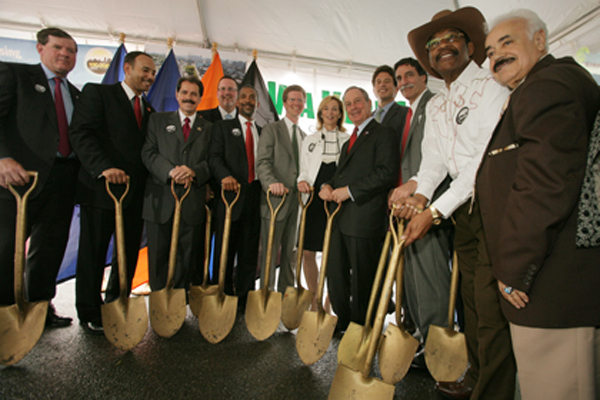
Photo by: City Hall
Mayor Bloomberg and other officials pictured in 2010 as they celebrated the completion of the 100,000th unit of housing under his 2003-2014 housing place.
Outside the brown brick towers of West Farms Square, the city trumpeted a “major milestone” this summer: Mayor Michael Bloomberg’s affordable housing initiative, the New Housing Marketplace Plan, was now three-quarters of the way toward reaching its goal to create or preserve 165,000 housing units by the end of 2014.
While the good news was delivered under a blue sky, officials later acknowledged the threat of darkening clouds. The last year brought a $71 million cut in federal funding to the city’s Department of Housing Preservation and Development, an agency that had been forced to lay off 300 employees over the past three years. Future funds to HPD may now be in jeopardy as Congress’ “super committee” settles on methods to reduce the U.S. budget deficit.
The axe could fall on programs vital to the New Housing Marketplace Plan, such as the Low Income Housing Tax Credit, which indirectly subsidizes financing for the construction or rehabilitation of affordable housing, and Community Development Block Grants. Earlier this year the Republican House proposed eliminating block grants, which provided HPD with about $130 million—or nearly 76 percent of its federal funding—in the 2011 budget. The city said the cut would have meant the loss of 700 more workers and decimated the agency’s efforts to fix unsafe housing conditions.
Not surprisingly, cuts in federal funds come down particularly hard on the poor. In 2010, the New York City Housing Authority’s Section 8 program faced a $42 million shortfall, placing as many as 10,000 families at risk before federal intervention. HPD ended up taking on NYCHA’s Section 8 participants. HPD Commissioner Mathew Wambua recently told a breakfast meeting on affordable housing that the city couldn’t bear the burden of deeper cuts without “significant pain.”
A plan, then a shift
The mayor unveiled his New Housing Marketplace Plan in December 2002 to develop and preserve apartments for low- to middle-income tenants. In exchange for loans to construct or to renovate housing—or in return for tax breaks—building owners or developers would agree to keep rents affordable, which means rents can claim no more than 30 percent of tenants’ wages. These agreements can last for decades.
Traditionally, federal regulations have targeted most subsidized housing at New Yorkers earning 80 percent of the Area Median Income or less, which generally translates into a family of four making a maximum of $63,360 a year. The mayor’s plan differed from earlier ones by targeting families with very low incomes (30 percent of AMI or less) as well as income groups that normally aren’t served by affordable housing, aiming 11 percent of the plan’s units to families of four making between $63,000 and $95,000 a year and 21 percent to those with six-digit incomes.
These moderate- and middle-income New Yorkers face a shortage of affordable housing, but claims that the mayor’s plan helps the city’s poor are largely “exaggerated,” says Tom Waters, a housing policy analyst at the Community Service Society of New York, an advocacy group for low-income people (and the owner of City Limits). “Most families fall in the under $60,000 category.”
Bloomberg was unapologetic when the majority of apartments at the new Hunters Point South development were targeted to households making around $100,000 a year: “We are setting the stage for the largest investment in permanently affordable housing for our police officers, nurses, teachers, and public employees and other middle-income New Yorkers.” At other times, however, the mayor went out of his way to characterize his plan as an all-encompassing life preserver that could offset even the losses of stabilized-rent apartments: “We can secure our future as a city of opportunity, where all New Yorkers can afford to live and pursue their dreams.”
The challenge of cost
Under the initial plan, the mayor’s goals were modest: 65,000 units built or preserved by 2008. But in 2006 the plan’s goal grew to 165,000 affordable homes by 2013, with the city spending $7.5 billion to build 92,000 units and preserve another 73,000. Since then, the deadline has been pushed back one year, the program’s price tag has added another $1 billion, and preservation has been promoted over new construction. The final goal is now 54,500 new affordable units built and 105,600 subsidized apartments preserved.
But even after this shift to preserve more affordable units rather than to build them from scratch—which should lower costs as well as qualifying income thresholds—the mayor’s plan faces challenges. Nearly 16,400 of the remaining 40,000 apartments will be new construction, and the mayor’s capital budget for 2011-2014 has slashed $70 million from HPD. The city has also reduced annual funding to HPD, from $80 million in 2008 to $60 million in 2011 and $67 million in 2012.
The shift to preservation came with the housing crash and subsequent freeze in credit markets, but the crisis also created opportunities, according to HPD spokesman Eric Bederman. “The silver lining was that it opened up a whole new market for preservation,” Bederman says. “During the housing boom, affordable developments like Mitchell-Lamas nearing the end of their regulatory agreements would opt out of the program and go market rate. In this climate, the opposite can happen—there’s less incentive for them to opt out because the market isn’t offering what it was. It gives us the ability to come in with new offerings. They’re fairly old properties, and they need upgrades, major and minor, which means refinancings. We offer low-interest loans for capital improvements and refinancing. In return, there’s a regulatory agreement that extends their stay in the program for another 30 years or more.”
Since 2003, the city has preserved more than 30,000 Mitchell-Lama units, and it projects another 10,000 will be added through the New Housing Marketplace Plan. About 45 percent of the original 69,800 Mitchell-Lama units are still in the program, but currently 26 buildings—with 7,500 units—can opt out if the owner gives tenants just one year’s notice.
Waters hopes the move to re-regulate Mitchell-Lama buildings is successful, but he believes the window of opportunity will be short. “The longer-term picture isn’t as bright because rents are still high and an owner can reasonably expect to get a good return from an apartment, much more than low-income people can pay,” Waters says. The median income of tenants in Mitchell-Lama housing is about $25,000 a year. “It won’t be easy to figure out how to make these deals work to provide affordability for the people who need it the most in the long-term.” The city will have to be tough negotiators, he cautions, “and it will still probably cost a fair amount of money to achieve true affordability.”
With the cooperation of city, state, and federal housing agencies, NYU’s Furman Center for Real Estate and Urban Policy has created a new database tracking 2,551 government-subsidized apartment buildings in New York City, seeing the system as an “early warning” for officials to preserve units with expiring affordability agreements. It’s available to the public at http://datasearch.furmancenter.org/.
The fresh emphasis on preservation spurred the planned rehabilitation of 526 units at West Farms Square, a complex of eight buildings in East Tremont that the city acquired as part of package of distressed properties from HUD. Most of the units will go to families earning at or below 60 percent of the Area Median Income.
Vacant housing tempts
Vacant and unfinished construction left over from the housing bust was another area some affordability advocates believed to be ripe for the picking. In 2009, City Council Speaker Christine Quinn spearheaded the Housing Asset Renewal Program, a $20 million pilot to convert unsold condos and stalled residential construction projects into as many as 400 affordable housing units for moderate- and middle-income families. But since then, HPD has spent half the money on just two buildings with 155 units. Rents will be affordable to families of four earning between $79,200 and $102,960 a year.
Tom Angotti, director of the Hunter College Center for Community Planning & Development, has been leading a community-based effort to count vacant property in each of the five boroughs. The total of vacant units could now be in the tens of thousands. “We think there’s more than the city’s own data recognize,” Angotti says. Counts this summer were conducted with the advocacy group Picture the Homeless, which participated in a 2006 count with Borough President Scott Stringer that discovered 24,000 vacant apartments in Manhattan. About 39,000 homeless stay in city shelters each night.
“A lot of the properties are stalled construction sites, new buildings that haven’t been occupied or sold, completed buildings that developers are holding off the market, waiting for prices to increase,” Angotti says. “And then there are buildings in distress. They were bought by speculators, and they’re holding them.”
Angotti says that empty buildings are wasted resources that the city should know about. A bill to mandate an annual vacancy survey has languished in the City Council, where it’s sponsored by 29 members but not supported by Speaker Quinn. “The first step is detection, having a good up-to-date understanding of where these vacancies are, where the distressed buildings are,” he says. “One of the purposes of the count is to create an information base.”
Under the Housing Asset Renewal Program, the city’s average subsidy ranges between $60,000 and $75,000 per unit. Waters worries the ultimate cost of converting half-finished buildings into affordable housing will prove to be too great. “It’s a wide open door to give the landlord a lot of help for only a little bit of affordability,” he says.
A plan’s limitations
While Angotti and Waters applaud the New Housing Marketplace Plan’s tilt toward preservation, they both note the city has been steadily losing more affordable units than it’s gaining. The greatest affordability program—rent stabilization—regulates rents for about 1 million apartments, but advocates say it suffers from lax enforcement by the state’s Division of Housing and Community Renewal. Many apartments are illegally falling off the rent-regulated rolls, says Waters, through the manipulation of vacancy decontrol. According to a state Assembly report this year, the city lost 569,700 units of affordable housing between 2000 and 2007 due to destabilization and rent increases. At the same time, affordability agreements were winding down. Last week, the Furman Center released a survey showing more than a quarter of the city’s 171,500 government-subsidized affordable apartments could begin charging market rents by the end of 2015.
Considering the immensity of the problem, the New Housing Marketplace Plan could never close the gap between housing demand and affordable supply in the city. “Grandiose claims have been made for it,” Waters says. “But it’s not big or good enough to justify the claims.” Yet he adds: “It is a good program. The city is putting its own money into affordable housing, and it’s doing a good job of making use of the resources it gets from the federal government.”
Questions remain about how the mayor’s affordable housing plan fits into the administration’s broader policy picture. The city argues its controversial upzonings create room for more housing and, therefore, more affordable housing. But Angotti points to a map in the recent PlaNYC update showing new subsidized developments focused on central Brooklyn and upper Manhattan, areas that have lost a lot of affordable apartments. “Every time the city upzones”—allowing larger development—”it increases value for private landowners, and landowners logically take advantage of that increased value by building housing for people with higher incomes,” Angotti says. “That fuels gentrification and increases land values in surrounding neighborhoods.
Housing, after Bloomberg
When Ed Koch became mayor in 1978, the city owned 8 percent of all housing. “We owned it because the landlords had said, ‘Take it—we don’t want it, it costs us money that we don’t have,'” Koch recalled at a 2005 luncheon. In 1985, Koch announced a 10-year plan to build or preserve 250,000 units of affordable housing. While that plan has been credited with stabilizing dozens of neighborhoods, its production fell off dramatically once Koch left office and his successors dealt with recession and their own priorities.
For Bloomberg, the question isn’t so much what will happen to the New Housing Maketplace Plan once he leaves office—its 2014 deadline falls only six months after the end of his third term—but what will happen to affordable housing after his plan.
“I’d love to see it continue under the next mayor, but mayors like to have their own programs—they don’t want to have Michael Bloomberg get all the glory for the money that they spend,” Waters says. “The next mayor is going to be tempted to do something different, and housing advocates have been thinking about how we’re going to deal with that. We’re going to have to deal with the problem of providing affordable housing to the people who need it the most and are not well served by the federal government.”
Though PlaNYC is intended to have continued impact on the city’s growth, it is short on detail. “The long-term goal is still for the city to build its way out of the problem with new units,” Angotti says. “You have a long-term plan going to 2030, but what happens after 2014? There’s a big question mark there.”
“We’re always thinking about that,” counters HPD’s Bederman. “It’s hard to say what the economic situation will be, but the need for affordable housing won’t end in 2014.”