

Photo by: Charu Sudan Kasturi
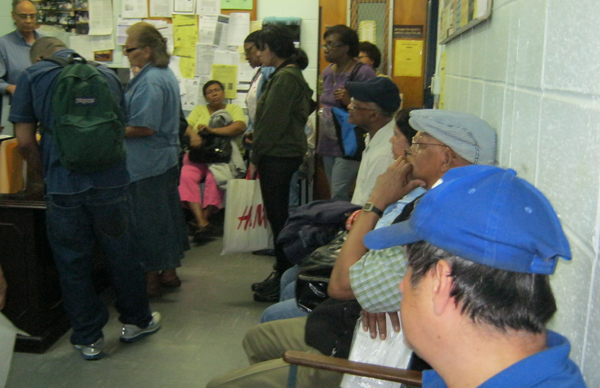
Residents wait early morning in the lobby of the Washington Heights and Inwood Coalition for the housing assistance officer to start work.
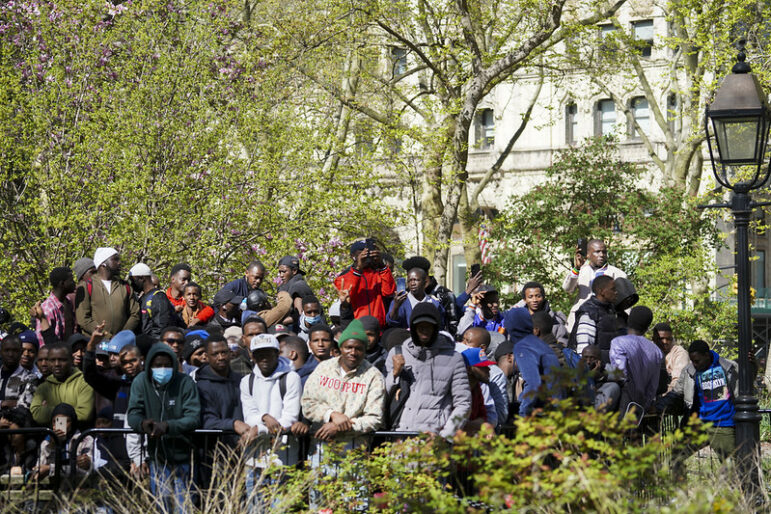
At 3 a.m. every weeknight, an orderly queue of residents forms in the lobby of a tall building on 187th Street, waiting for the sun to rise and help to finally arrive. Though the housing assistant they await doesn’t start work till 9 a.m., these lines have been forming nightly since July, when the Washington Heights and Inwood Coalition’s housing staff fell from three to one.
When the assistant Juan Felix arrived last Tuesday, he had bad news for most of the 25 people in the line that day. “I’m sorry, but you know that now there’s just me—and I can only see the first eight among you,” he said, to sighs of anguish around him. “The rest of you will have to try tomorrow—maybe by coming even earlier.”
Ramonita Tolentino, who had come at 5 a.m. seeking help in sorting out a lease dispute, but was 12th on the list, grumbled, spoke loudly about how “no one cares anymore,” and then walked out, shaking her head. A young girl called her mother on the phone, telling her “4 a.m. isn’t early enough, mama.” Others who had waited, hoping that Felix would see them, left—denied help.
Bleeding from cuts in government funding for housing assistance, community-based groups in Inwood and Washington Heights that once offered hundreds of residents help—with lease and rent disputes, landlord harassment and eviction orders—have trimmed their programs to a bare minimum.
A question of ‘priorities’
The Audubon Partnership for Economic Development used to receive $50,000 for the program from the city’s Housing Preservation Department. In 2010, the group lost all funding from the city for housing assistance. But it continued offering the service daily, using resources drawn from other sources.
Two months ago, it retreated. Julio Alvarado, housing director at the organization, now sees residents only on Fridays, though he says that occasionally he helps out “emergency cases” on other days.
“The city needs to relook at its priorities,” says Carmen Diaz-Santiago, the Partnership’s executive director. The city, she argues, is focusing resources on preserving housing stock when “it should instead be funding community groups to help people tackle housing crises.”
The same scenario is playing out 20 blocks to the south. Until three months ago, Nelly Perdomo, 76, would walk into the office of the Washington Heights and Inwood Coalition at 9 a.m. and receive an appointment with one of three housing advisers for help in tackling her landlord’s demands, she says.
That changed this July. The non-profit organization laid off one housing adviser at the end of June, and when a second quit for another job in July, the group did not look for a replacement. “The truth is, we can currently afford only one housing adviser,” Josh Swauger, the organization’s executive director, says.
Cuts at all government levels
Last year, the Washington Heights and Inwood Coalition had a housing assistance budget of about $150,000, thanks to city, state and federal grants. This year, the only funding it is guaranteed so far is $30,000 from the discretionary fund of Councilmember Robert Jackson, who represents the neighborhood.
The coalition until last year received $50,000 of its housing budget from then state senator Eric Schneiderman. That’s been erased by state budget cuts and a crackdown on the legislature’s discretionary budget items.
The Coalition’s federal funding came under a Community Development Block Grant—and that too could go, soon. In January, President Barack Obama announced plans to cut the federal grant scheme, a remnant of Lyndon Johnson’s War on Poverty, by 50 percent in the 2012 fiscal budget, which Congress is expected to take up this month.
“We don’t know exactly how much we would lose if the president’s plan comes through,” Swauger says. “But if it’s anything significant, then I don’t know whether the housing program will exist next year.”
The third community-based organization serving the neighborhoods of Inwood and Washington Heights with housing assistance is also battling to sustain services. The Northern Manhattan Improvement Corporation is the only group among the three that offers legal aid for tenants. But it too has been forced to cut back on the number of residents it can see.
The group received $402,909 in city funding for its housing programs in 2009-10. That dropped to $299,674 in 2010-11. This year, the city has allocated just $130,409 for the group’s housing assistance programs.
Neighborhood faces unique threats
The cutback in housing assistance could disproportionately bruise neighborhoods like Inwood and Washington heights where nearly everyone has a landlord, the 2009 American Community Survey findings show.
In Inwood and Washington Heights, 90.8 percent of residents live in rented accommodation—compared to 66.5 percent tenants overall across New York City.
Community Board 12, which serves the twin neighborhoods, has also cautioned the city about the growing crisis in its community needs statement for the 2012 fiscal year. Over 5,000 apartments in the community district are owned by private equity firms “that subject our tenants to harassment, overcharges, baseless litigation and failure to make repairs,” the needs statement reads.
The community board has demanded increased funding for housing organizers, legal service attorneys and paralegals at the non-profit groups that offer these services. It has also demanded reforms to state and city laws to protect tenants from harassment and discrimination, and asked the city to improve data collection and dissemination about housing complaints received through New York’s 311 hotline.
The crisis in housing assistance comes when the overall housing market in Washington Heights is booming. In Washington Heights and Inwood, housing rents have jumped up 5 to 10 percent in just the past year, according to Gus Perry, owner of Stein Perry Real Estate, Inc.
Rent-related disputes are among the most common reasons tenants visit them, housing advisers at the community organizations say. Though many residents stay in rent-stabilized accommodation, overall inflationary pressures in the housing market usually accompany greater complaints of harassment by landlords to try and extract the market value of rented accommodation, they said.
A context of demographic change
But a far deeper fear is also tugging at many local residents. Dominated by Dominican and other Hispanic populations for the past few decades, these neighborhoods are undergoing a demographic shift, the latest Census Bureau statistics suggest.
The 2009 American Community Survey showed that while the total population of Washington Heights and Inwood stayed almost steady over the past decade, the Hispanic population declined by almost 7 percent—from 154,414 in 2000 to 143,692 in 2009.
Over the same period of time, the non-Hispanic population of these neighborhoods has gone up by almost 20 percent—from 54,000 in 2000 to 64,523.
“What’s worth noting is that even though rents have gone up here, they are still way below what people living below 125th Street, for instance, are encountering,” Perry says.
Residents and community leaders say that a failure to provide adequate housing assistance could force tenants to either accept higher rents even when unjustified (like in rent-stabilized apartments), or move out, possibly to cheaper neighborhoods in the Bronx.
That is a fear frequently discussed by those who queue up early in the morning outside the Washington Heights and Inwood Coalition, curled up in blankets, in between bouts of fitful sleep.
“Landlords want people who can pay more rent, and we aren’t those people,” said Perdomo, as she waited for the clock to turn 9 a.m. “We could lose our neighborhood.”