

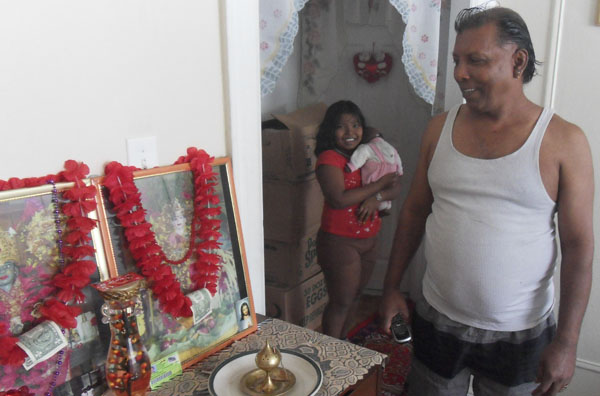
Photo by: Patrick Arden
After a social worker observed unhealthy conditions in his basement apartment, the landlord moved Boodnarine Sarju and his family to an upper floor, and an illegal apartment. Now the landlord is trying to obey they law, but it means Sarju can no longer afford the rent.
Boodnarine Sarju opened the door to his tidy one-bedroom apartment in northern Queens. The three rooms didn’t provide much space for his wife and daughters, but he was glad to be home. The living room doubled as a bedroom, with a mattress on the floor and a bureau topped with garlanded portraits of Hindu deities. Wallet-sized photos of his children were tucked into the picture frames along with a prayer card of Jesus.
Sarju had lived in this building since arriving from Guyana eight years ago. He was in a basement unit early this year, when a social worker threatened to report his landlord to the city for exposed electrical wiring and pipes wrapped in asbestos. The landlord quickly moved Sarju’s family upstairs, but this new apartment was also illegal. The city permitted three units, but the building had been carved into smaller spaces long ago. Not one of these units had been approved by, or received permits from, the Buildings Department. The two apartments upstairs violated safety and building codes: Each had just one exit and no fire escape.
The dangers of illegal conversions attracted renewed attention this year after two fires, one in the Bronx and another in Brooklyn, killed five people. The Bronx blaze was described as an accident waiting to happen: The city had received repeated complaints about the three-story building, which was illegally subdivided into tiny apartments with only one escape route, but inspectors were always denied access.
The city responded by stepping up enforcement. The Bloomberg administration and the City Council drew up an initiative to pinpoint illegal conversions at the highest risk of fire, vowing to send inspectors to targeted locations within 48 hours. It was the latest step in a larger crackdown on illegal units. More than 150,000 flyers in multiple languages had already been distributed to warn people about the dangers of illegally converted apartments, and the previous year the Buildings Department began an undercover sting by responding to apartment ads on Craigslist.
Yet the mayor also admitted the immense number of illegal units—estimated to be as high as 100,000 citywide—was the result of inadequate housing options. In June, he announced the formation of a task force with three deputy mayors to study where regulations could be updated to allow for three alternative housing types: Legal home conversions, “micro-units,” and shared housing. The latest version of the mayor’s PlaNYC promised to enable “expanded housing models to serve evolving population needs.”
While no details have been released from the task force members—and no responses have been offered to City Limit’s inquiries—a glimpse at their conclusions were to be offered on Monday, November 7, when four agency commissioners, plus the director of zoning from City Planning, participate in a discussion led by David Bragdon, head of the mayor’s office of long-term planning and sustainability. The panel is part of a daylong event at the Japan Society of New York. The event “Making Room,” staged by the Citizens Housing & Planning Council (CHPC) and the Architectural League of New York, will unveil designs by five teams of architects following the three new housing models. Responding to various real-life household scenarios, these designs will serve as the basis for discussions.
The underground market
The new models can’t come fast enough for Sarju. After his landlord had been alerted to the illegal units—and possible citations carrying fines of up to $15,000 and one year in jail—he decided to set things right. The landlord planned to convert the building back into larger units and started to evict tenants, who were renting month-to-month with no lease. Sarju would be the next to go.
“I’m trying to move, but everything costs $1,500 or $1,600 a month,” said Sarju, who paid $900 in rent. The 55-year-old father of three was collecting $2,000 a month in worker’s comp since his foot got injured by a forklift in June. Most of the apartments he’d visited were also illegal with no lease. “I tell you the truth, sir, I can’t afford $1,500. When I pay my rent and bills, my kids will have nothing to eat.”
The city’s desire to confront the issue of illegal housing may be rooted in the last census. The mayor claimed New York’s population was undercounted by 250,000 due in part to illegal residences. A 2008 report by the CHPC and Chhyaa, a Queens-based nonprofit working with new immigrants, estimated the population in illegal dwellings could be as high as 500,000. That report was funded by the city’s Department of Housing Preservation and Development.
At a City Council hearing in June, Buildings Commissioner Robert LiMandri acknowledged that illegal apartments respond to a real need for affordable housing and extra income for homeowners trying to meet mortgage payments. But these units, built without permits in garages, basements, and attics, often violate fire and building codes and are “potentially dangerous,” without such basic safety measures as smoke detectors and two forms of egress. They put a strain on electrical wiring and often rely on extension cords and space heaters. “Creating an illegal apartment can include construction work or almost no work,” LiMandri said. “Just by adding bunk beds or locking a couple of doors, a property owner can significantly change the use of his building and make it unsafe.”
Over the last fiscal year, the city received 18,000 complaints about illegal dwellings in 13,000 properties, said LiMandri, but inspectors had issued just 3,800 citations because, without a court order, they couldn’t gain access to the property. A 2009 comptroller’s audit found inspectors could respond to only 40 percent of the complaints in Queens.
Community concerns
For years Robert Holden has been conducting his own informal illegal-housing counts in the Queens neighborhoods of Middle Village and Maspeth. “Sometimes it’s easy to tell,” said Holden, president of the Juniper Valley Civic Organization. Multiple doorbells and mailboxes were giveaways. “We have some blocks where 75 percent of the buildings have an illegal apartment. We complain, but if the Buildings Department can’t gain access, you’re out of luck.” Holden told LiMandri to track down illegal units on Craigslist. “The commissioner wrote me back saying, ‘Good idea.’ But you still see plenty of these places on Craigslist.”
Holden represents the opposition the city will undoubtedly confront from some homeowners and community boards when trying to add housing capacity. He complains that the added residents overcrowd schools, take up scarce street parking, and put a burden on buses and community services like garbage pick-up. Insurance companies can refuse to cover fires started in illegal units, he said. Some of his neighbors have taken the legal route to adding apartments. One spent $40,000 to build a third unit in a two-family home.
“We’d rather have legal apartments than illegal ones,” Holden said. “But if the area’s not zoned for more apartments, it’s not a good idea. I’ve talked to city officials going back to the Dinkins administration who say, ‘Well, where are they going to go if we really crack down on illegal apartments?’ That’s ridiculous. Why have building codes and regulations if you’re not going to enforce them?”
Housing that reflects needs
Enforcement will never eliminate the underground housing market, said Sarah Watson, a senior policy analyst at CHPC, who noted that increased fines have not lessened the illegal housing stock. “It’s too widespread,” she explained. “There’s no doubt the path forward is difficult politically, but we need to recognize that there’s a mismatch between the types of housing we have and the ways we’re really living today. The housing stock has not kept up with how people have changed.”
The last century of housing laws and building codes were aimed at eliminating overcrowding and dangerous conditions, but the regulations ended up favoring larger two- and three-bedroom units. “There aren’t a lot of options for single adults, at every income level,” Watson said. “People have to improvise and maneuver around the housing stock that’s not designed for them.” That’s led to the rise in illegal housing as well as a warping of the rental market, where four graduate students, for example, can price a family out of a three-bedroom apartment and the family must find a smaller unit.
“Right now it’s illegal for more than three unrelated adults to share an apartment,” said Watson. “It’s rarely enforced, but it handcuffs the industry from being able to come up with smaller units or any legal shared housing.” The laws ensure the continued construction of the same types of housing. “It’s quite surreal. People in government talk about households as families when half of New Yorkers are single.”
The old options, like SROs, boarding houses, and women’s hotels, are gone. “People turn to Craigslist,” Watson complained, and risky situations without the protection of a lease. “It’s all been forced to go underground.”
Homeowners have expressed fears that permitting shared housing or micro-units will create “little SROs for working men,” Watson said. “But I always ask, ‘Where does the guy who sold you coffee this morning live? Where does the person who delivered your laundry live?’ They’re living somewhere. Allowing legal and safe housing options for them doesn’t mean that they’ll multiply. They’re already there.”
Illegal housing units are found throughout the city, said Seema Agnani, executive director of Chhaya CDC. Her group has helped homeowners legalize apartments, but the process can be lengthy and expensive. Chhya proposed that larger windows could be turned into second forms of egress. The city responded by asking for sprinkler systems, which Agnani found might cost $15,000 and be “too expensive for most owners.” Watson said the city should set up low-cost loan programs to implement new regulations: “You would need to find a way—not just through enforcement—to make it easier for landlords to comply.”
Chhaya regards illegal units as an important source of affordable housing. “What we want to do is make them safer and more hospitable,” Agnani said. “Also we want to make sure the tenants have rights. Bringing the units up to code would benefit not only the tenants but the owners, who complain that they can’t evict tenants for not paying rent. Nobody is happy with the situation.” Tenants forced out by the city usually wind up in another illegal apartment. “There’s really no affordable housing within their price range.” Rents range from $500 to $1,000.
“A lot of elected officials have been scared to touch this, because it’s seen as an immigrant issue,” Agnani said. “Older residents are asking for additional enforcement.” While fears of low-income people might be what’s expressed, she said, “I think it’s racially driven.”
Uncovering problems
Nizam Ahmed didn’t know his basement unit was illegal back in 2004, when he purchased his two-family apartment building in Ozone Park. “It was nice,” recalled Ahmed, a 57-year-old cabdriver. His loan was based on income from three units. Ahmed’s family lived in the basement, while he rented the two apartments upstairs. When his second-floor tenant stopped paying rent, he asked her to move, and she reported him to the Buildings Department.
Complaints about illegal conversions can be made anonymously to 311. Some contractors have reported illegal units in order to drum up business, claimed Agnani, who would like to limit complaints to neighbors. People might complain to “harass” others, allowed Holden. “I think, if you make a complaint to 311 on an illegal apartment, you should have to give your name.”
The current system leads to selective enforcement. After city inspectors fined Ahmed $800, he spent another $6,500 on a lawyer. He can’t rent the basement unit, and he’s now five months behind in his mortgage. He’s having trouble getting a loan modification that would help prevent foreclosure. In the meantime, he works double shifts before returning home to his street of two-family homes, many with illegal apartments. “Everybody has a basement rent,” he said.