

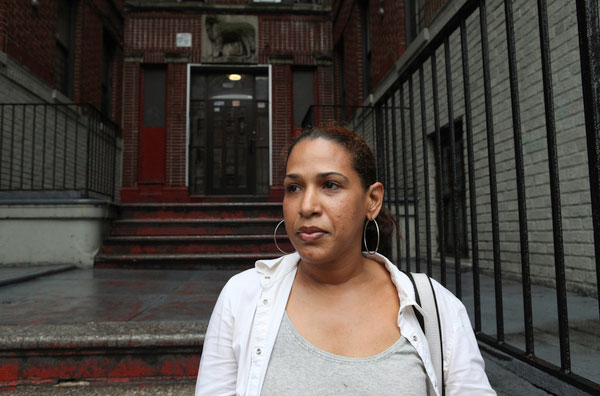
Photo by: Marc Fader
Cinthia Caimares, who has lived at 2500 University Avenue — a Milbank property — for about 2 years, is a student at Bronx Community College and works at Yankee Stadium on the weekends. She is afraid of being forced to move out and does not understand who owns the building.
In December 2006 a Los Angeles-based real estate investment company made an interesting acquisition. Milbank Real Estate, which had previously focused on high-end office buildings in southern California, bought 10 rent-regulated buildings in the Bronx for $35 million. Millbank thought the properties were “positioned to undergo significant gentrification” and that “revitalization would… allow for an improved tenant base and increased rental income from the properties.”
Instead, as mortgage payments exceeded income, Milbank cut back on building maintenance and basic services. It came as little surprise when Milbank defaulted and Wells Fargo, the bailed-out bank that by then owned the mortgage, filed for foreclosure in March 2009.
The challenge now, say tenants and affordable housing advocates, is to make sure the cycle isn’t repeated.
So the City of New York is trying to intervene in the legal process, to have a say in who the next owner is. The city’s Department of Housing Preservation & Development (HPD) wants to ensure that when the foreclosure process is complete, the buildings end up in the hands of an owner that knows how – and wants – to maintain them as livable places for the cab drivers, health workers and city employees that have long found homes in the neighborhoods of Fordham, Kingsbridge Heights and Tremont.
HPD has for a month been in discussions with LNR Property Corporation, the special servicer working for Wells Fargo on behalf of the investors who bought into the commercial mortgage-backed security that grew out of the Milbank mortgage.
HPD wants LNR to transfer the buildings to a local non-profit housing company or private owner capable of making them livable again.
“We are in the middle of trying to figure out what needs to be done to preserve affordability,” said Arlen Sokolow, the executive director of HPD’s distressed asset financing program. “What we don’t want is for these buildings to be sold again for a price that presupposes that rents have to increase.”
From the very beginning, the Milbank deal raised eyebrows among the affordable housing groups that own and manage buildings in the neighborhood, because the $35 million sale price was far beyond what the new owners would be collecting in rents.
“Some of the prices were just absurd,” says John Reilly, executive director of Fordham Bedford Housing Corporation, a nonprofit born out of the Bronx landlord abandonment of the early 1980s. “I don’t think they were stupid,” he says of Milbank and other investors in snapping up buildings in 2006 and 2007. “I don’t think they cared. I mean, we could have told them these buildings can’t support that kind of price.”
Milbank and its investors aren’t the only ones whom the deal has hurt. Tenants in the 10 buildings are contending with dramatically deteriorated conditions. At one address, 770 Garden Street, tenants called the city’s buildings department 44 times to complain of broken elevators. At 3018 Heath Avenue, the Department of Housing Preservation and Development records 768 major violations – from rodent infestation to broken windows, water cascading from ceilings, exposed wiring and holes in the 70-year old floors. Some buildings were without heat for so long last winter that tenants bought a space heaters and took to putting their children to bed in their coats and hats – all while continuing to pay rent.
Last month Legal Services NYC took action on behalf of tenants in the Milbank buildings in an attempt to force the bank to spend money on maintaining and repairing the buildings while the foreclosure process—which could take years—continues.
But that legal maneuver was a stopgap effort. Eventually, foreclosure proceedings will conclude and the buildings will be sold.
Using last year’s sale of the Bronx’s Ocelot portfolio as a general model, HPD intends to assemble a package of subsidies that would permit a so-called responsible buyer to take ownership. The agency doesn’t want an open auction, in which a new speculator could scoop up the buildings at a discount, take rents and walk away in a few years, repeating the cycle.
Instead, HPD wants a controlled foreclosure auction. The bank will likely lose money, because the sale price will be less than the note they hold on the property, and the city will have to spend some of its own to facilitate the deal. In January the Bloomberg administration established a $750 million rescue fund, intended to assist buildings like the Milbank properties.
No one has yet been selected to take over the Milbank portfolio, Sokolow said.
The agency will issue a request for qualifications in the next few weeks, from which they hope to draw a pre-approved list of potential buyers for both the Milbank portfolio and dozens more in similar situations around the city. There is no guarantee that banks or landlords will play ball.
Joe Cicciu, executive director of Belmont Arthur Avenue Local Development Corporation, which operates buildings for moderate income tenants in the area, is interested in taking over the Milbank buildings because many are in the neighborhoods he serves, and because Belmont Arthur was appointed receiver for the portfolio when it went into foreclosure. It has been collecting rent and doing basic repairs since.
But Cicciu said with the condition the buildings are in, Milbank needs to sell very, very low: “The buildings, all together, need $15- to $20 million in improvements to bring them up to standard. I’m talking about major system repairs: the boilers, the roofs, the plumbing. These are 1920, 1930 structures. Systems are due for replacement.”
LNR declined to comment, but did confirm that it was in negotiations with the city.
Affordable housing policy makers and advocates are watching the Milbank deal closely, because they think it will need to be repeated frequently in the coming months as more buildings default under the weight of boom-time mortgages.
“There is a tremendous public policy interest in rescuing these buildings,” said Ben Dulchin, executive director of the Association of Neighborhood Housing Developers, a nonprofit that advocates for affordable housing. An ANHD report last year warned that as many as 100,000 individual apartments across the city were at risk of foreclosure as a result of unsustainable boom-era sales.