

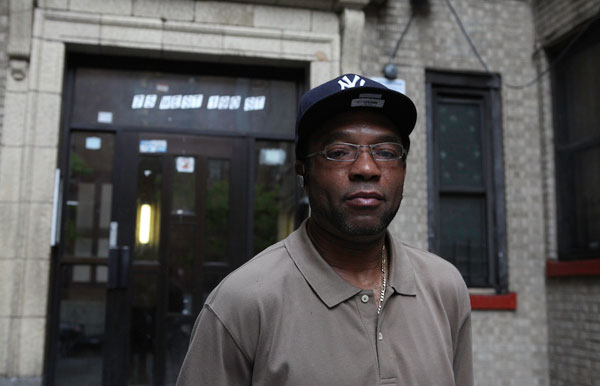
Photo by: Marc Fader
Howard Ross, who has lived at 75 West 190th Street — a Milbank property — for about 10 years, complained this summer about the condition of the building and said the front door lock has been broken for months.
New York City’s housing commissioner on Thursday announced an aggressive enforcement plan at 10 Bronx buildings—a real estate portfolio that has come to embody growing worries about what will happen to badly decayed, foreclosed buildings and the people who live in them.
Department of Housing Preservation and Development (HPD) commissioner Rafael Cestero, who visited the long-troubled buildings on Monday night, announced that HPD is kicking into high gear, issuing hundreds of code violations against LNR, the financial servicing firm in control of the buildings, which are referred to as “the Milbank portfolio” after their former owner.
“In my 21 years of working in the affordable housing industry in this great city I have never been more shocked, angry and frustrated by what I saw in those buildings,” HPD Commissioner Rafael Cestero said in a conference call with reporters Thursday morning.
HPD is also starting to make emergency repairs, the bills for which will be sent to LNR.
Cestero toured three of the ten buildings with tenants organized by the Northwest Bronx Community and Clergy Coalition. He found collapsed ceilings, tubs sinking into the floors and water pouring down walls, he said, conditions tenants have been raging about for ages.
HPD inspectors wrote 173 code violations in the three hours Cestero spent in the buildings Monday, Cestero said.
“My frustration is that lenders and financial institutions like LNR have made imprudent investments and have threatened the neighborhoods and the residents who have to live in these conditions,” Cestero said. “We are going to insist that owners hold up their end of the bargain.”
Sale price a problem
LNR has been negotiating to sell the portfolio to Chestnut Holdings since mid-summer. The sale has been held up, according to sources familiar with disputes between the two parties, because Chestnut wants the sale price lowered to reflect the extent of repairs it will be required to make.
Chestnut’s legal department did not answer its phone and a message left at another department was not immediately returned.
HPD has also been trying to convince LNR to lower the sale price to prevent the next owner from being in the same cash-strapped situation that ultimately harms tenants.
The Milbank portfolio has become something of a poster child for the dangers of over-leveraged rental buildings—properties that private equity-backed firms bought up during the real estate boom, often at prices unsupportable by existing rents—and quickly found themselves unable to maintain the buildings and meet mortgage payments.
Bought in 2007 for $35 million, Wells Fargo began foreclosure proceedings on the Milbank properties in March 2009.
HPD and the City Council are now struggling to unwind dozens of such deals across the city, a task hampered by the fact that neither have the legal authority to intervene in private real estate transactions.
But Council Speaker Christine Quinn, who heads a council committee on distressed property, argues the city has a vital interest in making sure New Yorkers have decent places to live and that “irresponsible” deals are not repeated. “These are not buildings that the city is washing its hands of and walking away from,” Quinn says.
A huge repair bill
Last month, an expert analysis by Baer Architecture Group of conditions at the buildings found it will cost at least $19 million to return the decaying homes to livable standards.
The report inspected 550 apartments, or 25 percent of the units in each building, as well as lobbies, roofs, boiler rooms and basements, said Brian Baer, the architecture firm’s director. The scope of repair needs is staggering. “All the roofs needed to be repaired. They are, at their youngest age, 40 years old. Most of the brick facades had water flowing through them. Windows in many cases are inoperable. Entry doors in many cases were not locked or had broken windows. Radiators were falling through some floors,” he said. Repairs average $1.7 million to $2.6 million per building.
He stressed that the $19 million to $24 million price tag represented the cost of merely making the buildings livable and code compliant, “Not to make them luxury or even market rate.” The buildings carry more than 3,000 housing code violations, according to HPD records.
Under an initiative by the City Council’s committee on distressed properties and architecture and engineering firms such as Baer offering pro-bono services, tenants in other buildings will be able to request similar needs-assessment reports on their buildings.
The goal is to arm tenants and advocates with professional estimates of the true scope of repairs and renovations and their cost, so that they can more effectively demand services from property owners.