

Photo by: Marc Fader
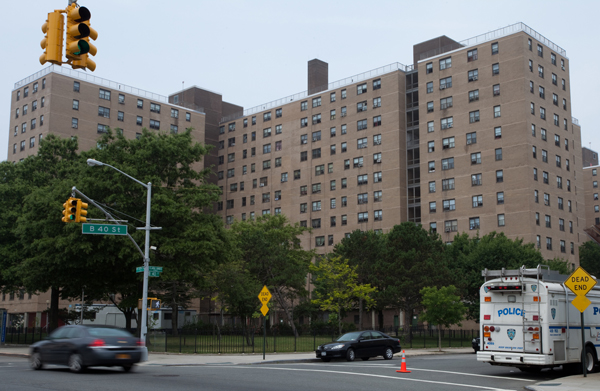
In 1996, a firefighter died in this building. Ten years later, another almost perished there. Along with other incidents, the blazes at 40-20 Beach Channel Drive spurred FDNY to alter its approach to wind-driven fires.
This is the third of five chapters in an investigation supported generously by the Fund for Investigative Journalism and the George Polk grants for investigative reporting administered by Long Island University.
On the night of Jan. 5, 1996, Firefighter James B. Williams was the “can man” for his company, Ladder 121, when it pulled up to the 13-story building at 40-20 Beach Channel Drive in Far Rockaway after just after 10 p.m. It was windy.
Ladder 121 arrived four minutes after the 911 call came in reporting fire in a third-floor apartment. Capt. John Rokee led Williams and Firefighter Brian Gallagher into the lobby and up the stairs to the third floor. Other firefighters on the scene took to their assigned tasks. Engine companies grabbed hoses and nozzles off their rigs and marched into the building. Rokee and his men came to the entrance to the fire apartment, put on their face masks and pushed through the unlocked door, Rokee and Williams moving to the left, Gallagher to the right—all three searching for people who might be trapped inside. They got about 10 feet in. “Within 15 seconds,” an investigation later found, “conditions in the apartment deteriorated to extreme heat and blinding smoke conditions.”
Rokee, the report said, “saw a fireball coming at him from within the apartment. … The temperature in the apartment became unbearable.” Out in the hallway, three engine company firefighters were quickly surrounded by smoke; they hit the ground and hurriedly put on their masks. Heat roared from apartment 3F, burning these men on their faces and ears and forcing them to evacuate. Outside, residents screamed for help from windows, and fire dispatchers began to get calls from “panicky people” and elderly folks stuck inside.
Rokee, Gallagher and Williams fled down the hall. The apartment door stuck open as they ran out, allowing the heat and smoke to race after them. The hallway was shaped like a T, with the exit located at the long end. As they hustled out of the flaming apartment, all three men missed the turn. Rokee and Gallagher found their way back to the corner and down the hall. Williams did not, and collapsed. In the anxious moments that followed, a firefighter from another ladder company crawled into the hallway, found the hose the engine company had dropped and moved into position to spray the fire but came upon Williams lying in the hall. It took several firefighters to get Williams down the stairs and into the street. He was pronounced dead at Peninsula General Hospital.
A lot went wrong the night Jimmy Williams died. As at Deutsche Bank 11 years later, the delay (a half hour this time) in getting water on the fire was devastating. FDNY investigators blamed this largely on one engine company bringing the wrong hose and trying to hook up to the standpipe so close to the fire that they were exposed to flame and smoke and were unable to finish the job.
But the report concluded that “adverse weather conditions were a significant contributing factor.” The tenant in the fire apartment had left her window open. “When the door to the fire apartment was opened, gusting winds drove the fire back into the apartment and toward the members of Ladder 121,” the report found.
Ten years later, on Jan. 27, 2006, there was a fire in a sixth-floor apartment in the same building, 40-20 Beach Channel Drive, which is a 234-unit building owned by the New York City Housing Authority. Thirty-three FDNY units responded, led by Ladder 121. This time, it was the apartment door that was left open. As firefighters were searching the room for victims, the windows failed and 40-mph winds turned the fire into a blowtorch. Firefighter James T. Byrne grabbed a probationary firefighter working with him and ran to a nearby apartment to seek refuge. There he heard a Mayday, crawled back into the hallway and discovered Firefighter Kevin McCarthy lying on the ground near the door to the fire apartment, surrounded by flame. Byrne dragged McCarthy 22 feet to safety. For this, Byrne won the FDNY’s highest medal for valor. Had he not acted, 40-20 Beach Channel Drive might have killed a second firefighter. As it was, 10 firefighters were injured in the blaze.
Less than a month later, 138 firefighters responded to a blaze at Tracey Towers, a two-building high-rise complex on Mosholu Parkway in the Bronx. By the time the fire was brought under control, flames had lapped from the 24th floor to the 30th, and nine firefighters were injured, including one who suffered second- and third-degree burns. “The wind conditions were terrible,” Mike Parrella, a fire department spokesman, told the local Norwood News.
Wind has been a factor in at least five FDNY deaths since 1991. The two nearly disastrous wind-driven fires in 2006 spurred the FDNY to consider new ways of approaching a fire when flame and wind are allied against them. Luckily, the hunt for better methods was already under way—thanks, in no small measure, to Lionel Hampton.
A better way?
A year after James Williams died, a breeze blew through an open window in the 28th-floor apartment near Lincoln Center where Hampton, the legendary jazz vibraphonist, lived. It knocked over a halogen lamp, which fell on a bed, starting a fire. A woman with Hampton in the apartment apparently opened a window to relieve the smoke and then, to get the wheelchair-bound 82-year-old band leader out of his flat, propped the apartment door open. Soon, says former FDNY battalion chief Jerry Tracey, the wind-driven fire became “a blow torch.”
Tracey retired from the FDNY in 2009 with 31 years of experience. Back in the 1990s, he was the commander of a ladder company that responded to the Lionel Hampton blaze. He was off duty the day of the fire but later learned what happened: As they responded to the alarm, fire companies came up a stairway that put them 54 feet from the door to Hampton’s apartment. Buffeted by heat and fire, it took the FDNY 45 minutes to cover that distance. The heat was so intense that one lieutenant was burned by the brass ring of his helmet. “We kept sending companies. We went through eight engine companies,” Tracey says. “The fuel sort of burnt away. That’s what allowed entry, finally, to that apartment.” Eleven firefighters were hospitalized. Mayor Giuliani told The New York Times that “a fire that could have been life threatening was an inconvenience with some injuries, none of them life threatening and most sustained by firefighters.”
But Tracey knew that the effort it took to extinguish the Hampton blaze was a wake-up call. “After that, I began taking a look at our tactics. The only tactic we attempted to employ at the time was the direct, frontal attack—meeting this fire head-on and trying to do battle with it,” he says. “I said to myself, There’s got to be a better way.”
The year after the Lionel Hampton fire, the FDNY received another costly object lesson on the power of wind. At a fire on Vandalia Avenue in East New York in December 1998, Lt. Joseph Cavalieri and firefighters Christopher Bopp and James Bohan from Ladder 170 opened the door to a 10th-floor apartment and were caught in a wind-driven blast of flame. Some firefighters heard two maydays, but it wasn’t clear who they were from. It took the first engine company three tries to get a hose line anywhere near the fire, so intense was the heat. Only when the engine company got close to the apartment door did they discover the first of the three, badly burned men. The other two were found a short time later. All three died.
A pressure phenomenon?
A fire is not a simple matter of flame on fuel. A fire feeds on oxygen. It thirsts to burn efficiently and produces smoke when it does not. It can ignite its own vapors. And it produces pressure, heating air so that molecules ricochet off one another creating gasses that expand, seeking release. It is this force that pushes smoke into the paths of people fleeing down stairways: Fire and smoke want to go where they aren’t.
This has long been recognized by the fire service. In fact, in 1972, the FDNY used one of the buildings that were to be torn down to make way for the construction of the World Trade Center to conduct a test in which stairwells were pressurized to keep smoke out. This technology was eventually required by code in new high-rise buildings that lack sprinklers—such a system uses fans located on the building’s roof to pump air into stairwells so that when doors are open, smoke is pushed away from the exits. But many buildings were not covered by that requirement. So if pressurizing stairwells was something a fire department needed to do, a portable fan would be necessary.
The problem, says National Institute of Standards and Technology researcher Dan Madrzykowski, is that fire departments have a hard time getting private industry to produce the gizmos they need. “The fire service is rather small, and so, as a result, there are very few things that would be made just to serve them,” he says. “Many times we’re looking for tie-ins for somebody who is making a tremendous amount of technology for the military for some purpose and can also develop it for the fire service.” Thermal-imaging cameras, for instance, which are used by firefighters to detect fire behind walls and civilians behind smoke, came into fire department use only because the military was buying them.
Luckily, the way Madrzykowski remembers it, about 20 years ago a firefighter saw a fan being used to inflate a hot-air balloon and realized it could be handy at fire scenes. But in the early years, these fans were used for “negative pressurization”—drawing air away from a fire, usually as a way to clear out smoke once a fire was mostly under control.
In the mid-1990s, however, interest was turning to “positive pressurization”—using fans to force smoke or even flame back toward their area of origin and maybe to resist the wind. This shift became possible because the fans in play got much more powerful—from producing air at 3,400 cubic feet per minute to more like 24,000 cubic feet per minute.
Before the Lionel Hampton fire, Tracey had been hearing about pressurization research at firefighting conferences. The idea first appealed to him as a way to keep smoke out of stairwells and possibly spare firefighters the danger of retreating to a stairwell when they were low on air only to find that it, too, was contaminated with smoke. But after the Lincoln Center fire, he and Madrzykowski began talking about a more intense use of fans to counter the force of wind on a fire.
Some small-scale testing went forward. It wasn’t until early 2006 that Tracey and Madrzykowski received permission to practice in a full building: a closed school in Toledo, Ohio. Using theatrical smoke, NIST was able to demonstrate that fans could effectively control smoke.
But to explore the fans’ value in fighting not just smoke but fire, they needed a structure that they could actually burn. Later in 2006, Chicago permitted a controlled burn in a building that was about to be torn down. The test involved setting fires in three apartments on each of four selected floors in the 16-story building. The rooms were filled with hotel furnishings to make sure each room was identical to the others. Preparing the building took a week. In three of the rooms, windows were broken and artificial wind was created to simulate the conditions at a wind-driven fire.
Video of the test—the brief bit that is visible before the raging fires destroyed what Tracey says was $18,000 worth of camera equipment—shows a small fire exploding as soon as the wind hits it. Flames blast out of the apartment door, with temperature readings on a hallway wall jumping from 71 degrees to 1,000 degrees in a matter of seconds.
“It was this video that we brought back to NYC,” to show to FDNY leaders, Tracey says. “Their jaws dropped.”
The FDNY, which had been permitting Tracey to travel on department time to conduct his research and had just suffered the near-misses at 40-20 Beach Channel Drive and Tracey Towers, began preparing for a New York City test of strategies for battling wind-driven blazes like the one captured on video in Chicago. As it turns out, several high-rise buildings that were part of the former Coast Guard base on Governors Island were about to be torn down.
A death intervenes
On Jan. 3, 2008, Lt. John Martinson led Engine Company 249 up the stairs to the 14th floor of a residential building at 1700 Bedford Avenue in Brooklyn. He left his nozzle man, control and backup in the stairwell and went into the smoky hallway to find the fire apartment. He wasn’t seen again until 21 minutes later, when a firefighter found him unconscious a few feet from the fire. Martinson never regained consciousness and was pronounced dead later that night.
The FDNY’s investigation found that the deadly blaze had been “wind impacted,” rather than “wind driven,” because the night’s 20-mph gusts ebbed and flowed in their effect on the flames. But wind was certainly an issue. Firefighters brought a window blanket, which is used to seal off a window where the glass has broken, into the lobby of 1700 Bedford but not up to the floor above the fire, where it might have been used to block the wind. At the time, at least, department policy did not require them to do so.
That was about to change. In February 2008, the FDNY conducted 14 test fires on Governors Island. They tested positive-pressurization fans to push against the wind, window blankets and a newly developed high-rise nozzle with a bend that allowed firefighters to fight a fire from the windows of the floor below the blaze.
The test demonstrated that the combination of these methods “clears it in a matter of seconds. It drops the temperature by 50 percent,” Tracey says. “Wind control devices help us move in on a fire.”
In the wake of the test, the FDNY rewrote standard operating procedures and updated its training guides. Of the equipment—fans, blankets and nozzles—FDNY spokesman Frank Gribbon says, “They are out in the field. They are distributed job-wide.”
According to Madrzykowski, the FDNY has been the leader in this research. Equipment is just one part of the equation, though. “One of the challenges that we’re working on with the fire service is getting them to recognize the wind and change their tactics,” he says. For example, fire departments usually fight a fire from the unburned side of a house toward the burning side, so as to limit the damage they do. But if the wind is in their face, that approach puts them right in the path of the blowtorch.
In New York, resistance to the new ideas, Tracey says, has been “from officers who have worked in busy shops and have had good experiences performing the tactics as they learned them.” If FDNY tactics aren’t broken, their logic goes, why fix them? Indeed, window blankets had been shown to have a positive effect on wind-driven fires in FDNY tests conducted in 1999 in the wake of the Vandalia Avenue tragedy, but despite numerous injuries at wind-driven fires in the intervening years, weren’t integrated into departmental doctrine until after Martinson’s 2008 death.
The changes suggested by the wind fire research do challenge well-established firefighting doctrine. For instance, in a high-rise fire, one of the first things firefighters do is open the bulkhead door at the top of the stairwell. This is to relieve the smoke that might otherwise harm firefighters and civilians taking shelter in the stairs. It’s a great idea, except when a wind-driven fire is on the other side of the stairwell door. When that’s the case, every time the stairwell door is open, anyone between that door and the opening in the roof is in the flue—directly in the path of the heat and smoke that hunger for the oxygen outside that bulk-head door. “We do not open that roof door if we want to try to create equilibrium of pressure,” Tracey says.
In some ways, the FDNY still uses firefighting strategies that, Tracey says, “were born on tenement tactics.” Still, he adds, the “FDNY, I think, is ahead of the curve with many departments. They’ve been held back because of the economy.” Change costs money, after all.
Click here to read chapter 4, “When Fire Wins: Causes of FDNY Deaths.” Click here to read the sidebar “Firefighters’ Heart Risks Get New Attention.”